Showing posts with label transgender. Show all posts

Saturday, December 30, 2017

OB/GYN Ethics 301

In OB/GYN Ethics 101 I went over topics for medical students, residents rotating through OB/GYN settings, and OB/GYN interns. In OB/GYN Ethics 201 I reviewed topics for OB/GYN residents in generalist settings. Now I need to review a few subspecialty concerns with a fine-toothed comb, especially those not focused on pregnancy and maternal/fetal vital conflicts.

Please remember that I'm not a moral theologian. I'm one resident talking to another, and I am happy to engage in discussion and to retract whatever is in conflict with Church teaching.

REI

Img credit: RWJMS IVF Program, Wikimedia commons.
As in OB/GYN 101, observation of almost everything is okay. Observing gives you a better ability to talk to non-healthcare practitioners (e.g. patients, parishioners, priests, even ethicists) about things they may never see.

You can participate in and perform follicle scans, simple procedures such as transvaginal cyst drainage, medical management with provera (or other progestins), letrozole (or other aromatase inhibitors) clomid (clomiphene), follistim (urofollitropin), trigger shots (b-hCG), GnRH pumps, and anything else that won't have post-fertilization side effects.

You can participate in prenatal genetic diagnosis (or screening) with great caution. PGD is a biopsy of a large percentage of a human embryo's body; it's a significant procedure for that little person, but in itself it's a biopsy, not an act of killing or mutilation. If you know or suspect that the embryo being tested may be rejected (destroyed or cryopreserved), this may be proximate cooperation in evil and you may incur some of the guilt in that act. It's rare that the embryologist would let you do this, anyway.

You can observe but not participate in semen washing, egg harvests, and intrauterine insemination (IUI). These replace or interrupt intermediate steps in sex (semen washing replaces filtering and capacitation of sperm; egg harvest interrupts local motion of eggs; and IUIs replace local motion of sperm after ejaculation. (To clarify for those who have done bench research: semen washing of animal samples or of human samples intended for research does not carry the same gravity, even if the human samples were obtained through masturbation. The participation in masturbation is remote, mediate, material cooperation in the evil and does not confer guilt in the act.)

Family balancing by selecting embryos after prenatal genetic diagnosis is immoral; family balancing that includes embryo destruction is gravely immoral. Selective reduction is gravely immoral. Avoid witnessing destruction of embryos or selective reduction. Counsel against selective reduction.

The standard of care is now clomid/IUI for unexplained infertility, followed by homologous or heterologous IVF with embryo transfer (ET) if that doesn't work. But you'll find a lot of acronyms in Catholic bioethical literature. These are mostly from the early days of IVF when people were attempting to find techniques that boosted success rates. Eventually, REIs and ASRM realized that IVF/ET was easier and nothing else made a difference, except for ICSI (see below). Bearing that in mind, here is a quick list of acronyms, defnitions, and comments that you might encounter from bioethicists:
  • GIFT/TOTS: gamete intra-fallopian tube transfer, not permissible because it replaces the marital act, if sex is every involved (e.g. by collecting sperm in a perforated condom) it is only accidental
  • ZIFT: zygote intra-fallopian tube transfer, ethically analogous to ET, which transfers an embryo into the uterus (see below)
  • LTOT: low tubal ovum transfer, moving an egg from the ovary to the isthmus of the fallopian tube or even to the uterus, without removing it from the body is LICIT when there is intention of fertilizing it with an act of intercourse and not IUI.
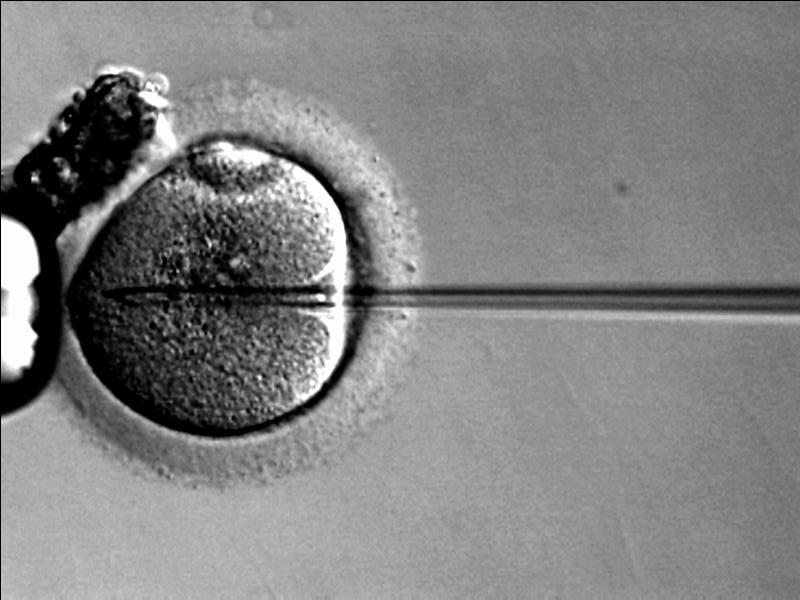
Img credit: RWJMS IVF Program, Wikimedia commons.
Intracellular sperm injection (ICSI) injects a sperm directly into an oocyte (see left). It's used for very abnormal or poorly motile sperm and low sperm count. It replaces part of the sexual act and is not licit; do not participate, although you may observe.

Embryo transfer is a slightly hot topic within bioethics. However, I don't see it as that contentious. Fertilization has already occurred, and the sex act has been totally replaced. The local motion of the embryo into the uterus is actually a step in gestation. It seems that ET, therefore, is not illicit and you should actually rejoice that an embryo is being given its rightful place instead of being condemned to that "absurd fate" of cryopreservation.

INVOcell is a new technology being marketed as "mini-IVF," and it basically replaces the embryology lab with a small plastic capsule carried inside the patient's vagina during a several-day incubation period. This conserves funds used to pay an embryologist, maintain sophisticated lab incubators, and maintain multiple federal standards. INVOcell still involves removal of the egg from the patient or use of a frozen egg, masturbation or sperm donation, fertilization outside the body, and ET. It can still involve PGD and embryo destruction or cryopreservation. Treat INVOcell as you would IVF.

Third party reproduction is use of a gestational carrier or use of donated gametes. As a trainee, there is little to nothing you can do about it, as most couples will come to their REI already with a gestational carrier in mind or will elect to use donated gametes without your counseling. If offered the opportunity to counsel on third party reproduction (especially gestational carriers), offer the patient the complex legal truths surrounding these entities, and recommend they speak to a lawyer, to trusted friends and spiritual leaders, and to seriously consider the possibility of adoption.

Transgender medicine is a misguided effort to alleviate real suffering that individuals feel due to a mismatch between their phenotypic sex and their psychological perception of their gender. Hormonal treatment in these cases, like in cases of fertile women seeking contraception, is manipulation of a healthy organ and not medicine. Surgical transition is mutilation of healthy organs. Do not participate.

Sexual Health

There is a lot of material in treatment of orgasmic disorders that amounts to pornography and masturbation. You may teach a woman the location of her own organs with diagrams and even with a mirror, but be very careful to maintain clinical professionalism and (obviously) always have a chaperone in the room. You may explain the function of these organs and how women experience orgasm (including how they experience it differently). With the magnificent teachings of the theology of the body, reassure women that sex is good, that it is meant to be enjoyed.

You may recommend a patient to psychological or psychiatric services for comorbid disorders. Be careful when recommending her to mental health services simply for her sexual dysfunction, as they may recommend illicit methods to become more comfortable with sexuality. Do not refer her to explicit websites or video series. Do not recommend self-stimulation. Do not recommend experimentation with more than a spouse.

Psychiatry

A relatively prominent problem that has come up since I've started this blog is quality of psychiatry services. Some mental health professionals, especially those who adhere to the whims of the APA, not only have incorrect ideas of sexuality but also have incorrect ideas spirituality and medications. Others are incompetent.

I've seen OB/GYN residents and fellows of all stripes struggle with conflicts with consultants. Bottom line is: if you don't think the provider will offer benefit to your patient, don't consult them. Consult someone else. If there is no one else, use experts available in other venues (online, prior institutions) to answer your clinical question.

Vulvar care

As with sexual health, anything amounting to masturbation should be avoided. In general, the other meds, lubricants, behavioral modifications, and hygiene counseling in vulvar care is licit.

End-of-life (GYN oncology)

Futility of surgery: many, many times residents in my program have operated while not being excited about it, although we're young and maybe don't understand everything. If your conscience moves you to protest a surgery based on a patient's medical fragility, say so and consider escalating it to the ethics committee if you have an appropriate way to do so.

Some oncologists do not give percentages for success for treatment unless a patient asks. Others always deliver expectations. If a patient asks for a percentage of success, always give an evidence-based, up to date number or offer to ask someone for the answer and do not rest until the patient gets an answer or says she doesn't want one after all. If you believe someone is being led to chemo or to hospice out of a wrong idea of percentages of success or failure, ask the attending and ask the patient what their view of the situation is, before wading in.

Ethics committees are great except when they're ineffective or pancretist. When faced with an ethics committee that cannot find the moral truth, many trainees are powerless. It is licit to withdraw your opposition in the face of impossible odds, but it is best to make it clear that you still maintain your position and beliefs.

Hospice is great except when its not. Sadly, since I've started this blog I've realized that not all hospice programs are focused on the patient's autonomy. If hospice personnel at the program that will be covered by the patient's insurance demand code statuses that the patient does not want, or demand POLST or other documents the patient does not want, offer to provide similar services (e.g. narcotic and benzo scripts, DME scripts, megace/nutritional scripts, anticholinergics) through the resident clinic or another venue. Never participate in physician-assisted suicide. Counsel actively against it.

Monday, October 30, 2017

Quaeritur: Transgender follow-up

Img credit: Bill Barrett, Wikimedia Commons
Some time ago a medical student and I had a great interchange on
care of patients with gender dysphoria. The student followed up some time later with the following email:
I’ve come to the conclusion that nobody can change their gender. ...[O]ur maleness and femaleness are defined by our participation in the ability to create life within the marital act. So, “maleness” shouldn’t be defined as a Y chromosome, male genitalia, or a “male brain” (whatever that means). This means that if a man who has fathered a child suddenly claims that he is actually a woman “on the inside", this is an impossibility. The same would probably apply to all people who are born with functioning and properly developed reproductive organs.

With all that being said, I consider all the proposed treatment options for transgender persons not as actually changing someone’s sex or gender, but providing a coping mechanism for their gender dysphoria, which is a mental illness with a biological component. So, I would probable propose the least irreversible “treatments” first such as maybe wearing clothes typical of the opposite gender, and then if the gender dysphoria does not resolve and their mental health worsens, I would even consider some more drastic, irreversible steps such as hormones and/or gender-reassignment surgery.

I understand that many theologians see the concept of changing one’s gender an impossibility and I agree! However, I think that in some cases, especially for a patient with severe gender dysphoria the more drastic measures could be taken following all other options fail.

I know that many moral theologians have difficulties with this topic, and I understand why! I’m still exploring and keeping an open mind, and I know that if the Church were to propose an answer that definitely concluded that these “treatments” are immoral then I will gladly stand behind her judgement!
I really admire that you're committed to obeying the Church's judgment should she speak in a definitive way on this topic. I wish more Catholics were like that. I'm that way about embryo adoption: I think it's licit, and I'm going against some big names in that. But if the Church were to come out and say that I am wrong, I would accept that.

Women with AIS and related DSD.
Credit: Ksaviano, Wikimedia Commons
I agree with you that gender is not modifiable. It's really interesting how you define it! You define it by a person's ability in the marital act. (Did I read you correctly?) If a person is able to father a child with a woman, he is male. If a person is able to conceive a child with a man, she is female. For some reason I think that's amazing. I struggle to identify exactly what gender is. It's not a phenotype, or a set of traits/likes, or even (I hesitate) a genotype. (AIS, anyone?)

I think we disagree on whether medical and surgical transition therapies are good for men and women. (I'm not sure about dressing differently but I even think complete cross-dressing is not a good treatment.) Dysphoria should be addressed at its root and a man helped to love his masculinity, a woman helped to love her femininity. In the process of helping this love, societal roles should be tossed if necessary and clothing/hair should be evaluated objectively and not with too many cultural attachments. But I don't think dysphoria should be palliated by altering or amputating parts of the body or creating imitations of genitalia. Mutilation is wrong.

Tuesday, August 15, 2017

Quaeritur: Care of Transgender Patients (Part 2 of 2)

This post is a continuation of a conversation about Catholic teaching applied to transition for transgender patients. A medical student asked whether gender dysphoria could licitly be relieved with medical and surgical therapies. Following my reply, the student wrote back. I'm going to interject my responses outside of the block-quoted text from the student.
My initial reaction is that I completely agree with your succinct assessment: “The Popes have said that we are born male or female, and that is our gender. Any distress we feel about our gender is a disorder.” My thought is that for the vast majority of us, this is a clear cut statement. For persons with intersex conditions (and I would add transgender as well), they suffer from a disorder.

I’m going to take intersex cases an example before approaching transgender persons: Some of them are born with ambiguous genitalia and chromosomes. Determining their correct gender is a difficult clinical task involving input from the physicians, parents, and children. I’m sure that Pope Benedict would probably agree that due to the brokenness of the human condition, persons are sometimes born with mixed features from both genders. The existence of intersex persons doesn’t disprove or say anything about Catholic teaching regarding sex and gender, it just confirms for us that we live in a fallen world. Another analogy would be that persons are born with down syndrome, schizophrenia, and many other illnesses that impair intellectual capacity. The existence of these persons obviously does not disprove the existence of the “intellect” or the “will” that human beings, as rational animals, possess. These cases are just more examples of the brokenness of the human condition in our fallen world.

I think (hope?) that the above paragraph isn’t particularly controversial. I’m sure that most Catholic theologians would probably agree with my statements.
"Intersex" is a colloquial term, not a medical one. In medicine we refer to people with ambiguous genitalia, and I think that's more helpful in this discussion, because it's only a physical (and pretty external) defect. "Intersex" is a more emotive term that tends to lead the hearer to believe in a spectrum. Since I know that sex is binary, I find it an unhelpful term, much like "gender-fluid" or "bisexual." These terms refer to things that exist (e.g. a woman who has periods in life or even periods during the day in which she feels more like a man, or a man who finds himself attracted to men and women), but the words themselves tend to make us think of reality wrong. Words should help reveal the way things are; doubtless, many people today believe that "intersex" and "bisexual" reveal the way things are, but since we believe that humans are male or female, I would disagree. I don't mean to be picky, but I do want to draw your attention to the use of a term that is non-medical and possibly unhelpful. I agree, however, that persons with ambiguous genitalia do not prove that sex is non-binary.
I’m going to (try) to apply the same principles to some (maybe not all) persons that identify as transgender. My understanding is that the current scientific theory about gender dysphoria is called the “brain sex” theory. Essentially, it confirms what we Catholics have been saying for a while: Sex and gender are deeply ingrained properties of the human experience. They are the result of many neurological and hormonal puzzle pieces that have to fall into place during development. For most people, all the puzzle pieces align and our biological sex and neurological sex are congruent. Most males feel as though they are male, and most females feel as though they are female. However, like most of human development, there are many other environmental factors that come into play. I am sure, as you have pointed out, that for transgender patients, the experiences of "broken early relationships or abuse, self-hatred, misunderstanding of femininity or masculinity) as well as the co-morbid conditions (domestic violence, high risk sexual behaviors, mood disorders, substance abuse, etc)” are all contributing factors into why they experience gender dysphoria. So, my conclusion is that for these people, they really do have a physiological justification for why their body does not feel right for them. They have a mismatch between their neurological sex and their biological sex.
I think this is likely correct, although the lines between neurological and psychological are difficult to pin down.
Now, this doesn’t necessarily justify any of the treatments or therapies I will describe below for this disorder, but I think that it makes an argument for why these persons may have a biological/neurological basis for their gender dysphoria. I have heard some relatively influential Catholic commentators use the term “gnostic” to describe these persons, and I really do think that this could be a mischaracterization of the conditions these persons face.
I don't understand why people use the term "gnostic."

So, moving on to therapies for gender dysphoria. I completely agree with you that these patients probably do need therapy to help them with: "broken early relationships or abuse, self-hatred, misunderstanding of femininity or masculinity) as well as the co-morbid conditions (domestic violence, high risk sexual behaviors, mood disorders, substance abuse, etc)”. However, and I certainly do not consider myself an expert in this vast and complex field, but my understanding is that there is little evidence that these reparative therapies for gender dysphoria actually work. From my understanding, the APA and American Academy of Pediatrics appear to be against using reparative therapies. Now, certainly, there is a political agenda with these groups and they are fallible organizations, but they are the experts in these fields and I haven’t found any convincing studies that would tell me why I should ignore their advice on these matters (if you know any, please shoot them my way!).
Finally, with regards to some of the more “dramatic” and irreversible therapies such as sex reassignment surgery and/or hormone therapy, my initial thought is that they would be similar to a preventative mastectomy/hysterectomy. The intent would be to relieve the patient of their severe mental suffering, and the sterilization would be the secondary effect in this case. I know that my thinking here is not as clear, but I don’t know if I necessarily agree with the comparison to elective abortion. Elective abortion is a grave evil precisely because it destroys a human life, which has infinite human dignity. There has been crystal clear teaching on this issue throughout Church history, beginning with the Didache. However, with regards to persons suffering from gender dysphoria, I sort of see this an attempt to help relieve them in some way of a neurological/biological mismatch that they are experiencing between their physical appearance and inward state. I sort of see it as a last ditch effort which does have proven clinical efficacy. I don’t like the fact that these patients have to mutilate themselves and recreate their bodies according to their “neurological sex", but I haven’t seen any therapies that are more effective.
Now some clarification: I am not a proponent of reparative therapy, which I understand to be largely in reference to people with SSA. SSA is just a desire and is not a sin, and reparative therapy is not the answer that the Catholic church extends. Unfortunately, many other Christian denominations with less philosophical patrimony, don't understand this yet. My hope is that they can, and the strange well-meaning punishment of people with SSA can stop.

If you're extending the concept of reparative therapy to those with gender dysphoria, you might be referring to therapists who don't help them through "transition" to the other sex. These therapists might try to redirect the person to their biologic sex or (dishonestly) promise transition therapies initially and put up walls, never intending to fulfill their promise. Before I go further, is this what you are referring to? I ask because I've never heard anyone refer to refusal-to-transition as reparative therapy.
I guess to put my point bluntly, I am wondering if (some, maybe not all) persons who identify as transgender could be allowed to undergo the sex-reassignment surgery and/or hormone therapy to relieve them of their distress? It seems to be clinically efficacious. I guess all the long emails before that were trying to justify why I reached this point. I know that this is definitely risky, uncharted territory in terms of Church ethics, which is why I was trying to use analogies to persons with ambiguous genitalia and down syndrome. If I am wrong, could you explain to me why? I am not trying to go against the Church’s teaching, and I also want to help these people and do what is best for them.
I and many theologians would bluntly reply that no persons who identify as transgender should be allowed to undergo sex-reassingment surgery or hormone therapy. Very bluntly: these patients' comorbidities should be managed and they should undergo significant psychotherapy for their dysphoria. Like other patients who are deeply uncomfortable with aspects of themselves (DID patients, body dysmorphic disorders), they should be helped to understand who they were created to be.

Here is my explanation for why. Our gender/sex is sacred and is inseparable from our soul. It's part of the way God makes us to be saints. Men and women are irretrievably different in ways we can only clumsily understand. Philosophers have tried and failed many times to identify what category of quality "gender" is. Poets and thinkers have tried to articulate what "masculinity" and "femininity" are but only come up with generalizations and analogies. This is a hard thing to understand! It's no surprise that people think that gender is something we decide on.

The same thing happened with sex and procreation in the 1960s, when Pope Pius VI commissioned faithful Catholics like yourself to research the idea of birth control. The so-called "birth control commission" concluded that our fertility is something we should manage rationally, like we do every other aspect of our lives. There were parts of the physical universe (chemicals/hormones) that we could use as sons of Adam to change our lives. Shouldn't we do this?

It is hard to see the truth: gender, sex, and fertility are sacred ground because they more than anything in the physical universe are signs of who God is and are avenues to make saints. Luckily Pope Pius saw the truth about contraception in 1968. I think you and I are called to see the truth about gender now. It can seem like a big "no," but just like contraception/NFP, it's a strange and important "yes."

Sunday, July 30, 2017

Quaeritur: Care of Transgender Patients (Part 1 of 2)

Recently a medical student emailed me a long and well-considered question.
I have a question regarding the care of transgender patients. Before I begin, I just want to say that I consider myself an orthodox, pro-life Catholic who is trying to follow Church teaching on this issue. I am not attempting to undermine Church teaching, and I do not want to be spreading heresy. Also, when I speak about transgender persons, I want to differentiate them from intersex persons (who actually do have ambiguous genitalia).

From what I have been reading about Church statements and Church teaching (from Pope Benedict and Pope Francis), there is a consistent condemnation of “gender theory”. This is something that I completely agree with. There is no such thing as “multiple genders” and those who claim there are are incorrect. During many of my LGBT lectures, they have included slides on how there are many different genders that someone can “define themselves” as. I think that for many people in the Church, this is what the transgender movement represents, and this is why there is such a strong backlash against many of its beliefs and ideas.

However, there are people suffering from gender dysphoria who are caught in the middle of this fight. Reading a lot of the stories of persons who really suffer from gender dysphoria breaks my heart. Many of these persons have co-morbid psychiatric illnesses, and many attempt and/or successfully commit suicide. They face a lot of abuse from family, friends, and sometimes Catholics/Christians. I didn’t provide the links with this email, but my understanding is that the current medical techniques to help some of these transgender patients are very effective for the majority of patients. Most transgender patients who undergo the hormone therapy and/or sex reassignment surgery really do experience psychological relief. I included a link here from a blog of a transgender Catholic who discusses Church teachings on this issue....

**Also, I want to clarify. My understanding is that most children who experience gender dysphoria grow out of it later in life, so if the Church were to approve of certain medical procedures, they would only apply to later in life.**

With all this being said, what do you think our role is as Catholics and healthcare providers for future transgender patients? Do you think it is ethical to help some, maybe not all, patients undergo hormone therapy? What about sex-reassignment surgery? Also, my understanding is that different transgender people cope in different ways. Some of them do not even want any medical interventions and prefer to cross-dress or just identify as the opposite gender, while some do have these interventions and then regret them in the future. The Catholic Church, from what I understand, does not have a clear teaching on this, but we are going to be in the front lines helping patients struggle with gender dysphoria.
This is a very important question. First, I am grateful that you are striving to be faithful to the truth and follow Church teaching. I understand that your questions is about persons who suffer from gender dysphoria (e.g. genetically XX individuals who feel male, or genetically XY individuals who feel female), not people who have physically ambiguous genitalia or people with SSA.

Let's clarify what Pope Benedict meant by "gender theory." In your email you define "gender theory" as the idea that there are multiple genders. (I'll stick with Benedict because he is a philosopher by training and was first among popes to articulate arguments about gender etc.) In his 2012 Christmas address, he used the word "theory" to describe the idea that our gender is not an innate property. The "theory" is that maleness and femaleness are not congenital, but societally or personally determined. I pasted the relevant paragraph from the address below my signature line for you. This means that what the Pope condemned is not only that male and female is binary (he states that this is a "duality" in the Christmas address); he also condemned that maleness and femaleness is something an individual can interpret or assign themselves. It's part of their nature and their nature does not lie. To make it very clear: the popes have said that we are born male or female, and that is our gender. Any distress we feel about our gender is a disorder.

I am not saying (and neither are the popes) that people suffering from gender dysphoria aren't suffering. They are, as you point out, in distress and sometimes constant revulsion, fear, or self-hatred. They do, as you point out, often suffer rejection and abuse from others. And they can experience psychological relief with transgender medical and surgical treatment.

Tell me what you think of this: the fact that someone is suffering and experiences relief after a certain therapy may not mean that the disorder causing the suffering should be treated that way. An easy example is elective abortion: it relieves the enormous distress of the threat to self and lifestyle that a mother-to-be faces, but it is not the right approach to that distress. If not all treatments that result in relief are the right treatments, then trans medicine and surgery may not be right for people with gender dysphoria. Indeed, many believe (as I do) that the right treatment for gender dysphoria is to dig to the root of the dysphoria and treat the cause (broken early relationships or abuse, self-hatred, misunderstanding of femininity or masculinity) as well as the co-morbid conditions (domestic violence, high risk sexual behaviors, mood disorders, substance abuse, etc).

The medical student sent me a response back, which is to follow in the next post.