Showing posts with label AAPLOG. Show all posts

Sunday, February 1, 2015

Eight weeks of Freedom!

I am currently on my last of eight weeks of no clinical duties. Free as a bird! What did I do with my time off? Well, I'm an unusual bird....

This was supposed to coincide with interview seasons so that I wouldn't be interviewing while working at the hospital, but I actually only had two interviews at the beginning of this "Christmas break," so I've basically had the time off.

Half of this eight-week break was actually a stay-at-home elective with teaching duties for the second-years preparing for their STEP 1. The other four weeks were pure vacation. Interestingly (ahem), I have done almost none of the teaching duties (I guess I'll do that during those apparently free afternoons during anesthesiology and radiology). Instead, I've been doing other things I'm really interested in:

  • Taking courses in four main methods of NFP: Coupe to Couple League, Marquette, Creighton, and Billings
  • Giving presentations to medical students about NFP (one on Marquette, one on Creighton, and one on all the methods)
  • Starting a research project! (Late in my med school career but early in my reseraching career.)
  • Finishing up a required "Quality Improvement" study...basically a shell project for a required fluff course
  • Continuing to work on the two inventions I'm helping with. Gah, these things move so slowly!
  • Preparing a talk with FACTS to give to OB/GYNs and to eventually (hopefully) integrate in OB/GYN clerkships and residencies. I'm going to help give this presentation at the AAPLOG conference in February.
  • Working with a medical illustrator to create the BEST fertility cycle chart EVER
  • Playtesting a gamebook I wrote and vacillating about publishing it (email me if you want to help playtest, which means reading it and discovering all the mistakes I made)
  • Planning for residency. I used to think I could float through life without much planning, but third year showed me that you can't float through 70+ hour work weeks without meal planning and aggressive prayer planning. Therefore I am planning a year of meals and a year of Scripture meditations. So much fun/work/screen-staring....

Saturday, May 5, 2012

Role Models: Good and Ill

I was relieved that Dr. Bruchalski's talk (see first post on this) didn't devolve into heckling by disagreeing audience members, or a pro-life fan-fest. It was thought-provoking and game-changing, in line with the truly pro-life and medically/ethically rigorous flavor of the Vita Institute and AAPLOG.

Several pro-choice medical students and one pro-choice nursing student stayed to ask questions--good, earnest, and respectful questions.

For example, the nursing student (having more clinical experience than any of the medical students) asked: What about the case of placenta previa in a woman six months along?

Rather than give a pat answer, Dr. Bruchalski first recounted a story of a woman in severe hypotensive crisis (I forget the ins and outs of the case) and said that he and his colleagues "took her straight to termination," but could not save her life. He next observed that, in that case, there were (medically) other things he could have done before abortion which may have saved her life. Finally, Dr. Bruchalski implied in honesty, that pat answers don't belong in the trenches. However, he maintained that there are two patients and his job is to treat both of them and never pit one life against the other.

San Damiano crucifix like mine.
Source: religiousjewelry.com
The pro-choice medical students asked lots of questions--so many that Dr. Bruchalski sort of had to cut them off to finish! Afterwards, they asked to keep in touch with them. One said she was touched by a lot that he had to say; she even called the talk "poignant for me." The other said he was an intellectual, and so much evidence demanded that he reassess the issue.

I hope these future providers can see the truth about women, the unborn, and evidence-based practice!

After the talk I thanked Dr. Bruchalksi. He learned I was from TAC and said he could recognize students from TAC, Steubenville, Christendom, Dallas....

He also noticed that I wear the cross of San Damiano and asked me why I do. I explained that it was an important symbol of poverty, which seems (to me) interwoven with medical practice and real gift of self to Christ in each patient.

As I was speaking, he began fumbling in his pockets. As I finished, he pulled out a small drawstring bag and revealed a relic of St. Francis of Assisi! He handed it gently to me. I kissed it and touched it to my crucifix, now aware that St. Francis was present in a real way (almost standing with us in the lecture hall). Dr. Bruchalski described that he also felt medical practice was a work of wholehearted mercy. I stood there, clasping St. Francis to my heart and having a hard time believing that I was really hearing someone else agree that medicine can be a self-expenditure for others for the sake of Christ. Wow.

Today outside PP, I met another professor who was volunteering. He recognized me and we exchanged a few pleasant words. I left the encounter much less sad than my first brush with a professor across the fence. Over this academic year (partly through experiences like meeting Dr. Bruchalski) I have built up a hope: all is not lost, even in such a dark world. There are saints among us, Christ is near offering Himself radically, and grace is abundant.

Wednesday, May 2, 2012

Former Abortionist? Oh, we don't talk about Controversy.

In February at the AAPLOG conference, I met Kristan Hawkins, executive director of Students for Life. There, I learned about Medical Students for Life of America (MedSFLA). This group facilitates pro-life medical student interest groups. Aware that medical students have less time than undergraduates, MedSFLA arranges for one speaker to visit 20-30 medical schools per semester. The medical students get a pre-packaged major event and catering funds--all they have to do is book a room and announce the date and time.

I told Kristan I wanted to help, but wasn't going to put too much time in it. After all, I thought, I'm submitting CMA's paperwork to become an official chapter and arranging our first White Mass, the OB/Gyn interest group still had two meetings on the calendar and I was thinking about running for something, I'm taking part in a national research forum in Galveston in April, and (oh yeah) I also have to study.

Well, so much for all those resolutions. I ended up helping get Dr. John Bruchalski to talk at my school after cancelling Galveston. Dr. Bruchalski is an OB/Gyn who performed abortions during his residency but, after completing his training, opened an NFP-only practice in Virginia called the Tepeyac Family Center. He gave a tremendous talk, asking the audience (which was mostly pro-life but a little mixed) five questions:
  1. Why is the abortion rate decreasing?
  2. Why do so few OB/Gyns do abortions?
  3. How does Opinion #385 of the American College of OB/Gyns touch conscience protection?
  4. Is abortion good medicine?
  5. Can physicians provide quality medicine while opting not to performing abortions?
But the wonderful evening was an adventure to obtain. Granted, I was not threatened with expulsion or anything serious. But I didn't feel exactly encouraged beforehand. In the final analysis, I believe this was a combination of my inexperience with hosting events and the skittishness of faculty (most of whom politically and medically agree with me about abortion, but prefer discussions to be about grayer issues to avoid controversy).

This is what the poster looked like.
(Obviously, the particular info was different.)
I tried to do everything right and, for the most part, I think I succeeded. I submitted a formal request to begin a pro-life medical student group, outlining what our officers would do, etc. I asked permissions before hanging posters (see right) on other colleges' bulletin boards.* I followed all the necessary procedures to reserve rooms, cater, and have the event recorded. I sent out three mass-emails (which makes me cringe) to the entire COM and the CON announcing the event, as a reminder, and as a follow-up to announce the recording and the survey. Since people send out mass-emails every day, I expected this would be fine.

De jure, it was; de facto, not so much. An assistant dean who is friendly to me passed me in the hall shortly after I announced the event with my first mass-email. Smiling, he said, "so who'd you finally get permission from?"

I had a moment of internal panic. Uhh...you have to get permission to host speakers? Don't we just kind of...let them come talk? "Oh," I said haltingly, not wanting to admit that I'd gotten permission from no one, "I just went through [the student event coordinator]," which (while true) is not the permission he was asking about. I knew he was looking for a higher name--the director of the Humanities Department, the Dean, the assistant dean for student affairs.... This mini-conversation should have been a red flag, but I let it slide off me and went on my way.

But next I got a concerned email from another mentor:
Dr. ____ stopped by my office this morning to discuss this event.  He made me aware that you had approached the Dept. of Humanities to sponsor or fund lunch for this event.  Dr. _____ and I believe that this event should be strictly a student organization event and should not involve any department or office of the College.  I respectfully ask that you withdraw your request of the Dept. of Humanities to sponsor the event. 
This resulted in a series of visits (by me) to certain higher-ups (just two, actually: Dr. _____ and the director of the Humanities Dept). The head of Humanities told me he glanced at the poster and winced. "Controversial!" he exclaimed during our meeting. "I can't do that!" he continued, explaining that he would have the president on his case immediately in a state-funded institution if there was no counter-point. I did a lot of smiling and nodding during that conversation, but it was a very interesting one (so hopefully it will become its own post).

Even after the dust settled, the friendly dean advised me that he had been dodging light comments he'd heard around him. He advised me, next time, to publish on the poster that it was a Catholic event. Resisting the urge to bury my head in my hands, I told him, it wasn't. I (as a medical student) through a totally ecumenical group (medical students for life) was hosting a doctor (not a religious leader).

In the end, people who attended the event have given me positive comments precisely because abortion is an under-discussed and polarizing topic. I got comments from students...
Thank you VERY much for sending this out to the College.  It’s a very relevant and controversial topic that needs much discussion! 

Thank you for making this video available.  I enjoyed listening to Dr. Bruchalski... very thought-provoking. 
 ...and staff.
Thank you much for facilitating  this!  We really had good discussion after the conference and were grateful for the participation opportunity.
So it wasn't all bad. In a subsequent post I'll tell you, in fact, just how good it was.


Saturday, March 31, 2012

Shadowing, confirmation, and humor

After last semester's shadowing experience (with Dr. A, a good doctor but PP board member) I decided I need to follow a pro-life OB/GYN in the future. With this goal in mind, I searched the AAPLOG physician directory. I called several offices and ended up with three days of shadowing Dr. C, whom I had never met before. I've blogged about him before, but only isolating our differences. We have a lot in common and I learned a lot.

The first day, I observed a hysterectomy, shadowed during his office hours, and watched him perform a circumcision. Day two was more office visits, plus rounding and learning how to suture; day three was office, plus learning how to gown and glove. I enjoyed it! His office was warm and charmingly decorated, his staff seemed happy to be doing their work with him, he talked at leisure with his patients, he spent very little time charting, and he was a kind teacher.

Whenever he found something pathological, he let me look (or feel!). I saw two cases of uterine prolapse, possible early vulvar and rectal cancer, a cervix s/p cone biopsy, and cervical blanching during colposcopy. We also mentioned Li-Fraumeni syndrome and cutaneous larva migrans, which had previously only been words and pictures on a page. I felt engaged and charged! I can get used to that.

My complete newness to physical diagnosis caused some amusing episodes, like when he told me to feel a patient's thyroid:

Dialogue:
outer • inner
Actions:
purported • actual
Doctor(to patient) Mind if she feels your neck?
PatientNo, not at all!
MeThank you.
Right. So...
The thyroid gland is supposed to be here somewhere...does she have one? I guess it'd be here...

(to patient) Please swallow.

Thyroid exam.
Mimes a thyroid exam. Feels...a neck?
DoctorI don't know about this kid...
Left or right?

MeWhat is he talking about? Does she only have half a thyroid gland? I obviously didn't pick that up... Well... I have a 50/50 chance...
Left.

DoctorYou are fooling nobody.
Good. It's like a little pea, moving under your fingers.

(to patient) Swallow.
Puts my hand back on the patients neck, beneath his. Presses (hard).
MeGood grief. Oh, cool.Feels the thing for the first time.


Tweezers, but you can bill more
if you call them "pickups" (jk).
After a few minutes of touching
the needle in my bare left hand, I
said  aloud to Dr. C, "this can't be
right,"  and he got me these.
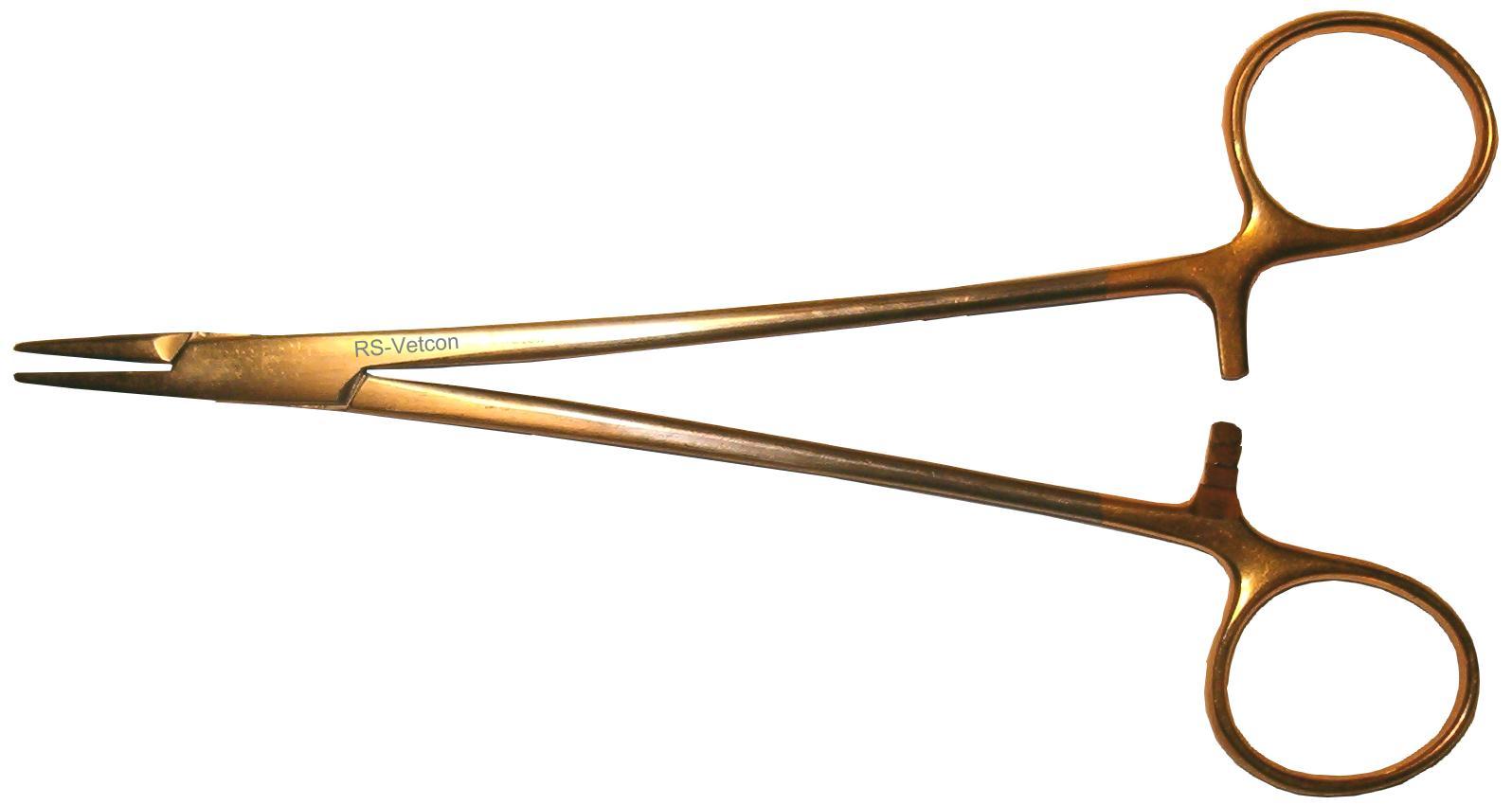
Needle driver/holder. This thing is well-
designed. The short effector side of the
lever (left) magnifies the force you
place at the affector side (with scissor
handle and locking mechanism).
Yeah...I have a long way to go before I should be trusted with patients. I missed a melanoma-esque mole and a palpable uterus on an abdominal exam, and I missed fibrocystic changes on a breast exam. I got to hear two mitral valve prolapses (lub-click-dub; listen to one here), but I could only hear the louder one.

I'm clumsy with suturing and gloving. (It's all about muscle memory.) Dr. C gave me two pair of old pickups, a small needle driver, some expired ties, and opened suture so that I can practice. He also gave me three pair of unpackaged ("contaminated") sterile gloves and an opened gown. How generous of him! Someday, all these things will be second nature to me. I can get used to that.

I did get good at finding fundal heights and fetal positions. I made mistakes, but by and large (even in a primagravid uterus!) I could make out where the baby's head, buttocks, and back were located.

This doesn't matter during most of pregnancy (only at 30 weeks and on). However, you look slick if you find the baby's back, guesstimate where his heart is, and place the fetal doppler RIGHT on the spot. The result: immediate, deafening, staticky heartbeat to the delight of the mother and the attending. I can get used to that.

Saturday, February 25, 2012

AAPLOG Conference

As I started to write this post, I had trouble labeling it. "Pro-life," obviously applies, as does "ob/gyn" and "research," but so does "ethics," "spirituality in medicine," "vocation," "advice," "surrender...." I had to stop myself from clicking almost all of them.

Today was the 2012 annual education meeting of the American Association for Pro-Life OB/GYNs. It was in Washington, D.C. (my first time in the capital); it snowed this morning, and the conference was great. I was impressed with the high and rigid standards for publications, recommendations, and protocols. I was fired up to start healing our culture, now!

The highlights:
  • 8:45 Maureen Condic, PhD. “Defining the Beginning of Human Life”
    • Dr. Condic was at the Vita Institute. She condensed several of her lectures into one (because the audience had a more uniform education) on when human life begins.
    • Dr. Condic's white paper probably contains her arguments, although I freely confess I did not read it!
    Credit: euthman
  • 9:45 Theresa Deisher, Ph.D. “Current Ethical Issues in Drug Development”
    • I had no idea that some cosmetics, several vaccines, and some drugs are made in cell lines derived from aborted fetuses (and they contain contaminants from those lines). I'm not advocating chucking all vaccines, but I agree with Dr. Deisher that we should make an effort to find ethical, economical, and technological superior alternatives. Check out some of these companies:
  • 10:30 George Delgado, M.D. “Reversing Mifepristone: Case Reports”
    • Repeated doses of 200mg IM progesterone in oil = stop a chemical abortion. He went through six cases (publication pending). Amazing.
    • You know, it's impossible to reverse a surgical abortion, so I feel that the increasing use of RU-486 is almost a boon.
  • 11:00 Paul Gray, M.D. “Medical and Surgical Naprotechnology”
    • Naprotechnology is incredible. Mainstream gynecology treats menstrual disorders and infertility very quickly with birth control or IVF, without finding the cause; naprotechnology finds the cause of a woman's problems and addresses them to correct the symptoms or infertility (when possible). It corrects a cycle instead of suppressing it. Besides being a theoretically better approach, it also doesn't involve carcinogenic pills predisposing the patient to thromboembolism!
    • If you want to learn more about naprotechnology, you can read up at naprotechnology.com or fertilitycare.org. Please note, I haven't explored these sites, and they weren't mentioned by Dr. Gray.
  • 11:45 Priscilla Coleman, Ph.D. “The Psychology of Abortion: Addressing the Critical Questions to Maximize Patient Care in 2012”
    • WECARE 
    • Dr. Coleman carried out the largest meta-analysis to date on abortion after-effects. She's met with a lot of resistance, but she concluded that (yes; surprise) there is psychological morbidity following abortion, especially in high-risk groups (unsupportive relationship, hx of previous mental illness, ambivalence about the decision...).  
  • 1:15 Frederick Dyer, Ph.D. “Horatio Robinson Storer, M.D. and the Physicians’ Crusade Against Abortion, with implications for the current practicing doctor’s responsibilities toward the abortion issue.”
    • Interesting historical sketch of a gynecologist in the mid-1800s who advocated against clandestine abortion because of the harm it does. I didn't know there was abortion in the 1800s! 
    • Dr. Storer was supported by the AMA and his work led to the laws against abortion that disappeared in 1973.
  • 2:00 Michael New, Ph.D. ‘Analyzing How State Level Anti-Abortion Laws Impact Fertility Outcomes.”
    • Dr. New was at the Vita Institute as well! Never hurts to hear it again.
  • 2:45 George Mulcaire-Jones, M.D. “Safe Passages Program: Confronting Maternal Mortality in Rural Nigeria, Update.”
    • Magnificat Maternal Health Project 
    • Awesome teaching tool; reminds me of the Worth the Wait program, because it treats the disease, not the symptoms (it heals the culture and the family and doesn't just hand out contraceptives to African couples).
    • My thoughts: it works in Africa? Good. Bring it here. I desire to touch the poor here.
  • 3:30 Angela Lanfranchi, M.D.: “The Abortion Breast Cancer Link: The biologic basis and a review of the literature 1957-2011
    • Breast Cancer Prevention Institute 
    • There is a link all medical professionals already agree on: an abortion stops a full-term pregnancy, which has a protective effect.
    • The link people debate about is the "independent" link: an abortion not only removes positive effect, but has negative effect on breast cancer risk. Just look at the physiology! Data supports this, too. (For instance, every time a study finds a statistically significant correlation, it's positive.)
  • 4:15 Byron Calhoun. M.D. “Premature Labor: The At-Risk Patient”
    • Image and video hosting by TinyPic
    • This presentation mostly went over my head. It was the only one that was purely clinical and all about management recommendations for patients, so there were lots of terms and acronyms that I didn't catch.... I learned what a cerclage is, but only because I looked it up on my phone in the middle of the session!
    • The point of this talk was: 127 studies show that women with a previous abortion (surgical, medical, or spontaneous) show increased risk for preterm delivery. It's above a 300% increase for women with combined medical/surgical abortions (e.g. incomplete medical abortion requiring D&C) according to a study from China (Laoi).
I also enjoyed briefly meeting with someone from Students for Life, and also talking with some old OB/GYNs about being countercultural, not being afraid of lawsuits, and doing God's will. It's late and I've got to get up at 4:30am tomorrow to fly back home, so good night!

Friday, January 27, 2012

More die from abortion than childbirth?

Knowledge is valuable, even tiny details about obscure proteins, for two reasons:
  1. Such knowledge may be practically useful in a current or future application.
  2. Knowledge is inherently wonderful to have (just ask yourself if you'd like to be deprived of your eyesight, memories, or intellect, which are a few examples of the faculties we have for knowing the world).
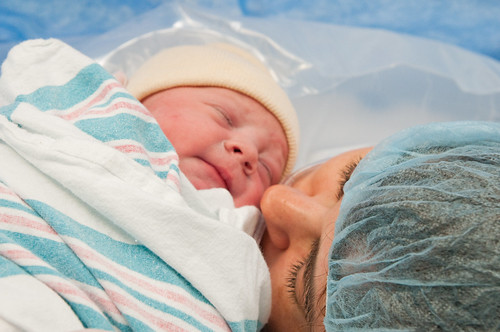
Baby and Mom
But when I did clinical research a few years ago as a premed, I noticed the huge information glut in the scientific community.

This glut is mostly harmless but uselessly repetitive research published for the sake of publication. But the glut also includes false conclusions published and tolerated because of bias (conscious or unconscious, good or evil) and lack of skill (in the relevant field or in statistics).

One example of a false conclusion is The comparative safety of legal induced abortion and childbirth in the United States, by Elizabeth Raymond and David Grimes, promoted by Reuters the day after the March for Life. Its flaws are pointed out by Priscilla Coleman in this brief critique. Coleman's main thrust is that Raymond and Grimes' data is incomplete, because:
  1. not all states count abortion-induced deaths,
  2. not all abortion clinics report deaths,
  3. not all abortion-induced deaths occur after first trimester abortions, and
  4. not all autopsies correctly report abortion as a cause of death (e.g. if a women went to the ER after leaving an abortion clinic). 
Coleman also criticizes Raymond and Grimes of failing to discuss the protective effects of childbirth, though I think this might be legitimately outside the scope of their investigation.

I am ready to believe well of people, since I cannot read their intentions. However, I do not hold out that hope for research, which I can read and dismiss as poor.
Update 1/29/12: AAPLOG recommends afterabortion.org's research on this.

Friday, January 6, 2012

AAPLOG Conference

I'm going to the AAPLOG conference in February! I am taking two of my classmates with me (not besties, just people who expressed interest) and I am pumped. Look at the schedule!

8:45 Maureen Condic, PhD. “Defining the Beginning of Human Life”
9:45 Theresa Deisher, Ph.D. “Current Ethical Issues in Drug Development”
10:30 George Delgado, M.D. “Reversing Mifepristone: Case Reports”
11:00 Paul Gray, M.D. “Medical and Surgical Naprotechnology”
11:45 Priscilla Coleman, Ph.D. “Psychological Effects of Induced Abortion: Summary and Update”
1:15 Frederick Dyer, Ph.D. “Horatio Robinson Storer, M.D. and the Physicians’ Crusade Against Abortion, with implications for the current practicing doctor’s responsibilities toward the abortion issue.”
2:00 Michael New, Ph.D. ‘Analyzing How State Level Anti-Abortion Laws Impact Fertility Outcomes.”
2:45 George Mulcaire-Jones, M.D. “Safe Passages Program: Confronting Maternal Mortality in Rural Nigeria, Update”
3:30 Angela Lanfranchi, M.D.: “The Abortion Breast Cancer Link: The biologic basis and a review of the literature 1957-2011
4:15 Byron Calhoun. M.D. “Premature Labor: The At-Risk Patient ”

The conference is the week before an exam, so I hope this isn't a dangerous move. But this is so important, I thought--how can I not go?

Friday, November 4, 2011

Conscience Rights

A few newsbites:
I got this summary from an AAPLOG email:
In a nutshell, Health & Human Services (HHS) has adopted the most limited right of conscience language ever to be used in federal law in its new contraceptive mandate to health insurance. Using language developed by the ACLU, the mandate now requires all policies issued to cover all forms of FDA-approved contraceptives, sterilization and counseling with no co-pay. The only entities exempt are those that:
  1. Have the inculcation of religious values as their purpose;
  2. primarily employ persons who share its religious tenets;
  3. primarily serves persons who share their religious tenets; and
  4. are non-profit organizations under section 6033(a)(1) and section 6033(a)(3)(A)(i) or (iii) of the Code.
Practically, this means that ROC protections are limited to churches. The one-in-six hospitals in the country that are Catholic must provide coverage for birth control and sterilization. Christian practices and non-profits that serve the poor must provide coverage for morning after pills.

Sunday, October 23, 2011

ACOG Patient Information

Last post, I linked some of ACOG's literature for providers. Now, I'll examine some of their literature for patients. I received five patient-information pamphlets when I became a member (yes, I am a member, but I also joined AAPLOG). ACOG sells these pamphlets to OB/GYNs in private practice. From their list of literature, I chose these five to receive:
  1. Birth Control Pills
  2. Emergency Contraception
  3. Human Papillomavirus Infection
  4. HIV and Women
  5. How to Prevent Sexually Transmitted Diseases
(I purposefully chose the hot-button issues because I expect that when "reproductive rights" are not involved, ACOG's recommendations are medically sound.) Let's just look at Emergency Contraception (EC).