Showing posts with label pediatrics. Show all posts

Sunday, November 3, 2013

Two quick stories

I have to go to Mass in a few minutes, but I really wanted to squeak out a post.

Story #1

At the end of my pediatrics rotation, a patient came in with a "hurt arm." I examined her and though we needed an elbow radiograph to rule out fracture (although I told the doc I thought it was a soft tissue injury, since she had so point tenderness). She got an X-ray and came back after hours (I stayed!) and we read the film. I saw something we had just learned about in radiology lectures, and said "isn't that a posterior fat pad sign?" Brownie points for that!

As the doctor was explaining the diagnosis to the parents (supracondylar fracture) the mother began to pale and she actually fainted. We laid her down on the examination table and the MA got her some cherry pedialyte and goldfish when she woke up. Then we put a splint on her daughter and the three of them went home. So, that was a terribly told story but that's what happened!

Story #2

At the beginning of my OB/GYN rotation, I was working in the private practice of a local OB/GYN and one of her patients came in for "rule out labor" (i.e. she was having contractions and wanted to know if she should go to the hospital). The answer (after we hooked her up to a fetal cardiac monitor, looked at the strip, and examined her cervic was yes, you are four centimeters and go now. The physician called the hospital ahead of time.

A few patient visits later, the phone rang for the doctor and her eyes widened as she listened. She slammed the phone down after a quick "thank you," and said to me, "that patient's complete" (meaning, she's dilated to 10 centimeters and is ready to push). The doctor said to me, "you'd better leave now, because I'm going straight there after I finish this chart, and I'm going to fly."

I raced to the hospital through the molasses of midafternoon traffic and jumped into a pair of scrubs. I didn't have appropriate shoes, but I slipped boot covers over my pumps. I helped with the delivery (at one point only I and the L&D nurse were in the room as she pushed!) and delivered the placenta. My first delivery in high heels (and hopefully the last).

Tuesday, October 15, 2013

Academic Medicine 101

Before I started medical school, I had no idea that "academic medicine" is the segment of medicine that researches and teaches. Some physicians see patients all day, every day while others do research (either clinical, basic, or translational) or teach (e.g. lecture, and supervise the practice of residents and the visits and notes of medical students rounding under them). Most of my experience of academic medicine is with the teaching physicians. Let me tell you about it.


First of all, I haven't had my big academic rotation yet. This is the famous "Internal Medicine" rotation (shortened in speech to "IM" for some schools, "I-Med" for us). From what I hear, that is twelve of the most intense weeks of seeing patients, giving presentations, writing notes, being humiliated, and learning the minute mechanics of fluid and medical management.

Did you catch the "being humiliated" in there?

Although I haven't had IMed (and so I feel like I can't really talk about this?), I have had one week of adult inpatient and one week of pediatric inpatient. My attending last week (pediatric) literally said that medicine is taught by shame. "That's how you remember things," he said, "by being put on the spot." I like to think that it's not shame, but responsibility that teaches us. When a person in need, in front of you, is your patient and your attending asks you "how are you going to replace his potassium in light of his serum creatinine?" and you blanch and have no clue, you're going to learn it well and know it next time.

Last week, for instance, I had one week of pediatrics. I got up early to report to the hospital an hour before the attending scheduled "rounds." I was assigned one patient each day, and went to talk with them and examine them and prepare a presentation and admission orders, including IV fluids, drugs and doses, and special nursing instructions. (All of these orders were practice; none were actually carried out except if someone else, e.g. the resident or fourth year, had the same idea/agreed with me and ordered them.)
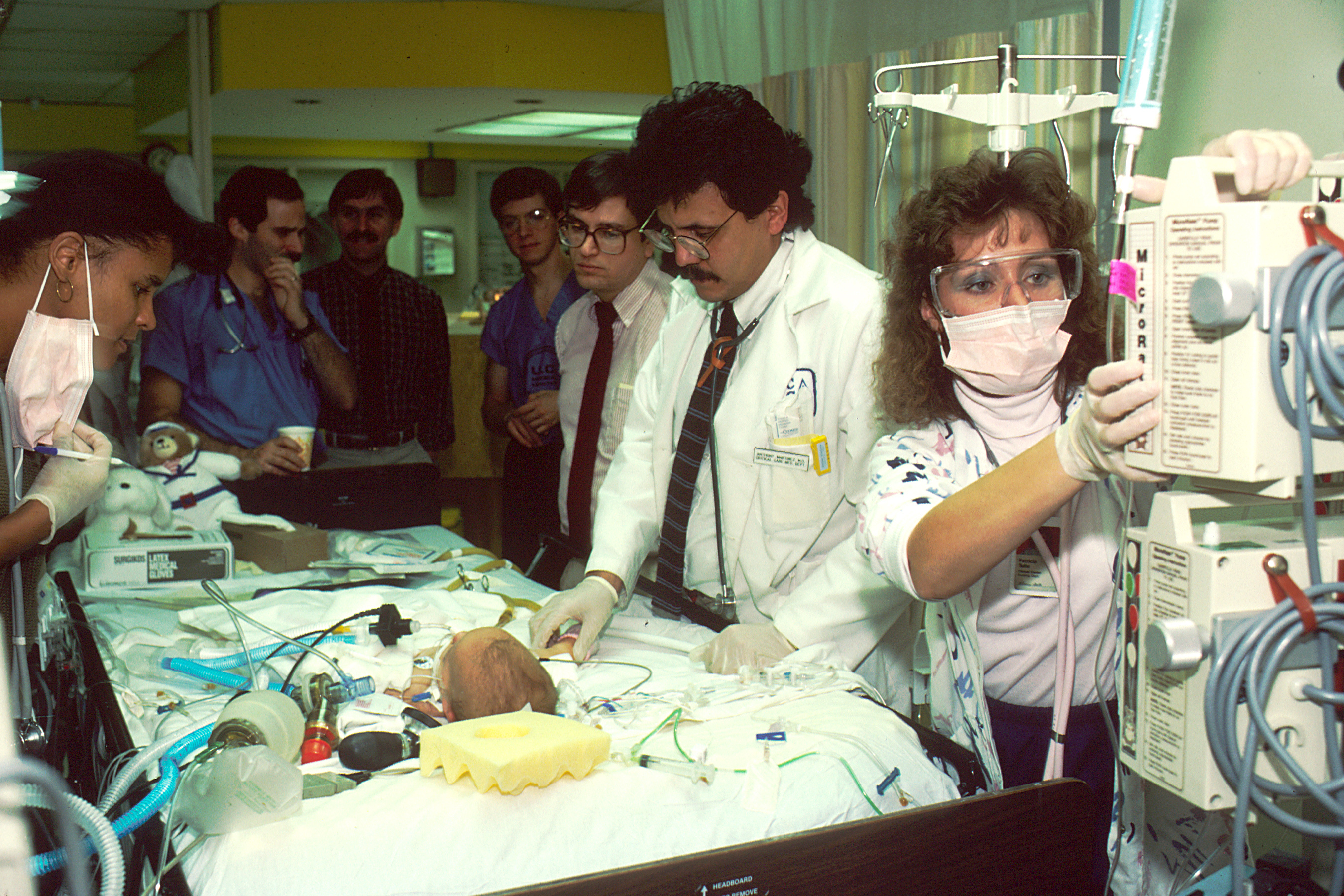
All the people standing behind the attending (who is actually
examining the patient) are the med students, etc. A nurse happens
to be adjusting the IV fluids at the same time.
"Rounds" is when the attending physician (the doctor in the leadership chair, over the third- and fourth-year medical students and residents on the "team") and the lowerlings meet to review everyone's work. Last week, there were three third-year students, one fourth-year (doing an elective in peds, his specialty choice), and a family medicine resident (doing a rotation in peds), along with a pharmacy student (?) and a recently-hired NP (rounding to get the feel of the unit, I guess) followed the attending from room to room. At each room, the lowliest person who'd seen the patient would present them. Each of the third-years saw one patient, the fourth year saw two or three, the resident saw almost all the patients, and the attending was responsible for all of them. This means that the patient I saw was seen by the fourth-year (sometimes) and the resident (frequently), so that when my presentation was over that person would add findings, challenge me, or critique my plan (instead of the attending).

When we came to my patient's room, the attending would face me and say, "go," or I would make eye contact with him and start presenting. "This is a 13-month-old white female who presents with a four-day history of vomiting," I'd rattle off. I'd then describe the history of the present illness (HPI), the pertinent positives and negatives, past medical/surgical history (including birth history for children!), currents meds and allergies, and my objective findings (vital signs, physical exam, labs, and imaging). Then, I state my assessment and plan. "This is a 13-month-old female with gastroenteritis. Plan is replace fluid losses with D5 one-half normal and attempt p.o. challenge today."

And then the education would begin. The attending critiques your presentation skills (if you're really new at this), asks for additional findings (and you better hope you have them), and corrects your plan (you feel awesome if this is all he has to say). Since I am new to this, I got lots of presentation-skills and additional-findings criticism.

Presentation skills are important because we're in medical school to learn to think in an orderly, analytical way about complex problems and not miss things. We're trained to think like a doctor by presenting and writing notes. Presenting skills are also important because communication to colleagues is made quick and safe by a universally-agreed upon format. The format in medicine is:
  • Patient ID sentence
  • Chief concern
  • HPI
  • Review of systems (ROS)
  • Past medical history (including birth history if pediatrics)
  • Past surgical history
  • Current meds
  • Family history
  • Social history
  • Allergies
  • Vital signs
  • Physical exam
  • Labs
  • Imaging
  • Assessment/Plan (A/P)
On the floor, you have to present confidently and quickly. The faster you go, the more knowledgeable you sound (although attendings aren't stupid and won't be fooled if you obviously skip a part of the presentation, a system on the ROS, or part of the physical exam) and the less chance you have of being interrupted. You really want to be able to finish that presentation and get that A/P critique, because that's the gold that makes you a better doctor. That's also the material that attendings want to talk about (not fussy details about presentations), so you make them happier while also looking good. Best of both worlds!

If your attending asks for additional findings, you are expected to produce them with ease. It looks sort of silly to shuffle through your papers, although that's better than having to say "I don't know" or "I didn't ask." We are supposed to know everything about our patients. (Was there green in the vomit? How far did it fly? What was her serum chloride on Monday? Did we get the results of the 99-technetium scan?) Not knowing a historical detail is not very excusable (it's a rookie mistake, only one level above the presentation skills problems); not knowing a lab result is only slightly less excusable. And one is looked upon as not up to snuff if you miss out on a social issue (e.g. illiteracy, bad home situation, poverty, mental illness, etc).

And A/P criticism, while desired, comes in very different flavors. "I think you forgot a decimal point on her IV fluids" is a lot better than "Now, if you give this potassium, you'll probably put this guy into acute kidney failure. You want that on your hands?" But even so, this is the best tier of criticism, and one hopes to reach it during every presentation.

One problem in this approach is stressed or nervous med students, or those who are shy or have thin skins or fragile self esteem, can get hurt. One girl last week cried! I have been lucky, since TAC and high school accustomed me to faking it till I make it (in terms of confidence, not A/Ps). I also have a good memory for medical knowledge. But I don't like that some med students have to learn by shame and embarrassment. I wish we could all take on responsibilities without being toughened by humiliation. Stay tuned for more about academic medicine in the spring, when I go "on the wards" for twelve weeks of I-Med.

Saturday, October 5, 2013

Pediatrics: An Inspiring Rotation

This post conforms to the blog rules.
Although pediatrics has not felt as relevant as other rotations, I've certainly had a lot of chances to be humbled and amazed by the parents I meet.

"Lupita"
In the outpatient clinic I worked in, my preceptor had me shadow for well child visits. One afternoon, I followed him into a well child check, only to see no child in the room...only a middle-aged woman sitting in the corner chair. She and the pediatrician began to speak and I slowly began to understand what was going on.

This woman was adopting a distant relative's child, "Lupita" after discovering that Lupita and her siblings were being neglected. Raised in a small town in south Texas, the children were left alone often and had to choose which children ate at meals. Lupita didn't speak English very well and didn't know what grade she was in. The woman said that at home, Lupita talked nonstop to whoever was around her and ate voraciously, almost choking on a sandwich in her haste to eat it. Drug use and deportation played a role in her mother's absence.

Lupita came in after the pediatrician had received all this news. She was a grave child, obeying the doctor in everything she could understand without smiling or showing any embarrassment that a girl her age would typically show. She spoke freely but only when spoken to. In her hand, she held a little charm, and when I asked her what it was, she opened her hand and showed me a plastic star the size of a die. "Mi estrella," she said simply.

I was very amazed by Lupita's new adoptive mother. This woman was also planning to adopt Lupita's baby brother, who was still in Mexico. And when my preceptor asked, "how do your twins feel about all this?" I was completely amazed. Pray for them!

"Aaron"
In the same outpatient office, with a different preceptor, I saw a follow-up with eighteen-year-old "Aaron" on a stress fracture. Aaron was a young adult with autism and a lot of sensory overload. He was in a post-high school program designed to teach adults to ride public transport, interview for a job, and use a basic skill set in an employment setting. He had come in with his mother, who I learned (and could see by difference in race) was his adoptive mom.

As the doctor conducted the history from his mother, Aaron would constantly interrupt: "what's going on? I don't understand," or "I have something to say. I'm going to explode. I still don't understand," and his mother would quietly redirect him or ask him for input. She was very skillful at letting Aaron talk as much and as constructively as possible, while also advancing the discussion of his painful foot.

During the physical exam, however, the doctor had to palpate for swelling and tenderness to palpation (an X-ray was inconclusive), and the pain began to be more than Aaron could communicate. Unable to say "stop it" fast enough, he screamed loudly, then began to cry. The doctor stopped and we stepped out of the room for a time, while Aaron and his mother re-grouped.

After a few minutes, we came back in. "Aaron wants you to know he's embarrassed," his mother said gently, "but he wasn't prepared for you doing that today." The doctor nodded, apologized to Aaron, and the interview went on. It reminded me of a video I'd seen about a nonverbal girl with autism (at right and also online: Carly's Cafe). It was as if Aaron's world was too overwhelming, and processing it took so much time that he couldn't ask the doctor to stop pressing, and the pain and the inability to stop it became very distressing.

Throughout, the mom was a calm and loving help to this young man who she was barely helping to function. At one point in the interview, she became tearful when she talked about Aaron "falling through the cracks." Where would Aaron be without this woman? This is another story of someone I'll not forget easily, someone whose generosity was humbling.

"Helen"
I just finished the week of newborn nursery time that's sandwiched between the other weeks of pediatrics. I rotated through the NICU and saw some very incredible moms there, too. I spent some time talking with one in particular, "Helen," who had delivered two preemies. Her first child was born at 28 weeks and she spent months in the NICU fighting lung problems and sepsis. While her baby used IVs and NG tubes, Helen pumped breastmilk from the day he was born, hoping that when he was mature enough he could take it. It was a nightmare, she said, something "I wouldn't wish on anyone." Fortunately, her son is now caught up in growth and milestones, and has no residual CNS effects except some possible learning disability.

During her second pregnancy, Helen received weekly progesterone injections (thick, oily, slow gluteal IM shots) and underwent cerclage, but still went into labor at 28 weeks. After trying every drug her MFM had to offer, she started a terbutaline drip at home and stayed on bedrest for six weeks. Helen told me she has a propensity to contact dermatitis and the indwelling needle for the terbutaline drip was a constant irritant in her leg during that month and a half. And at some point every week, she would go into labor again and the terbutaline dose would have to be increased in the emergency room.

"Was it worth it?" I asked.

"Oh, absolutely," Helen said emphatically. "My daughter was born at 36 weeks, and it was so worth it to have her that much farther along. Oh, absolutely." This woman has her priorities in beautiful order. The generosity of soul of these mothers astounds and humbles me!