Showing posts with label obedience. Show all posts

Friday, July 15, 2016

Easter Fire: In Which God has a Laugh

I notice things; maybe you do this, too. Maybe you always know where the fire exits are. Maybe you notice the elderly priest at Mass and think about what you would do if he fell or fainted. Maybe you notice the pregnant lady in the car next to you and think about what you would do if she got in an accident (maybe you even keep a scalpel in your car to do a stat C-section...).

Easter fire. (Stock photo, obviously not the situation I was in.)
I think it's neat that I can notice these things and be ready. But sometimes I think God makes fun of me for it, just to keep me humble.

I worked days this past Easter, but I had the nights off. So, after I got off on Holy Saturday I drove to an abbey not far from my city for their midnight Easter Vigil. It was going to be my rest: for just a few hours, I had no responsibilities. I didn't have to cantor, talk to people, or even stay awake! Thank God, I prayed.

This is the abbey where I made my week-long retreat before my consecration. It was an otherworldly week, partially because the abbey really lives the vow of poverty and the life of silence. Each member lives in a tiny (6x10ft) hermitage without heating or air conditioning. They also have foundations in Africa, and they live the same way on both continents. 

Given this spirit, I wasn't surprised to see a make-shift, but lovely credence table for the lighting of the paschal candle. In a broad stew pot were some coals, and this was placed on top of a cheap card table, covered with a white tablecloth.

I felt strange coming back after so many months in the world. I was then more than halfway through intern year: I was a competent, resident, I paid bills and bought stuff, and I was neck-deep in ethical questions, all far from ethereal prayer. That night, I re-entered the world of silence feeling like an outsider.

I slid in a few minutes early next to another woman. It was hot (remember: no air conditioning), and she had brought a water bottle. The plastic crackled in the monastic quiet before Mass. When the time came to light the candle, we all stood. Because I'd slid in the back, I was only a few feet away from the humble credence table. An acolyte poured some lighter fluid on the coals and clicked a lighter. My face and the faces of the whole back row were illuminated, and I felt even more exposed. Hide me, God. Please, just let me cower in the back and absorb the Mass.

All was well for a few minutes. Then the fire blew out of the pot and the tablecloth caught fire. The same sense of duty that makes me notice pregnant and elderly people was immediately awake: DO SOMETHING, it said.

What? I thought immediately. God, are you joking? 

The seraphic abbot and acolytes all stepped away in refined surprise. Inwardly, I groaned playfully at God, because it was as though He was nudging me lovingly. It had only been half a second since the fire started, and I grabbed my neighbor's water bottle, tore the cap off, and emptied it onto the table. There was just enough to put out the fire. I have residency to thank for the reflexes, and God to thank for His sense of humor.

Monday, March 9, 2015

Guessing and Pride

Vocabulary: Pimp (v.): to ask questions, often in front of other trainees or professionals, to assess a student's or resident's preparedness, medical knowledge, or professionalism
Third year medical students get used to getting pimped. We're advised (by survival guide books, by older students and residents, by faculty) to guess if we don't know an answer. This advice is logical. A third year knew even the smallest biochemical details of the pharmacology he's being asked about a mere six months ago, but after STEP 1 and two or three other rotations, he's refocused so many times that he can't exactly recall the correct answer. A third year sort of knows what to study for clerkships, and definitely never knows what to study for particular attendings. In general, a third year has just enough knowledge to know what's being asked, what the answer choices mean, and what he's missing to know the correct answer. (It's a very frustrating experience.)

We're advised to guess because we have enough knowledge to say something vaguely correct. I followed this advice, and had good and bad results.

I should have played the lottery during my pediatrics rotation. That's how lucky my guesses were. One outpatient physician with particularly pronounced ADHD forgot that he told me the most common cause of URI was "viral." When he asked me the question and I informed him that it was "viral," he was very pleased. I answered a few more softballs correctly, then he hit me with a hard one. "Why no fluoroquinolones for this patient?" he asked.

Fluoroquinolones! My M1 box of memories contained something about teeth...or was it cartilage? Tendons? Shoot! I had to pick between them. Because I remembered "cartilage" and "tendons," I eliminated "teeth," and then flipped a mental coin. "Cartilage malformations," I said. The whole internal answer-picking had taken only a fraction of a second.

"Correct!" the attending said. I got a fabulous evaluation.

Inpatient looked like it was going to be a different story. Our attending was demanding and taught in a more classical fashion: we presented patients in front of everyone on rounds, wrote detailed notes, and did long mock case workups. While I was in front of the room at the board (pen in hand) pretending to work up a child with renal failure, he told me a stool culture came back positive for Shigella.

"So," he said. "You wanna give him antibiotics?"

His CBC was terrible, he was febrile, he already had an IV in, and I very much wanted to give antibiotics. I remembered that Salmonella and Shigella had funny reactions to antibiotics...something about the child would feel better but there would still be bacteria in the stool...for even longer? But that was only for one of the two species (darn the person who named these two things so similarly!!)... Do I hazard a guess, or do I just give the antibiotic? I gambled.

"We could," I said, "but doesn't it prolong clearance in the stool...?" I trailed off gingerly, just in case I was wrong.

The attending raised his eyebrows.

"It does," he said, surprised. Apparently I'd skirted the trap he usually set for students. He then told a few case histories of patient's he'd treated. "So," he concluded, "if it's just going to be fluids, what do you want to use?"

"D5 half-normal," I replied. That wasn't a guess; that's what everyone in the unit was on. He gave me a mischievous look and pressed further.

"There is one case in which you would consider using quarter. Do you know who?"

Time for another guess. Babies are all water balloons at birth, so my brain spat out:

"The neonate?"

The attending clapped and grinned. "That's hot!" he said (which must have meant something different when he was a teenager). "Strong work." And I got another fabulous evaluation based on guessing.

But this has terrible effects, especially when we're asked to guess in front of other people. Those of us with the vice of pride (which is many doctors and student-doctors, and (so I'm told) a few other humans) do terribly in this environment. We have one of several reactions. It's a little complicated, so I made a flowchart.

I was typing this post while my attending was at a meeting; he came back and we had a mini lecture/pimping session on hydrocephalus. And I guessed some more. It will never end.

Thursday, June 12, 2014

The Third Year Manifesto, last part: An Analysis

There are days that I want to ask the hospital at large: “When do I get my personhood back? When am I treated like I have the dignity that everyone else does?”

I want to be comfortable where I work. I want to be safe to be myself and express my limitations. Instead, I cork up dozens of questions a week. I’ve violated the sterile field a half dozen times and don’t bring it up. I hate being told that I can’t do something because being so uninvolved, it's not what I’m paying for, and I have more to offer. I hate being told that I can do something because I will be watched, I will fear derision and misunderstanding, I will fumble out of fear, I will put on my game face and fumble out of incompetence, or I will get lucky and be deluded so that the next fumble hurts more.

I want is to be satisfied with the way my life is going. I want the basic esteem of others. “Oh,” is all I wish that people would think when they saw me, “she’s a medical student. You know, those people can’t do much. But they sure try.”

#

Once, I caught myself apologizing to someone in these exact words:

“I’m so sorry for taking up so much space!”

After uttering this ridiculous sentence, I went out the nearest door in a polite rush. Only after the door shut behind me did I shake my head and think, “what a stupid thing to say. I’m taking my own personhood away; apparently, I don’t need anyone else’s help.”

So, now that it is the fourth year of medical school, I am deciding: no one is taking my dignity away, least of all me. If they demean me in the OR, they are doing something inappropriate. I will graciously excuse them, like one ignores a person passing gas.

I am determined never again to agree with the lie that I am a worthless idiot. That lie leads to an psychological hell.

Part of the reason I became such a doormat/basket-case of self-critical emotions and permitted everyone else’s criticisms (petty or cruel) to sink me, was that I had a lousy idea about humility. I had this glorified picture of religious life in somewhere between 1600 and 1900 in which saints were made by kissing floors. Didn’t St. Bernadette, St. Jeanne Jugan, St. Therese, and many others have to be grossly misunderstood and abused to become saints? Don’t you have to believe all the derogatory things people say about you if you want true humility? Yeah! So, I was excited because I’d heard (correctly) that the third year was a lot like a floor-kissing novitiate.

But there is a basic misunderstanding there. Cultures that file away at personal dignity crowd out holiness! A person tossed around in such a culture becomes so distraught over himself and convinced of his incapacity that he can’t have the magnanimity a saint needs to become like the all-loving God. Believing himself to be a microscopic locket—always too small, always wanting, always disappointing—this miserable man can’t imagine becoming a vault, a temple.

It is a lie of Satan that I am worthless. I want to do great things for God. I want God, I want to be like Him, and I expect He will make us that way. So if I ever stoop to another floor for a kiss, it will be because Jesus is there, waiting to kiss me back and make me His gorgeous, eternal, perfect bride.

Wednesday, June 11, 2014

Third Year Manifesto, Part 2: Stories

In which I vent all the stories that I've kept bottled up so as not to be a whiner. The last part of this trio of posts is coming tomorrow.

#

I obediently submitted to being taught how to insert a Foley every time I inserted one. Today (the first day of fourth year) was the first time no one approached me and said, “oh, let me show you how….” It was disorienting. Wasn’t someone going to smother me with their preferences?

I breathed. I felt free! But the freedom was not to last. As I proceeded, I heard a very distinct “hmpf!” behind me, in the same tone people use when they raise an eyebrow and say “well, that’s interesting!” and really mean something much less benign.

#

The first vaginal delivery I attended on L&D, I did what the clerkship director told me to do: I protected the perineum and stayed close, in case I could actually be allowed to deliver the baby. This is called, good-naturedly, “being aggressive,” and it’s a good quality in medical trainees.

In that first delivery, a senior resident and an intern were also there. I guess if I were more shrewd, I would have known that it was bound to be the intern’s delivery. But who was I to know that what the clerkship director told me wasn’t right?

The senior resident decided to put an end to my aggressiveness. She put her hand on my hands and pushed them away from the field. Pushed. No exaggeration; the equivalent force could have shoved a gallon of milk several feet. The embarassment (and the sheer force) moved me to the back table for the rest of the delivery. When she asked me later, “did you see how the baby did xyz during abc stage?” I felt like saying, “No, of course not. If you want me to see things, don’t push me away.”

#

When a gentler resident was graciously allowing me to suture subcutaneous tissue in the OR, I put my needle driver down on the field, with the needle still in it. It was the first time I had ever done this, because it was the first time I had to cut off my needle to tie. (It was the first time I wasn’t using 4-0 and subcuticulars in the skin). The scrub tech slapped my hand, chiding me verbally. I blushed with angry embarassment underneath my mask, but tractably apologized, etc. Then, she said these words exactly (I remember them and you’ll see why):

“There are some people,” she said self-righteously, “who’ll slap your hand for that. I won’t, but there are some.”

I tried not to stare at her blankly. I guess it never dawned on her that she, SHE had ACTUALLY (not metaphorically) slapped my hand. I guess people who use that phrase end up acting on it without realizing it?? She has been the only one to do that.


#

One day in surgery I learned that the scrub tech, the scrub-nurse-in-training, and I were all within a few years of each other. I was the oldest. I was paying, snipping, uncomfortable, and chastised during the surgery. The other two, who were allowed to take a lunch break (during this six-hour surgery), were paid and thanked.

The fact that I’m paying to be there seems to some surgeons to mean that I’m not to be thanked and that I’m automatically incompetent. It seems to say, “she can’t do anything.”

“No, no,” one surgeon said when I reached for a towel to drape a patient. The scrub tech, who had offered me the towel, knew me better than that surgeon. He was being a pal, and he knew I have seen patients draped dozens of times and I could do it. But no! “She’s a medical student, she doesn’t do that,” the surgeon said.

“Excuse me, Doctor Bossy-Pants,” I burned to say. “I am a medical student and I can do that. Watch!” But it’s her sterile field, it’s her OR time, I’m her responsibility and (the real reason) she’s grading me. So I didn’t do that. I backed down. I abased myself.


Tuesday, June 10, 2014

The Third Year Manifesto, Part 1: Cutting Suture

I will now discuss the stuff of third year that is not happy and glamorous. Having a blog places slight pressure on a person not to whine. But not to disclose the negative parts of medical school would be dishonest. So it’s time to air a few grievances, and (because I can’t seem to not do this) discuss morality and holiness at the same time.

At some point during my third year, I got very demoralized. It’s hard for a person who wants to do great things well (and is used to doing great things well) to find herself unable to hope even for mediocrity.

One response to this predicament: Ah, what a chance to grow in humility!

THIS IS AWESOME.
"Ah," goes this response, "I have had many peers, past and present, who have struggled to get the things I’ve gotten, like A’s and letters of recommendation and leadership positions and success…. Now, God is making me more like them, to help me see that they are my brothers in everything. I have nothing of my own and am happy to have God, because I truly lack nothing."

Another and much more human response to this predicament:
THIS IS TERRIBLE.
In its severest form, this disappointment becomes sadness, loneliness, isolation, depression, and despair.

It was a war between these two responses for the second half of third year. However, it is old news that 1) I am a little soul and 2) there's a war going on in me between holiness and not-holiness. God is exerting Himself to the maximum and employing all kinds of things (sacraments, virtues, habits, circumstances, living people, dead people, people I’ve never laid eyes on, angels, and even me) to make me like Himself. On the other side are all kinds of things (occasions, vices, habits, circumstances, living people, dead people, people I’ve never laid eyes on, angels, and especially me) persuading me to stay in my nice little hidey-self-in-hell-hole.

But morality aside for a teensy moment: seriously! This year was so demoralizing at times!

Do you have any idea what it is like to stand in a surgery, not allowed to do anything except trim suture? Somebody ties a knot around [whatever], and I come in with scissors and snip it. That is 90% of my intraoperative action. This is especially painful because I’ve been given great responsibility and responded rather well to in the past. I wish I could speak my mind in those ORs.

“You know, I am a person.”

Snip.

“With an intellect.”

Snip.

“A rather good intellect.”

Snip.

“And I have pretty good hands, too. Did you know I paint? And I’m handy around the house.”

Snip.

“And if you let me stick-tie the ovarian vessels/close the fascia/dissect adhesions/use a bovie/debride dead tissue/MANY OTHER EXAMPLES, I bet I could do it.”

Snip.

The worst part is, I am not even permitted to stupidly cut as I like. I am chided because I am not doing it properly. Since the clinical years of medical school are a dizzying merry-go-round through services and surgeons, I can never acquire expertise in one thing. Many have pretened to, but no one ever has, given me a comprehensive lesson in how to properly cut all types of suture in all places according to the preferences of all surgeons. (I expect even the Eternal Father would have difficulty with this one. Just kidding, Abba.)

“Whoa!” says one surgeon. “Too short.”

Or again, the surgeon is uncomfortably silent after I cut. I timidly ask, “too long?”

At least I have never cut someone’s knot. There was once when I took the blame for a broken knot. A few minutes after I snipped, one of the resident’s knots came undone. To save the resident face, I said, “Oh, I cut your knot, didn’t I. I’m sorry.”

I became the queen of taking flak this year. There was an “Oh, thank you,” after every correction; there was a sincere-sounding “I’m sorry,” after every action someone objected to.

Today, while snipping, I grew less and less successful. I began to wonder whether there was a problem with the scissors. Surgeons and residents are quick to ask for a different instrument if the one they’re holding does something silly or inefficient. Not being a surgeon or a resident, I waited out my silly, inefficient instrument for a good five more snips. While I waited, a new scrub tech clocked in. This meant I lost the rapport I’d built up with the first one (my pulling a gown and gloves, helping in setup, etc) I didn’t think anything of this at the time, but now I wonder whether er shift change made a difference in the answer I received when I eventually asked, “Do you have another pair of scissors?”

There are at least four pairs of scissors in almost every set. I know because I know their names: curved Mayos, Mets, tenotomies. There are also Potts and Dietrichs, but even I wouldn’t use those for suture (now I’m just showing off how many types of scissors I can name without looking things up). The suture scissors are called “heavy sciz” by some, but their real name is straight Mayos. Technically, you’re supposed to use the straight Mayos for stuff, like foam, suture, and mesh. Cutting these undelicate things with the better scissors would dull the blades and damage tissue. But I’ve seen surgeons get frustrated with a pair of straight Mayos. They drop them to purposefully exclude them from use, then start to use the curved Mayo’s or the Mets. I’ve even seen someone use the tenotomies. So certainly it would not have been absurd for me to use a different pair of scissors. But what did the scrub tech say?

“Is it the scissors, or is it you?”

I felt like exploding.

Please,” I wanted to say, “even if it is me, could you think of a different way to say it? Maybe ‘show me how you’re cutting’? Or maybe, just maybe you could humor me? I humor people to ridiculous extent. Could you just hand me the curved Mayos? Maybe then I’ll learn that it is, in fact, not the scissors. And you know what else? Even if it’s not the scissors, I don’t like that you said ‘me,’ as if I/me/my person is a problem. My technique might be lousy, but why the ad hominem? Why do I become a problem because I don’t cut suture properly? And anyway, who has taught me how to cut? No one! I have had to cobble things together myself!”

See the med student, doing nothing?
Oh wait, I forgot to get them in the camera view.
But I said, smiling doormat that I have become, “Oh, probably me.” And she said what I should have been doing. My success was unchanged: some good cuts, some lousy ones. In retrospect I think the scissors were fine and I was fine. The problem was that the incision was getting deep (down to the retroperitoneum) and therefore the sutures were getting further and further away from me. When you have to stand on tiptoe and crane your neck and reach to cut something, nothing works quite as well. I can’t wait to be the surgeon or the resident and have a legitimate place to stand so that I can see the operative field all the time.

Tuesday, October 15, 2013

What is formation like for consecrated virginity?

Disclaimer: you are now reading a post about formation by the one being formed, not by the formers, which is kind of like asking a second-grader about the objectives and milestones required to advance to the third grade. </disclaimer>

Formation for consecrated life is formation for the whole person, to prepare them to live as a spouse of Christ on earth and a mother of souls. Forming the whole person includes spiritual, intellectual, and affective components. For example, I am taking a Faith Foundations class through the School of Faith (it's free and available to you, too!) for intellectual formation right now. For affective and spiritual formation, I am following a rule of life and meeting with local focolarine weekly. Each week, we review and share on practical applications of topics like:
  • God loves me immensely (where? when last week? even when you were suffering? how do you know? do you trust Him?)
  • doing God's will in the present moment (even in the car? are you patient in the present moment? do you stay there with Him?)
  • loving like God: first, unconditionally, with a smile (this is how you spend the whole day with Him! If only I knew anything about it....)
  • the Word of God lived out in life (we're on this now and I'm totally confused)
Med school is also a help with affective maturity and discipline. When I read about old-fashioned religious obedience and humility (e.g. when St. Bernadette would be told "kiss the floor and leave" or when St. Therese would not excuse herself for misdemeanors she wasn't guilty of) I think, "oh, perfect. Med school is just like that." The third year med student is in a year-long postulancy where no no excuse is valid and no credit is given. And who needs hair shirts when you have to give up your personal time to do practice questions, study, and drive? It's very hard to keep a balanced lifestyle, so it really tests your discipline and prudence. (When should I study? How much? Am I doing my duties? What comes first: morning prayer, or morning report??)

Formation has been challenging but amazing. I am shocked at the changes I see in myself just in the past 12 weeks. The most important part has been having spiritual mothers to set an example of unconditional love. God is radiantly generous!

Monday, August 5, 2013

An Open Letter to Christians

Dearest sibling,
Recently I attended a lecture by a man who claimed to be a deeply religious Christian but lived against some of its tenets. When an audience member asked him about the disparity, he shrugged off the difficulty as ethereal. "Look at Christianity," he said. "People have all kinds of interpretations and translations. Some people include books that others don't." He effectively said, "Christianity isn't one thing, it's a free-for-all, so I make of it what I choose. And that goes for any of my other actions! I do what I choose, and it is good."

Dear Christian, this goes against what we believe. We do not choose what is true and what isn't! We are chosen, we are added to the Lord--conformed to Him, made like Him! It is a beautiful, saving obedience. We know this, and we hope to spread this knowledge to others so that they, too, can be safe in holiness.

I call us to unity. We are giving scandal to the world by being so separated. We are lending credence to faults and sins that pain our Lord! We must stop it, and we must put effort into stopping it!

On my way to work I drive down a block with six churches of various denominations on it. Flanking both sides of the street and one right next to the other, they stand like detached body parts of a man horribly wounded. How can we stand to see our Jesus like this? I call us to knock on our brothers' door: knock on the door of the church nearest you and set up a meeting. Talk about what you have in common. Talk about unity in the next fifty years. Talk about stitching our Lord's wounds closed. And talk about setting an example of love, unity, and radical holiness to our world.

With a fond embrace and with Jesus among us,
Your sister in Christ


Wednesday, May 16, 2012

Can I take two minutes to say: being a faithful Catholic right now is awesome? When one understands that our Church is true and that it will persist, life/history becomes a beautiful story of the victory of the Church. Perhaps this is because I just graduated from a current-events bubble (TAC) last May, but I think this is especially true of the past ten months! I am thinking of the return of some Anglican Churches, the new translation, SSPX, LCWR, the HHS Mandate, the NY Times ad....

On a completely unrelated note: 200 posts and 11k views, yay!

Tuesday, May 15, 2012

First Icon: my Guardian Angel

Two wax paper tracings of the fresco I am copying
Madonna with 54¢ of cull lumber (five 3.25x4" pine boards)
I have put off beginning my first icon for a while: I wanted to start one at the beginning of Lent. Now that it is dangerously close to Pentecost and I am in a lull between classes and summer work, I realize my window is closing.

I really wanted to do this right. I read that some iconographers follow schedules of fasting and prayer. I didn't want to treat the process frivolously, mistreat the sacred, fail in obedience, innovate on top of holy traditions, etc, etc.

However, I also recognized that my desire to paint a holy person comes from a good intention, to spend time thinking about holiness in members of Christ's body and to exercise my devotion in a physical and visual way.

And I looked at the big picture: the Church has no partiality to one style or another (she is, after all, universal). In fact, just looking at the icons attributed to St. Luke one sees extreme variation across time and cultures. Materials, style, method--all these are accidental. What is essential to an image that will increase devotion in the painter and the future beholders is devotion and right intention.

With this in mind, I started last Friday. I am painting my guardian angel, with whom I barely converse at all and whom I barely know. The pattern I chose to copy is an Italian fresco (rather late considering the reported ancient source of many icons). This fresco, more than many other patterns that I could imitate, showed a masculine and attentive figure, with a face communicating significant activity. I will continue to post to record future progress.

Sunday, May 13, 2012

Submission, Change, and the Church

I recently discovered Fish Eaters, a site with loads of excellent apologetics on hard-core Catholicism. It explains the richness of our millenia-old traditions and is truly marvelous! The site creator, Tracy, states states her position, which is pretty solid. (I'm used to people saying that the the Tridentine rite is superior to the Novus Ordo and pretty much agree.) Moving around the site, I discovered a fun page: Lists Every Catholic Should be Familiar With. (I like lists.)

As I was happily stuffing information into my brain I saw that the list of mysteries of the Rosary had only 15 items. Then I read
...His Holiness, Pope John Paul II, recommended adding 5 more Mysteries.... This novelty does not change the true Rosary and is merely presented as an option for Christians. This option, however, is one that totally disrupts the relationship between the Rosary and the Breviary's Psalms.
While I disagree with Tracy's thoughts about the five Luminous mysteries, I have a lot of empathy with her: I wince to hear that the Roman Calendar is all messed up, or that the fifteen-decade Rosary fits with the old Office and now everything is all confused. I like things to fit and remain consistent.

In fact, lots of things in the Church make me wince. I used to wonder why there are redundant religious orders (e.g. Dominicans, Salesians, Ursulines—they all teach!). Can't we be systematized and have one monastic order and one apostolic order? Why are there so many vocations? Can't we be saintly in an orderly, limited number of ways?

The Vocation Tree: a helpful infographic, but
the first time I saw it I definitely winced.
But that's not how agapic love works. God has an unexpected, organic fecundity and the Church reflects this in the differences between souls and the developing Church: remaining one, she changes by adding and pruning to produce more fruit for our salvation!

(This post is about more than the Rosary, but recently Msgr. Charles Pope proposed adding more mysteries to the Rosary, in a lighthearted but earnest way. The Rosary isn't the Canon of the Mass. It's not Scripture. It's a devotion and, like the vocations blessed by the Church, changes as the Church's needs change.)

So, despite my love of Latin, lists, ritual, order, and incense I need to remember the nature of the Church. But where is the balance between maintaining tradition and allowing for true growth? St. Pio of Pietrelcina has great words to say about this, similar to the recent words of Bishop Fellay, superior of SSPX. First, St. Pio:
...A renewed Church is coming, faithful and united, and you must help to usher this in by setting an example of great loyalty and fidelity. Perhaps there are things you do not agree with about this Church. Heaven accepts the fact that you have opinions. But you should discuss these things with Jesus and not use these points to pull your Church down and distance others from obedience. You will be accountable for this, my friends.

If Jesus is calling you to lead in the Church, then you must lead. If He is calling you to follow in the Church, I suggest you follow or risk displeasing heaven. ...[B]eing in a constant state of disagreement with your Church is causing you unnecessary stress. ... This is God’s one true Church and that has not changed. Be faithful during this time.... [B]e accepting of both your personal crosses and also accepting of the crosses your Church is carrying during this period. Heaven is with you in each personal cross and heaven is working to renew the Church. Be patient and calm while we work together in these matters.
Next, Bp. Fellay: "today’s Church still has Jesus as its head. You give the impression of being so scandalised that you can no longer accept this is still true..." and "[this] conception of the Church is too human and fatalistic; [it sees] the dangers, the scheming and the difficulties but you no longer see the help offered by grace and the Holy Spirit."

Ultimately, both urge us to obedience as a guide: we will walk the correct line between too much change and too much rigidity when we are obedient. The Church, they remind us, is God's—not ours, not the Pope's, not the Councils'. Therefore, let us constantly seek Christ, because He embodies obedience and thus sets us free. Dilige et quod vis fac.

Thursday, April 19, 2012

United States Consecrated Women

This post, like the last one, starts with my evening in the hospital chapel. But this post, unlike the last one, is not long and nice and reflective.

Before Mass (which was only attended by the celebrant, four habitless Franciscan sisters who administer the hospital, and yours truly), the first part of Evening Prayer was prayed. However, we did not pray out of a breviary. We prayed from The Companion to the Breviary: a Four Week Psalter Featuring All-Inclusive Language (emphasis mine). The doxology was rendered:
Glory to you, source of all being,
Eternal Word, and Holy Spirit,
As it was in the beginning, is now, and will be forever. Amen.
It was printed on cute little cards with sunny clip art and inserted as bookmarks into the Companion. I can think charitably about ugly architecture, but removing God's masculinity from one of the most necessary prayers is very different. Who would want to sterilize their Spouse? It is interesting to me that the culture of sterilization (i.e. Western civilization right now) does not exempt members of the Church.

But there is good news!
  1. Real Catholicism is winning.
  2. The Church is speaking with the LCWR.
  3. Update: I like Elizabeth Scalia's thoughts on this, more than anything else that has come out. I tend to assume the worst of habitless nuns, but she has a balanced perspective that ultimately emphasizes obedience.
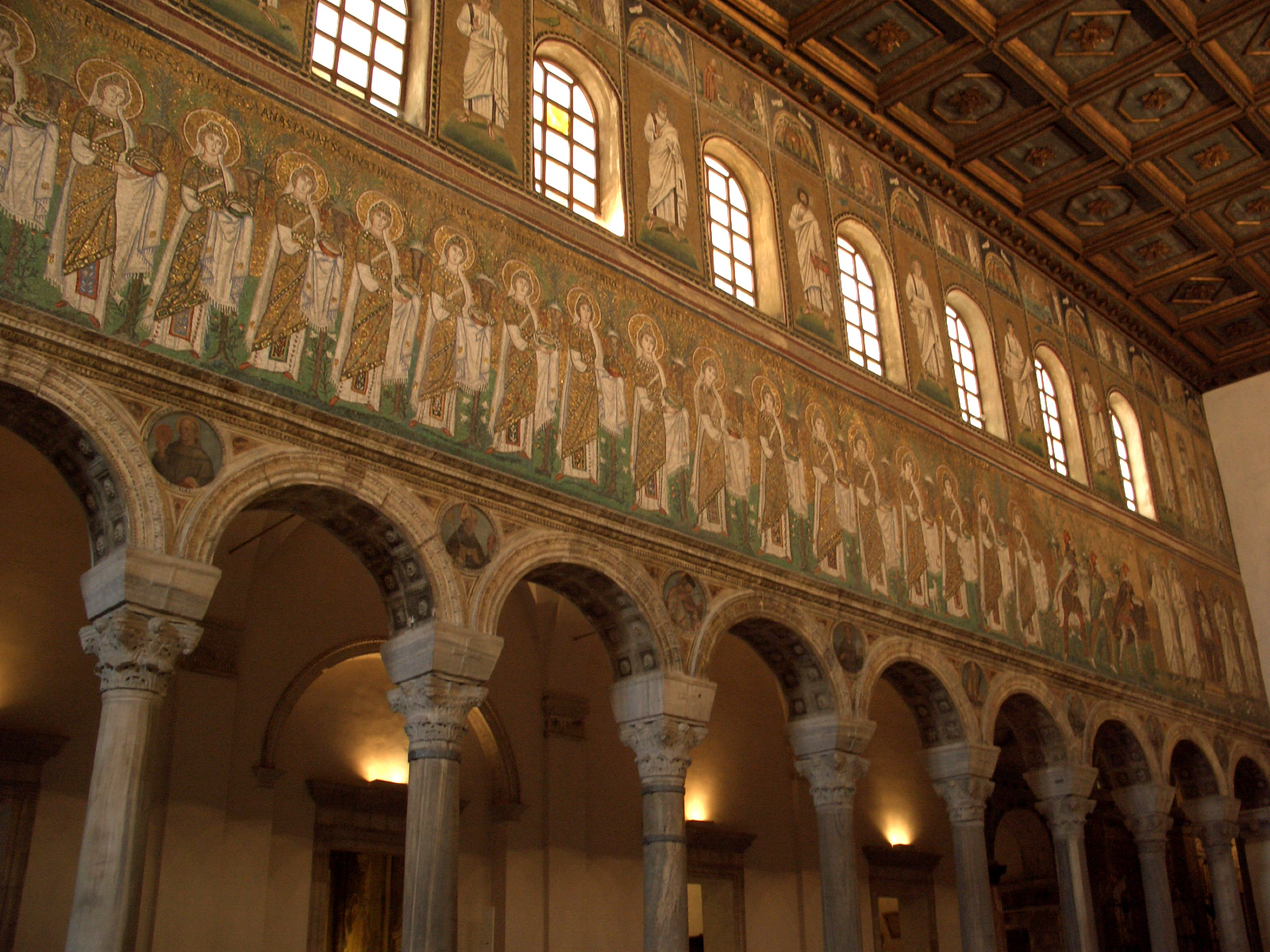
I pray that women religious in this country return to their radical beginnings. Look to the thousands of years of strong and beautiful women saints!

(Right: Main nave of the byzantine basilica of Sant'Apollinare Nuovo in Ravenna, Italy. The mosaic shows a procession of early Christian virgin martyrs, such as St. Agatha. Doesn't this beat sunny clip art?)

Thursday, December 15, 2011

Total Consecration to Jesus, through Mary

I began my fifth year of total consecration this past Thursday. It's hard for me to explain, so I'll let St. Louis-Marie de Montfort do it for me. (Emphasis mine; I added it because the quote is long and I tend to skim the latter half of long quotes.)

St. Louis de Montfort noticed that the saints
stay at home with their mother—that is, they have an esteem for quietness, love the interior life and are assiduous in prayer. They always remain in the company of the Blessed Virgin, their Mother and Model, whose glory is wholly interior and who during her whole life dearly loved seclusion and prayer. It is true, at times they do venture out into the world, but only to fulfill the duties of their state of life, in obedience to the will of God and the will of their Mother.

No matter how great their accomplishments may appear to others, they attach far more importance to what they do within themselves in their interior life, in the company of the Blessed Virgin. For there they work at the great task of perfection, compared to which all other work is mere child's play. At times their brothers and sisters are working outside with great energy, skill and success, and win the praise and approbation of the world. But they [the saints] know by the light of the Holy Spirit, that there is far more good, more glory and more joy in remaining hidden and recollected with our Lord, in complete and perfect submission to Mary, than there is in performing by themselves marvelous works of nature and grace in the world....

Lord Jesus, how lovely is your dwelling place!1
In this consecration, I give all my possessions—corporeal and spiritual, present and future—to Mary, so that she may dispose of them as she wishes. In this way, I make her my superior in life. Mary, not to be outdone in generosity, lends me her virtues, and molds me perfectly to Jesus. (I remember reading the biography of a Carmelite nun; on the first day of her postulancy the superior took her to the foot of a statue of Mary and said, "ask her to make you a perfect spouse of Christ." This is what this little consecration is.)

Examine this verse (a favorite at this time of year):
...and she gave birth to her firstborn son. She wrapped him in swaddling clothes and laid him in a manger, because there was no room for them in the inn.2
The inn is the world, and there is no room for Christ in a heart full of worldliness.3, 4 Instead, Our Lady lays Jesus in the wood of the manger which, like the wood of Noah's ark, is a symbol of the Church. The Church, empty of all other glory, is able to receive Him.5 This consecration enables a soul to be empty, so that Christ can enter as He ordained: at the hands of Mary.

Please contact me with any questions about this devotion! Footnotes are after the jump.

Tuesday, September 20, 2011

Unjust laws

I did a tiny amount of research on unjust laws between studying the leukocytes and reviewing the anterior abdominal wall. I found an incredible page: a compendium to Catholic social teaching, courtesy of the Pontifical Council of Justice and Peace. §399 and §400 deal with unjust laws, obedience, objection, and resistance.

§400 quotes St. Thomas Aquinas: "one is obliged to obey ... insofar as it is required by the order of justice" (Summa Theologiae, II-II, q. 104, a. 6, ad 3um). St. Thomas defines "the just" in II-II q. 57:
I do "the just" when I render to others what is their right or due, i.e., what is "commensurate with" them in their dealings with or relationship to me.
The order of justice refers to the order in the kinds of law (II-I q. 91): eternal law (God's providence), natural law (principles in us driving us to natural goods), and human law (public law, military law, decrees, statues, international law...).
St. Thomas considers the unjust law in II-I q. 96 a. 4.
...laws framed by man are either just or unjust. If they be just, they have the power of binding in conscience, from the eternal law whence they are derived, according to Prov. 8:15: "By Me kings reign, and lawgivers decree just things."

...On the other hand laws may be unjust in two ways: first, by being contrary to human good, through being opposed to the things mentioned above.... The like are acts of violence rather than laws; because, as Augustine says (De Lib. Arb. i, 5), "a law that is not just, seems to be no law at all." Wherefore such laws do not bind in conscience, except perhaps in order to avoid scandal or disturbance, for which cause a man should even yield his right, according to Mt. 5:40,41: "If a man . . . take away thy coat, let go thy cloak also unto him; and whosoever will force thee one mile, go with him other two."

Secondly, laws may be unjust through being opposed to the Divine good: such are the laws of tyrants inducing to idolatry, or to anything else contrary to the Divine law: and laws of this kind must nowise be observed, because, as stated in Acts 5:29, "we ought to obey God rather than man."
Where do inconvenient laws about ebooks fit? One could argue that control of intellectual property doesn't promote the common good, or is outside the authority of government, or is overly burdensome. These arguments don't seem iron-clad to me. And it's certainly obvious that these laws are not unjust "through being opposed to Divine good" or natural law, or Divine law. Other laws, like the court precedents and healthcare bill promoting abortion, are different. These are against Divine and natural law, and we may object and resist according to Catholic teaching, summarized in §399-§400 of the Compendium of the Social Doctrine of the Church.

It's back to blood cells for me; what do you think of this?

Wednesday, September 14, 2011

More on ebook behavior

Update on the ethics practical: I presented my question to my online peers. Results are below. Disclaimer: small sample, uncontrolled population, so results are statistically useless. But I am intrigued anyway.

Are unpaid-for ebooks common at your school?
Yes (most students have them) 66 72.53%
No (most students don't have them) 9 8.79
Sorta (maybe half the students use them) 15 15.38
Don't know... 3 3.30%
n: 91

Two sample comments:
it is illegal...everyone, including medical students, share anyway...who cares. If you morally object to it, then don't do it[.]
Man-made laws and your own sense of morality are not mutually inclusive.

In my investigation I also learned that this is a matter of civil law (lawsuits), not criminal law (misdemeanors and felonies). But it is still the law. I believe there is a virtue and holiness acquired by obedience to law, whether be it an excellent law, a pure convention, a harmless hoop to jump through, or inconvenient measure. I didn't say all that online, but I did say "I tend to think breaking the law is not moral." Someone called me "naive" twice in one sentence. And someone simply responded:
...I'm afraid you are wrong.


Update: I looked up the Church teaching on this legal-moral-ethical-same-thing deal. Here's what I found.