Showing posts with label pancretism. Show all posts

Saturday, December 30, 2017

OB/GYN Ethics 301

In OB/GYN Ethics 101 I went over topics for medical students, residents rotating through OB/GYN settings, and OB/GYN interns. In OB/GYN Ethics 201 I reviewed topics for OB/GYN residents in generalist settings. Now I need to review a few subspecialty concerns with a fine-toothed comb, especially those not focused on pregnancy and maternal/fetal vital conflicts.

Please remember that I'm not a moral theologian. I'm one resident talking to another, and I am happy to engage in discussion and to retract whatever is in conflict with Church teaching.

REI

Img credit: RWJMS IVF Program, Wikimedia commons.
As in OB/GYN 101, observation of almost everything is okay. Observing gives you a better ability to talk to non-healthcare practitioners (e.g. patients, parishioners, priests, even ethicists) about things they may never see.

You can participate in and perform follicle scans, simple procedures such as transvaginal cyst drainage, medical management with provera (or other progestins), letrozole (or other aromatase inhibitors) clomid (clomiphene), follistim (urofollitropin), trigger shots (b-hCG), GnRH pumps, and anything else that won't have post-fertilization side effects.

You can participate in prenatal genetic diagnosis (or screening) with great caution. PGD is a biopsy of a large percentage of a human embryo's body; it's a significant procedure for that little person, but in itself it's a biopsy, not an act of killing or mutilation. If you know or suspect that the embryo being tested may be rejected (destroyed or cryopreserved), this may be proximate cooperation in evil and you may incur some of the guilt in that act. It's rare that the embryologist would let you do this, anyway.

You can observe but not participate in semen washing, egg harvests, and intrauterine insemination (IUI). These replace or interrupt intermediate steps in sex (semen washing replaces filtering and capacitation of sperm; egg harvest interrupts local motion of eggs; and IUIs replace local motion of sperm after ejaculation. (To clarify for those who have done bench research: semen washing of animal samples or of human samples intended for research does not carry the same gravity, even if the human samples were obtained through masturbation. The participation in masturbation is remote, mediate, material cooperation in the evil and does not confer guilt in the act.)

Family balancing by selecting embryos after prenatal genetic diagnosis is immoral; family balancing that includes embryo destruction is gravely immoral. Selective reduction is gravely immoral. Avoid witnessing destruction of embryos or selective reduction. Counsel against selective reduction.

The standard of care is now clomid/IUI for unexplained infertility, followed by homologous or heterologous IVF with embryo transfer (ET) if that doesn't work. But you'll find a lot of acronyms in Catholic bioethical literature. These are mostly from the early days of IVF when people were attempting to find techniques that boosted success rates. Eventually, REIs and ASRM realized that IVF/ET was easier and nothing else made a difference, except for ICSI (see below). Bearing that in mind, here is a quick list of acronyms, defnitions, and comments that you might encounter from bioethicists:
  • GIFT/TOTS: gamete intra-fallopian tube transfer, not permissible because it replaces the marital act, if sex is every involved (e.g. by collecting sperm in a perforated condom) it is only accidental
  • ZIFT: zygote intra-fallopian tube transfer, ethically analogous to ET, which transfers an embryo into the uterus (see below)
  • LTOT: low tubal ovum transfer, moving an egg from the ovary to the isthmus of the fallopian tube or even to the uterus, without removing it from the body is LICIT when there is intention of fertilizing it with an act of intercourse and not IUI.
Img credit: RWJMS IVF Program, Wikimedia commons.
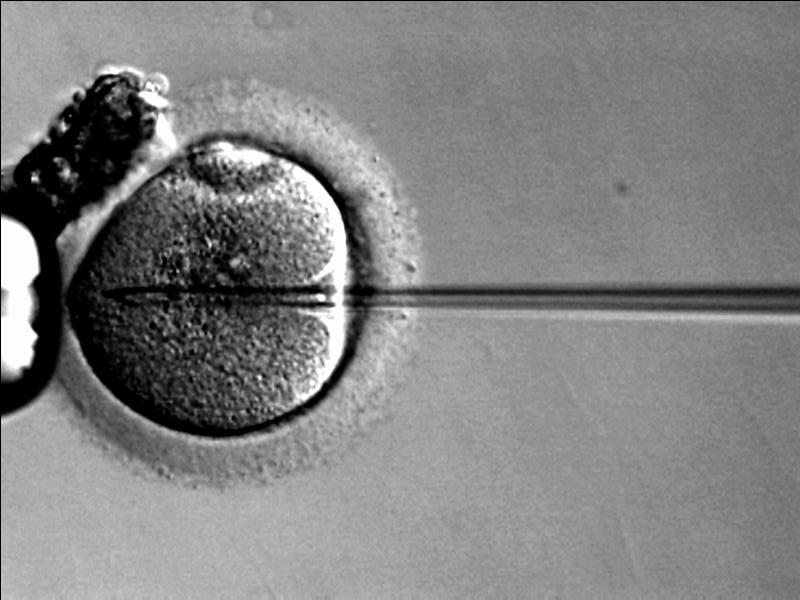
Intracellular sperm injection (ICSI) injects a sperm directly into an oocyte (see left). It's used for very abnormal or poorly motile sperm and low sperm count. It replaces part of the sexual act and is not licit; do not participate, although you may observe.

Embryo transfer is a slightly hot topic within bioethics. However, I don't see it as that contentious. Fertilization has already occurred, and the sex act has been totally replaced. The local motion of the embryo into the uterus is actually a step in gestation. It seems that ET, therefore, is not illicit and you should actually rejoice that an embryo is being given its rightful place instead of being condemned to that "absurd fate" of cryopreservation.

INVOcell is a new technology being marketed as "mini-IVF," and it basically replaces the embryology lab with a small plastic capsule carried inside the patient's vagina during a several-day incubation period. This conserves funds used to pay an embryologist, maintain sophisticated lab incubators, and maintain multiple federal standards. INVOcell still involves removal of the egg from the patient or use of a frozen egg, masturbation or sperm donation, fertilization outside the body, and ET. It can still involve PGD and embryo destruction or cryopreservation. Treat INVOcell as you would IVF.

Third party reproduction is use of a gestational carrier or use of donated gametes. As a trainee, there is little to nothing you can do about it, as most couples will come to their REI already with a gestational carrier in mind or will elect to use donated gametes without your counseling. If offered the opportunity to counsel on third party reproduction (especially gestational carriers), offer the patient the complex legal truths surrounding these entities, and recommend they speak to a lawyer, to trusted friends and spiritual leaders, and to seriously consider the possibility of adoption.

Transgender medicine is a misguided effort to alleviate real suffering that individuals feel due to a mismatch between their phenotypic sex and their psychological perception of their gender. Hormonal treatment in these cases, like in cases of fertile women seeking contraception, is manipulation of a healthy organ and not medicine. Surgical transition is mutilation of healthy organs. Do not participate.

Sexual Health

There is a lot of material in treatment of orgasmic disorders that amounts to pornography and masturbation. You may teach a woman the location of her own organs with diagrams and even with a mirror, but be very careful to maintain clinical professionalism and (obviously) always have a chaperone in the room. You may explain the function of these organs and how women experience orgasm (including how they experience it differently). With the magnificent teachings of the theology of the body, reassure women that sex is good, that it is meant to be enjoyed.

You may recommend a patient to psychological or psychiatric services for comorbid disorders. Be careful when recommending her to mental health services simply for her sexual dysfunction, as they may recommend illicit methods to become more comfortable with sexuality. Do not refer her to explicit websites or video series. Do not recommend self-stimulation. Do not recommend experimentation with more than a spouse.

Psychiatry

A relatively prominent problem that has come up since I've started this blog is quality of psychiatry services. Some mental health professionals, especially those who adhere to the whims of the APA, not only have incorrect ideas of sexuality but also have incorrect ideas spirituality and medications. Others are incompetent.

I've seen OB/GYN residents and fellows of all stripes struggle with conflicts with consultants. Bottom line is: if you don't think the provider will offer benefit to your patient, don't consult them. Consult someone else. If there is no one else, use experts available in other venues (online, prior institutions) to answer your clinical question.

Vulvar care

As with sexual health, anything amounting to masturbation should be avoided. In general, the other meds, lubricants, behavioral modifications, and hygiene counseling in vulvar care is licit.

End-of-life (GYN oncology)

Futility of surgery: many, many times residents in my program have operated while not being excited about it, although we're young and maybe don't understand everything. If your conscience moves you to protest a surgery based on a patient's medical fragility, say so and consider escalating it to the ethics committee if you have an appropriate way to do so.

Some oncologists do not give percentages for success for treatment unless a patient asks. Others always deliver expectations. If a patient asks for a percentage of success, always give an evidence-based, up to date number or offer to ask someone for the answer and do not rest until the patient gets an answer or says she doesn't want one after all. If you believe someone is being led to chemo or to hospice out of a wrong idea of percentages of success or failure, ask the attending and ask the patient what their view of the situation is, before wading in.

Ethics committees are great except when they're ineffective or pancretist. When faced with an ethics committee that cannot find the moral truth, many trainees are powerless. It is licit to withdraw your opposition in the face of impossible odds, but it is best to make it clear that you still maintain your position and beliefs.

Hospice is great except when its not. Sadly, since I've started this blog I've realized that not all hospice programs are focused on the patient's autonomy. If hospice personnel at the program that will be covered by the patient's insurance demand code statuses that the patient does not want, or demand POLST or other documents the patient does not want, offer to provide similar services (e.g. narcotic and benzo scripts, DME scripts, megace/nutritional scripts, anticholinergics) through the resident clinic or another venue. Never participate in physician-assisted suicide. Counsel actively against it.

Wednesday, December 4, 2013

Bizarre, Unsurprising, Pitiable, Absurd: a lecture on Homosexuality

I went to a mandatory lecture about homosexuality. (It wasn't relevant to medicine, although it was supposed to be.) My notes on his lecture have three phases: dutifully recording the bizarre but natural consequences of his ideas, pity for a man who was still clinging to an outdated and dystopian revolution, and shaking my head as he reduced himself to the absurd.

Big Surprises: NOT.
  • The lecturer admitted freely and happily that the LGBT community was vague. (The T was added in the '90's, another T for T-squared added shortly thereafter, then I for intersex, then Q for questioning and another Q for queer....) No one could agree on what the community was really made up of, or who should be in or out, or whether membership was permanent, or whether people who didn't want to be in were in based on criteria that admitted others who wanted to belong. No surprise to me and to anyone who knows what separation from objective truth can mean. Look at the fallout of the Reformation! Of course legitimizing a falling away from man's natural inclination will result in chaos.
  • He discussed the possibility of "polyamorous communities," or "open marriages" (his words). Again: surprise? This is an old reality with a new name. It used to be called cheating, but it's the new normal. I can forsee it happening very soon, since the youth who grew up in the hookup culture (basically a culture of polyamour) will likely live the same habits later in life. The sad thing is, love with many is love with none. When human love isn't exclusive and irrevocable, it's not love.
  • Still on the topic of "open marriages," he said that marriage is "not just for individual beauty...but also for children," meaning that consenting adults should reap not only the enjoyment of sex, but the enjoyment of children, too. But in this, he subtly states that children aren't individuals. He next stated that "open marriages" would involve "lots of complexity that kids have to deal with." Again, no surprise: we have been treating children as less than human for nearly half a century: first, the unborn, then, the born. Now, we just speak about it openly.

Forty Years I endured this Generation. That's Enough.
  • "The whole notion of labels [is] melting before our eyes...beginning to thaw and melt away." When the lecturer said this, I simultaneously pitied him and felt anger. I pitied him because he's so behind: that battle cry rose almost a century ago and now plays as cheap background music in the minds of everyone under (at least) forty. And I was angry, because this attitude has played out its destruction on my generation. The lecturer said, "my goal is to disrupt society" and "deconstruct statutes." But society is already deconstructed. My generation might say to the lecturer's, "We were raised in divorces or among divorces, breathing relativism and drinking perpetual self-absorption and agnosticism about everything except opinions and sensation. What else would you like to deconstruct?"
  • Around this point in the lecture, I wrote in my notes "So Marxist!" And one inch lower on the paper I wrote: "Two minutes later he brought up Marx. [The lecturer] studies [Marx] and says he doesn't believe everything of it." Whatever.
  • And then, because this man happened to be a lapsed Catholic, we got a good dose of pancretism, or the choice of religion based on preference of accidents (the lecturer liked Episcopalianism better for several reasons). Yawn.
  • The lecturer condemned "the puritan U.S. division of sexual and spiritual," and I was happy to hear it, since puritanism is one of the great errors of our time. But (as with his quotes about thinking deeply) this didn't pan out, since his next idea was excitement about prostitution. At this point in the lecture my notes became frustrated question marks. See above for how my generation is already living prostitution. Again: thanks for the errors.
  • "Language is unintelligible," he said, and I can't remember what he said that about. I wanted to snort, "language isn't the only thing that's unintelligible," and not in an ad hominem: nothing is intelligible in relativism. My first question to my peers who want to talk about God is always: do you think we can know anything? (And then, "how?" or "why not?" or "how do you know that?")

Nonsense is Nonsense
  • He did such an elegant job of characterizing his position as nonsense that I felt my job was done. He specifically said that this is a first world problem.
  • "Other" on forms that list "male" and "female" as genders is offensive. I was so close to laughter.
  • In Angels in America, the homosexual patient tells the doctor his diagnosis by the end. He thinks that's a great ending; in a way, so do I. It says outrightly, "we assert our statement over the truth," if you take the physician as the art of medicine personified, a symbol of the objective way the body works.
  • He used the word "tragedy" that we did not accept those who did not identify as male or female. Tragedy is a word I use more carefully.
  • "Gender and sexuality [are] entirely separated for us," he said, speaking for the LGBT community, I guess. "But that doesn't mean anything." ???
  • The lecturer was saying that about 1% of children are intersex, based on some ridiculous data counting boys with hypospadias as intersex. "I personally tend to believe this literature," he said.
  • On the last page of my notes, I have written in large handwriting (which happens when I get angry), "WHY are we talking about the ordination of women??" The lecture had devolved and I felt like I was in a Catholic-bashing fest. He exhibited one of his own paintings, which featured a photo of The Ecstasy of St. Theresa, various pornographic photos, and unconsecrated hosts (covering the genitalia of the naked figures). I was upset, but also felt vindicated. I am proud that the Church is ridiculed in the rejection of the truth: she stands with her Spouse.
  • The lecturer's last advice: find a community that allows your behavior. But that is backwards. We go into communities to become happy, fulfilled, perfected people, not children.

Sunday, February 24, 2013

Coffee with the Culture

Based on a coffee I had with a classmate the other day. All I did was omit her name.

The other day I met up with the Culture for coffee. She picked the place: it was a fashionable, relaxed coffeehouse, with catchy rock playing so softly that unless you listened, you would miss the profanities woven into the lyrics.

We got our steaming paper cups and sat down opposite each other at a round little table near the center of the room. Since we were only acquaintances, so I asked about her day. It was busy, she said; she'd been interviewed. I told her I'd been studying most of the day, and I didn't mention that I went to Mass that morning.

I asked about her background, to get to know her. She was very educated—in engineering, neuroscience, and medicine—but had complaints about the U.S. educational system, that no one learns to think. She wants more people to study philosophy and spoke much about recent scholarship and discoveries about older cultures. The books she recommended to me all sounded interesting, but they all sounded like negations of past assumptions. (I guess that's what still sells.) They all sounded like history and sociology, not what I know as philosophy.

Her mother identified with one religion but supported her when she chose to follow no religion at all, keeping only some remnants of her culture's behavioral standards. Her father was not much a part of her life. She'd chosen no religion, and told me she would never indoctrinate her children. "No scripture is true," she said once or twice. I felt like I was being used for archery practice and started praying with my fingers in sign language under the table. I l-o-v-e Y-o-u. I l-o-v-e S-a-c-r-e-d S-c-r-i-p-t-u-r-e.

Currently her studies were focused on medical ethics, she said. She spoke about conscience boundaries and patient autonomy (a few more arrows, right to the heart). She spoke about changing cultures and values, and the need to adjust what physicians are expected to do to include not only contraception and abortion but euthanasia. It was, after all, only a choice that should be available to patients. She was permeated with relativism. I didn't turn anything into a debate, but when she literally said, "there are no absolutes," I pointed out that this is an absolute. She seemed mildly confused and thought that she must have made a misstatement.

But she was polite and asked me about myself. I told her that I had a bachelor's in liberal arts and studied philosophy and theology; as usual, I expected that she didn't know what I really meant. And she didn't. How could she? I studied the objective and absolute truth and began to learn to find it; she does not believe that such a thing exists. To her I have a bachelor's degree in Fairies or Heliocentrism. I had to work to avoid feelings of embarrassment whenever she mentioned a philosopher that I hadn't heard of, since I spent most of college reading Aristotle, with a few landmark treatises before 1900.

Our conversation touched practical ethics, too. She told me how appalled she was to learn that a certain pro-life physician she'd discovered did prenatal ultrasounds and hid bad news from patients (fearing that they would abort). She though this was horrible.

Happy to find some ground for agreement, I agreed that he was not serving his patients well. (I didn't state why I thought so, but I will for you: a good pro-life doctor should share what he finds with patients and refer them to perinatal hospice, so that they could prepare for the birth of their child and parent them well). I didn't go into my reasons because I had a burning question to ask her. "Is this behavior always wrong?" I asked her.

"Yes," she replied.

"But you think good is relative," I responded. "Why would this always be wrong?"

Many words followed my question, but no answer came with them. The right thing is dependent on circumstances and culture and values, but there are some things that she would never do and which offend her, and which...no one should do.

"I think there is one right thing and one happiness," I said, "and that's why some things are undeniably bad for everyone."

She was quick to say much about how different people pursue different things and that she doesn't agree with me. But eventually she asked me, "What is happiness?"

"Love," I said. We all hunger for it, and try to find it in all kinds of ways.

"And what is the opposite of love?"

I looked at her levelly. "Apathy," I answered. I wanted to explain more, but she did not want to hear it today.

As we left and went out to the parking lot, she was still puzzling that "nothing is absolute" is an absolute. But I am not sure if a thousand coffee dates would ever sway her, so deeply ingrained is everything. Finally, coffee and words are just occasions; grace changes and intercession and penance open the gates to it.

Saturday, February 16, 2013

We Should Stop Taking the Hippocratic Oath.

No, I'm serious. That title is what I think, not what someone else thinks.

The other day a classmate and I had a long talk about the Hippocratic Oath (read it here). She is a pro-choice relativist, but she will take the Oath because she maintains that paragraphs like
...I will neither give a deadly drug to anybody if asked for it, nor will I make a suggestion to this effect. Similarly I will not give to a woman an abortive remedy. In purity and holiness I will guard my life and my art.

I will not use the knife, not even on sufferers from stone, but will withdraw in favor of such men as are engaged in this work...
are clinical vignettes meant to illustrate general principles like nonmaleficence, and not to bind a doctor never to perform an abortion, give an abortifacient, or aid in suicide. This is understanding the Oath in its history context. (Meanwhile the immediately succeeding paragraphs, which state
...Whatever houses I may visit, I will come for the benefit of the sick, remaining free of all intentional injustice, of all mischief and in particular of sexual relations with both female and male persons, be they free or slaves.

What I may see or hear in the course of the treatment or even outside of the treatment in regard to the life of men, which on no account one must spread abroad, I will keep to myself holding such things shameful to be spoken about...
are literally binding.) She maintained that she understands the Oath and swears by it, while others (presumably like me) think they know what it means and take it ignorantly but pleased, bending it to their agendas. Taking the Oath is an appeasement to both sides.

The only study of the Oath I've had is Leon Kass' work and reading other Hippocratic works (his medicinal treatises). My classmates' position came out of lots of recent scholarship (i.e. 1980s, around Kass' time), and it makes up the body of the official presentation on the Oath to the first years.

My response to her was: why are you so attached to this Oath? Who cares about Hippocrates, or his culture (about which we obviously don't know everything, about which people disagree, and which you rightly point out is so different from ours)? Why shouldn't we just swear what we mean? On graduation day, you can swear what you told me you think the Oath means:
I will do no harm.
(Which isn't in the Oath anyway, it's in the Epidemics and in later European medical humanities. Stop being so Western-culturist.) Maybe you will also add some of the other things you told me:
I will never allow my personal beliefs to get in the way of what a patient wants. I will never indoctrinate anyone. I give them all the information and options and allow them to make a free choice, for the contrary is absolutely abominable (although good is relative).
You can swear that. I will swear this:
To God and all men, I profess that I will fulfill according to my ability and judgment this oath and this covenant:
I will improve or palliate the condition of the sick, treating each as a whole human person for their benefit [because beneficence is primary] according to my ability and judgment. I will do no intentional harm [because non-maleficence is secondary].

I will actually not give a deadly drug to anyone, nor will I make a suggestion to this effect. Similarly I will actually not give to a sexually active woman an abortifacient (including hormonal birth control, IUDs, emergency contraception, or RU-486) or perform an abortion on a pregnant mother. Further I will actually not prescribe any contraceptive.

In purity and holiness I will live and practice. I will not exceed my competence. Wherever I work, I will work for the benefit of the sick, remaining free of all intentional injustice. What I may see or hear about the lives of patients I will keep to myself, unless there is danger to the patient or to others or unless summoned by sufficient legal authority. I will honor my teachers and those with whom I work, and will treat the poor with special charity.

If I fulfill this oath and do not violate it, may it be granted to me to use life and this art unto my salvation and the salvation of others. If I transgress it and swear falsely, may You, O Lord, and my fellow men have mercy on me and forgive me.
I'm obviously not married to the Hippocratic Oath. It's fine, but it really doesn't capture everything. It was perpetuated for so long (through the Middle Ages) in Catholic cultures and their offshoots (including Islamic and Protestant cultures) because it was a very close approximation of Catholic teaching. Perfect? No! Misused after the Reformation in Germany? Yes!

The relativists are bending over to interpret it, the Christian doesn't think the literal interpretation is immaculate either...so who cares about Hippocrates? It's better that we be frank and say what we mean.

Tuesday, September 11, 2012

The Preceptorship Diaries

This post conforms to the blog rules.
During second year, medical students at my school are placed one afternoon each week in a physician's office to learn to take histories, perform physical exams, create assessments and plans, and document their work at a tempo that resembles real life. (This replaces the lovely take-your-time atmosphere of the simulation center.) I became really excited: finally, a chance to play doctor at a real pace!

I knew that my preceptor, Dr. F, was an internal medicine physician. Further, I'd heard that she gave an informal talk on superfoods and was going to come talk to the Holistic Medical Society (which is actually a cool group, when it avoids the hippie commune end of the spectrum and adheres to good practice using all available wholesome methods). Her name was Indian.

Her office was adjacent to an acupuncturist's (later she told me that she was also certified in acupuncture). I entered and was asked to wait in the waiting room while she got off the phone. This was unusual for a medical student (usually, I'm told to come right back), but I sat among the patients and quietly waited the short time until I was called back. I noticed that this office, like Dr. D's, attracted people like the doctor: Dr. F's staff and clientele were more brown than, say, Dr. C's or Dr. A's.

When I was called back, Dr. F greeted me warmly and sat me down in her little office. She asked me what my goals were for this preceptorship, for which I was grateful. Next, she discovered that I studied philosophy and theology, and asked me for a favorite scripture. I mentioned the Song of Songs, and recited the verse that appears when my alarm goes off in the morning ("Arise, my beloved, my beautiful one, and come!"). She was charmed, and hinted that she might look up the book on Google.

While I was describing TAC, she learned that I was Catholic. She asked me, "what do you think of diversity?"

I answered honestly, if in an abbreviated fashion. "It's beautiful," I said. "I haven't always spent time in the most diverse environments" (TAC had one black student?) "but I realize that people's different experiences and cultures are enriching." This was true, and largely the product of my summer with Dr. D. I left other thoughts about diversity unstated: its ascent to a replacement for true exchange of ideas in this culture is strange at best, and relativist at worst.

Dr. F smiled slightly, but then looked at me squarely. "I meant difference in religion," she said.

For an instant, I was at a loss. I gathered that Dr. F was something of a pancretist: she had a large carving of a Native American medicine man on driftwood in her office, she wore a tiny rhinestone angel pin, she had a calendar displaying a Hindu god, she promised to look up the Song of Songs, and she was asking me this question.

I could not lie. "While I believe that my faith is the truth, I cannot and will not treat others without the dignity they have as human persons."

Boy, that was hard to say! A little wall went up in her eyes after the first clause, and her next sentence started in a tone most professors reserve for the correction of a wrong thought. ("Well, hypertension is associated with atherosclerosis, but this question is actually asking something else....") I'm not sure whether this preceptorship will go as swimmingly as I'd hoped. Time will tell.

Wednesday, February 15, 2012

It does matter what you believe

This article is about EXACTLY what I felt during Spirituality in Medicine class: If You Want to be a Good Person, It Does Matter What You Believe. DARN KANT!
A team of sociologists, led by Catholic University professor William D’Antonio, recently published a survey that has gotten quite a bit of media attention, for it shows that many Catholics disagree with core doctrines of their church and yet still consider themselves “good Catholics.” For instance, 40% of the respondents said that belief in the real presence of Jesus in the eucharist is not essential to being a faithful Catholic. Perhaps the most startling statistic is this: fully 88% of those surveyed said “how a person lives is more important than whether he or she is a Catholic.” In a follow up piece in the Chicago Sun-Times, a reporter asked a number of people on the street for their reaction to these findings. One man said, “I’m a very good Catholic because I follow what’s in my heart, more than what the church tells me to do…”

As even the most casual student of societal trends knows, this sort of cavalier attitude toward doctrine is rampant, at least in the West. I dare say that most people in Europe or North America would hold some version of the following: as long as, deep down, you are a good person, it doesn’t much matter what you believe. The intellectual pedigree of this popular idea can be traced back at least to the 18th century German philosopher Immanuel Kant, who held that religion is fundamentally reducible to ethics. All other forms of religious life and practice—dogmas, rituals, liturgies, sacraments, etc.—are meant, Kant thought, simply to contribute to upright moral behavior. In the measure that they fulfill this purpose, they are acceptable, but in the measure that they contribute nothing to ethics, they become irrelevant, even dangerous.

I would argue that what is truly dangerous is precisely the bifurcation between doctrine and ethics that Kant inaugurated and that has become so ingrained in the contemporary imagination.

Read more here!

Monday, February 13, 2012

Emptiness and Medicine

I have been meaning to post about how this Spirituality in Medicine class has been sucking the life out of me. The last assignment for this five-week class includes a survey, and here are a two of the questions and my answers.

Discuss the impact of the movie Patch Adams.
I enjoyed the movie because Patch reminded me that I want to help people by being an ordinary person, not a computer full of facts. But as I watched the movie, I realized that this class would not be what I was expecting. In this class, “spirituality” meant compassion, gentleness, humanity, and respect for others. These are all good qualities of human nature, but I thought “spirituality” always implied something above nature (not unnatural, but supernatural).

Discuss any insights or new ideas you have gained through this course- anything that you didn’t like or that struck you as particularly meaningful.
I appreciated the forthright manner that the course director took, acknowledging that talking with patients comfortably about things beyond medicine is vital to good care.

But throughout the course I felt that no presenter believed their religion was the only true one. Perhaps because I strongly believe this about my religion, the class began to drain me and I started to dread going. I am glad I took this class, but am also glad it is only five weeks long.

I am also wondering why Dr. C gives a presentation. We asked her if she used spirituality, and her answer was “not really.” In fact, I was hurt by her statement about the Catholic Church “thinking the world [would] end” if she didn’t go to Mass on Sunday (a serious obligation, a precept of the Church), which mocks the Faith that I love.

I am grateful, though, to have learned how to confidently speak with patients about their beliefs, as in the spiritual history.
Similarly draining was the annual College of Medicine Faith Panel, held to give medical students information on what patients of different faiths need and want. The panelists included:
  1. A sikh M4
  2. A buddhist undergrad
  3. A Lutheran vicar (in training to be a pastor)
  4. The pastor of my parish
  5. A Jehovah's Witness elder
  6. A rabbi
  7. A Muslim student
  8. An atheist (whom you've met before; I went home crying.)
Jesus, Mary, Joseph; save souls!