Let me tell you what it's like to be a Catholic millennial.
I am an older millenial, who remembers the days of dialup, and I'm obviously stuck in the past of the individual blogger. I remember the language of the "new springtime in the Church," the new Advent, language of the 90's and early 2000's. But I didn't realize that during my lifetime, the Church would have to pick up so many pieces we didn't know existed after the sexual revolution and after Vatican II. No matter what you think of the council, you have to acknowledge that we have a nuclear fallout level of cleanup to do. This post catalogs my realization of the size of the work to do, and my thoughts about it.
Some people may have realized that Vatican II would lead to radically irreverent liturgies (think "clown masses"). That is a travesty, but it's largely over. The disappearance of these liturgies was more or less spontaneous: there were outcries, there were reprimands, there was unhealthy silence on the matter, and then the people interested in those types of things left Catholicism behind in favor of openly irregular parishes, non-Catholic charismatic communities, or life without religion. Every time that something like this happened again (beach Mass, dog "receiving communion," etc) the conservative whack-a-mole arose again, but its machinations usually weren't needed. Slowly, parishes and parishioners that favored those things aged. Even now, those ideas and that architecture are being phased out.
A residue of bad architecture, bad catechetical materials, and liturgical carelessness remains. A casualness about parish announcements, extraordinary ministers, and the Real Presence persists. Even priests who would never experiment with the Mass ended up committing subtle and not-so-subtle irreverences and liturgical abuses, probably through poor formation. Mass even without gross ("clown") irreverence is, in most English-speaking Novus Ordo rites, celebrated more like an important human tradition (think Memorial Day salutes to the dead) and less like an act of divine worship (think Crucifixion). It's hard for priests to fight this, although for the good it is becoming easier and they are making it easier for others.
Some unexpected effects of the radically irreverent liturgies include the steep rise in unbelief among those who still call themselves Catholic. This seems stranger to me than those who want the moniker but want contraception or divorce. The Real Presence is an entirely intangible belief that (while difficult) has no real-world perceivable gains by its denial, as might contraception or abortion. Why are we denying it now, all these years after the Enlightenment has taught us that the physically measurable and useful is all that is? Why now, all these years after much of protestant theology has made Christianity out to be symbolic and practical for prosperity? I see it tied to a failure in orthodoxy and orthopraxis. We didn't do it or say it (lex orandi) and we don't believe it (lex credendi). Humans are cultural animals: when we aren't inculcated to the truth, it's much harder to grasp.
Another unexpected effect of radically irreverent liturgy is the fragmentation of conservative liturgical groups. The more decades pass between the origin of the SSPX and the present day, the more difficult it becomes to untangle all the events, souls, and teachings (both praiseworthy and troubling) involved. Add the FSSP and various media outlets (Church Militant, the Remnant) and it's a dizzying cacophony of voices that all want orthodoxy back, but are opposed to each other in various ways for various reasons, whether good or not.
In the aftermath of Vatican II, there was an enormous breakdown in trust in an authority, followed by the unveiling of significant scandal which further compromised current ecclesial authority. This breakdown in trust seeds discontent among allies, a purism that makes it hard to work together. This not only affects Catholic organizations, but others of similar mission, such as pro-life organizations. Certainly, many good ministries and collaborations have arisen, such as the Ruth Institute and Women Speak for Themselves. But so much damage has been wreaked among the most important organizations, such as SSPX and groups of sedevecantists, has been far more deleterious than the perceived benefits from other organizations. In particular, I have perceived a rise in sedevacantism since Francis became pope. I imagine this is like what St. Augustine felt among the Manicheans or Pelagians, or St. Nicholas among Arians. When I meet one who says he is "Catholic," is He like me? It is a very wounded Church we live in.
And I predict that after covid-19, Mass attendance in many parishes will drop even further. Where there is no belief in the Real Presence or the authority of the Church, why will there be Mass attendance when people have seen how little their lives are impacted without a homily on the values they hear about in TED talks or in the online sermons that were already being put out weekly by the nondenom church nearby?
Some parishes which are better catechized or more tightly-knit may not suffer this. But I expect this double blow (the "spirit of Vatican II" and the abuse scandals) has had and will have had far-reaching effects for parish life. It has had and will have effects in ministries like EWTN, Word on Fire, Church Militant, and others. Is had and will have more effects on individuals and their vocations to married life, consecrated life, and holy orders.
We will be picking up the pieces for a long time, and we will discover pieces (like sedevacantism and conservative infighting) that we never expected to have to glue back together.
Showing posts with label theology. Show all posts
Showing posts with label theology. Show all posts
Monday, June 22, 2020

Monday, May 15, 2017
A Plea for SSPX
My coworkers are primarily practical atheists. But even most of my Catholic friends find it hard to get all the Catholic culture right. Not everyone can keep FSSP and SSPX straight, or Miles Christi and Regnum Christi separate. I guess I should be glad they have heard of Dominicans. There are few that know about Carmelites.
 Honestly, there is a spectrum of knowledge of Catholic gossip. A few of the retired virgins I know seem to be familiar with every bishop, cardinal, church scandal and church document, and they will remark on what each one has said about each other one. Honestly, I don't know what Cardinal Sarah said last Tuesday or that such-and-such did an irregular thing and now has such-and-such canonical status. Not that it's bad to care about these things. The Church is the way to salvation and the mother of souls. Of course Church happenings matter. But I don't keep track of a lot of them.
However, there is something that is near to my heart. I love the extraordinary form. Irreverent and ill-prepared liturgies make me sad and angry. I have had classmates and coworkers in SSPX. So for my part, I would love for SSPX to come back into complete union with the larger Roman Rite. Please, please help the rest of your brethren understand the majesty of the Eucharist. Please spread the patrimony of the ages built into the 1962 Missal. Breathe into us your love for chant, your attentiveness to God, and your awareness of the differences between women and men and children. It's more important than we can comprehend.
However, there is something that is near to my heart. I love the extraordinary form. Irreverent and ill-prepared liturgies make me sad and angry. I have had classmates and coworkers in SSPX. So for my part, I would love for SSPX to come back into complete union with the larger Roman Rite. Please, please help the rest of your brethren understand the majesty of the Eucharist. Please spread the patrimony of the ages built into the 1962 Missal. Breathe into us your love for chant, your attentiveness to God, and your awareness of the differences between women and men and children. It's more important than we can comprehend.
Saturday, January 30, 2016
Disagreeing Theologians are Doing it Right
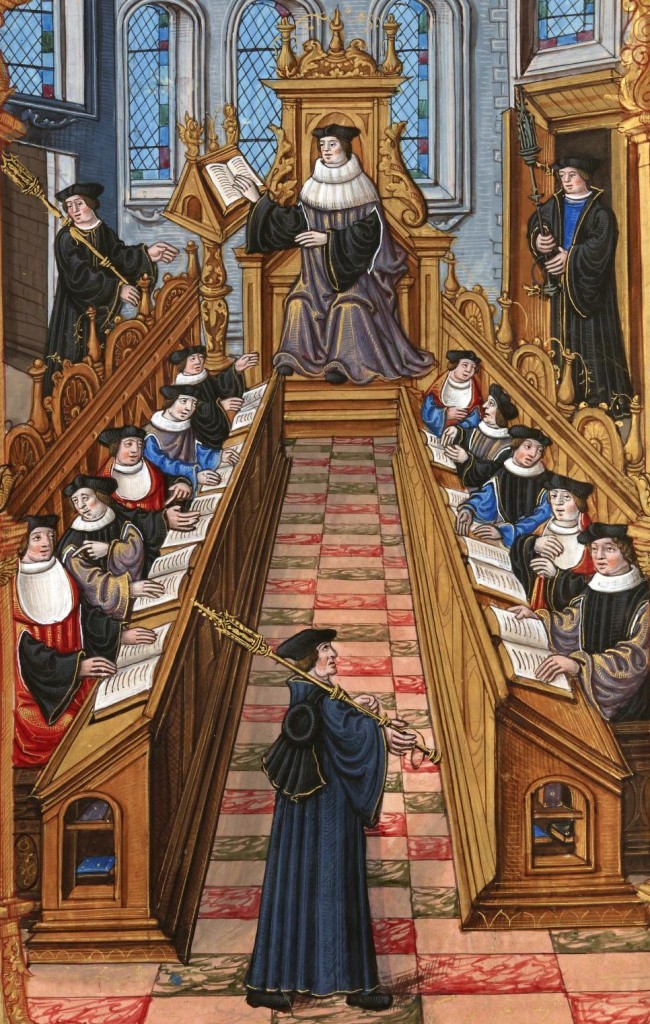 |
| All that fruitful disagreement is how we got universities! This is the University of Paris, circa the middle ages. Credit: Ex Urbe. |
Key points:
- The Church does not have doctrine about every procedure and situation. And that is okay. It's actually better to legislate carefully rather than redact hastily-promulgated stuff that wasn't well thought out.
- Faithful Catholics who have worked to form their consciences can discuss issues on which the Church has not spoken. It is even okay if they disagree!
- New scientific data can complicate the issue and that's okay, too! We shouldn't rest until we're confident about what we know.
- This patience, freedom, disagreement is extremely productive in the search for the truth, and often leads to the Church laying out doctrine.
- Theologians who are truly faithful will concede when they're wrong and adopt what's true, even if they don't understand it. Sometimes, they won't know they're wrong until an official promulgation or until more science comes out, but that's okay.
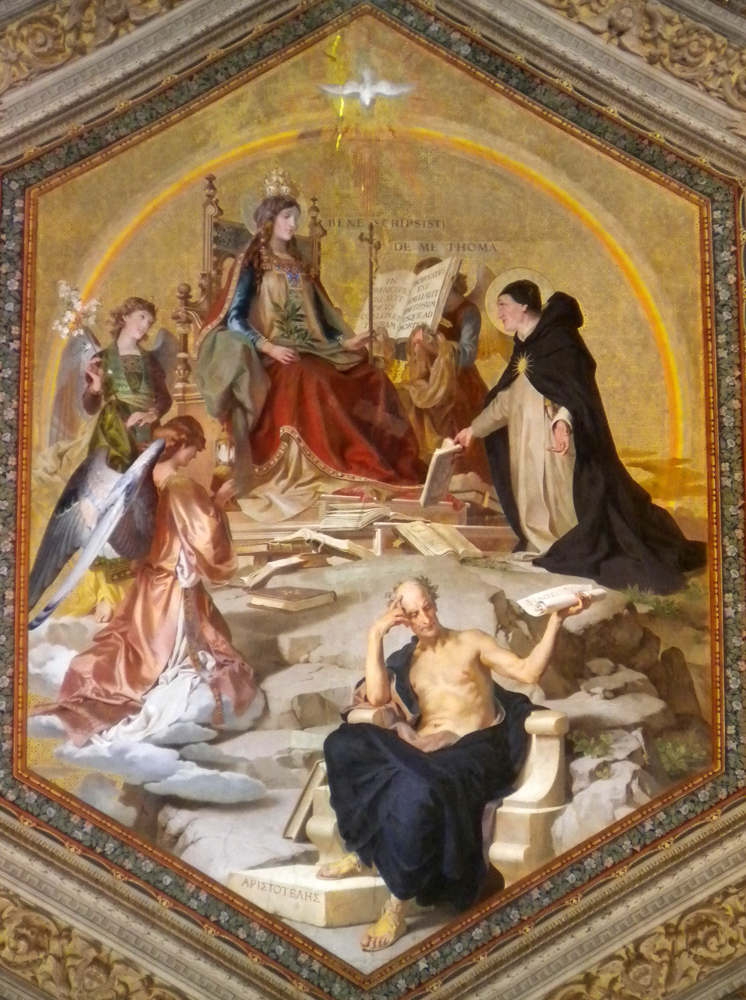
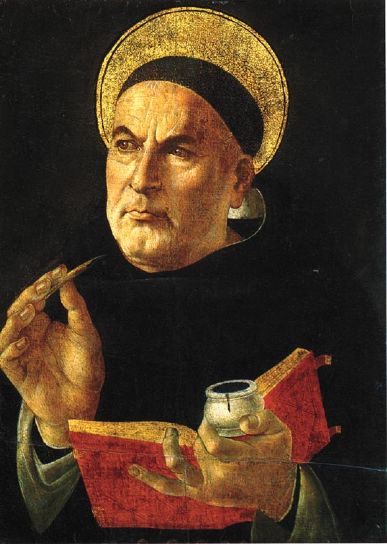
At left is a painting of St. Thomas presenting all his works to the Church (the female figure) who wears the papal tiara and sits in the light of the Holy Spirit. Yes, the man was wrong about when life begins, but he was a faithful son of the Church and the model for all theologians.
Postscript on blog data for 2015: number of posts last year was not bad, considering it contained my first six months of intern year. Sure, it didn't touch the absurd 136 posts I created in 2012, when I was just out of college and living fancy free as a medical student. (Twenty-one posts during one single month...what on earth did I have to say almost every day? And that happened twice that year!) I think my most valuable posts so far have been in 2015, as I've wrestled with ethical issues.
Friday, January 15, 2016
An Epiphany
This post is not about magi. It's about a revelation that is changing or might change my career.
Last time I posted asking whether you knew what Catholic teaching said about contraception. You may have been surprised to discover (or rediscover) that the Church has only said contraception is illicit within marriage. Although there have been many occasions to broaden this proscription, the Church has not done it.
Last time I posted asking whether you knew what Catholic teaching said about contraception. You may have been surprised to discover (or rediscover) that the Church has only said contraception is illicit within marriage. Although there have been many occasions to broaden this proscription, the Church has not done it.
I learned this at a local CMA guild event. Myself, a few other residents and a few attendings of various stripes (pediatrics, psychiatry, OB) gathered at the convent of the Religious Sisters of Mercy (who included pharmacists, a med student, two nurses, and one of the attendings). The topic, ostensibly, was birth control in the mentally ill. I went because I had patients like that on a PAG rotation in med school, and I have patients like that today.
But the conversation broadened to what Catholic teaching is on contraception outside of marriage. The facilitator pointed out that it has never been defined, although he stressed the issue of prudence in preventing promiscuity.
But the conversation broadened to what Catholic teaching is on contraception outside of marriage. The facilitator pointed out that it has never been defined, although he stressed the issue of prudence in preventing promiscuity.
We were all terrified, because none of us had ever realized this. One of the pediatric attendings thought that we should never discuss this--her "Catholic" hospital was already handing out condoms...how terrible would it be if they started handing out hormonal birth control! She was afraid that one of the nation's largest "Catholic" pediatric hospitals would suddenly start handing out birth control if they were better educated on Catholic teaching. How sad!
At the same time as I felt sad and afraid, I was also tempted to shrug. Why would a marginally Catholic institution that already doesn't care about God's will suddenly care about God's will when given new ground? A "Catholic" hospital that doesn't want to follow in God's footsteps will not care about "prudence" that would want to protect pediatric patients from promiscuity (or STDs, pregnancy, statutory rape, etc).
Still, argued the pediatrician, if we can keep the real boundaries of the teaching quiet, we can keep hormonal birth control from harming a few lives (in spite of the Catholic hospital).
I asked myself whether I should talk about this with others at all. Would I only create situations where people would be imprudent?
At the same time as I felt sad and afraid, I was also tempted to shrug. Why would a marginally Catholic institution that already doesn't care about God's will suddenly care about God's will when given new ground? A "Catholic" hospital that doesn't want to follow in God's footsteps will not care about "prudence" that would want to protect pediatric patients from promiscuity (or STDs, pregnancy, statutory rape, etc).
Still, argued the pediatrician, if we can keep the real boundaries of the teaching quiet, we can keep hormonal birth control from harming a few lives (in spite of the Catholic hospital).
I asked myself whether I should talk about this with others at all. Would I only create situations where people would be imprudent?
I decided to post about it because if we don't articulate what the teaching really is, we get pharisaical about it. We draw large margins of safety around established rules, which are burdensome and nonsensical. I found a few unfortunate examples of people who believed that all use of contraception is mortally sinful. (Although I have heard recent challenges to the Peoria protocol from the Linacre, so stay tuned.)
I feel like this is a big shift in my understanding of what makes up the culture of death. Contraception is not in the category of objective evil all the time, at least we don't know that it is. It's not per se like abortion*, against which I must fling my whole self because I understand it to be the taking of a human life. Granted, it still is contributing to the horrible idea that sex and procreation are totally different things, and that sexual life is for the self-satisfaction of two consenting individuals. It's still chemicals women don't always need. It's still a bandaid most of the time. But it's now a crutch without which some of us could be thrown into worse chaos.
If only I had a big glowing orb in the sky to tell me where to go.

*By this I mean that the act of using a contraceptive is not known to be objectively evil. Post-fertilization effects are akin to abortion.
I feel like this is a big shift in my understanding of what makes up the culture of death. Contraception is not in the category of objective evil all the time, at least we don't know that it is. It's not per se like abortion*, against which I must fling my whole self because I understand it to be the taking of a human life. Granted, it still is contributing to the horrible idea that sex and procreation are totally different things, and that sexual life is for the self-satisfaction of two consenting individuals. It's still chemicals women don't always need. It's still a bandaid most of the time. But it's now a crutch without which some of us could be thrown into worse chaos.
If only I had a big glowing orb in the sky to tell me where to go.
*By this I mean that the act of using a contraceptive is not known to be objectively evil. Post-fertilization effects are akin to abortion.
Saturday, January 31, 2015
Summa Fu
I sometimes forget how powerful my TAC education is. Then someone asks a "hard" question on reddit, and I can answer it. Thanks, God. Thanks, St. Thomas. Thanks, mom and dad. Thanks, TAC.
P.S. I'm working on posting all the backlogged posts since November. Sorry about that.
P.S. I'm working on posting all the backlogged posts since November. Sorry about that.
Monday, November 25, 2013
First Delivery!
 O I just got off 24-hour call, from 7:00am Sunday to 7:00am Monday. It was very eventful: I scrubbed in to four vaginal deliveries and two C-sections. And I delivered my first baby! And guess what his name was? I can't tell you because that would be breaking the law, but it may have been remotely related to one of my favorite people, and that made me really happy. Plus, the couple was really wonderful: the wife was beautiful, and was working really hard and keeping a great attitude the entire time. And the husband was kind and supportive, and when I handed him his child, he started to sniffle (hiding it as best as he could, which was not at all) and hadn't stopped sniffling when I left the room. They were young, and this was their first baby.
Positives and negatives: I also got shoved away (literally, my hand was boxed out of the field) from an earlier delivery, which was just although a little harsh. It was one of the interns' patients, and the intern had come on her day off between rotations to deliver the patient. I'd seen the patient before, and was just trying to do what our clerkship director told us to do by holding a sterile towel to the perineum. I'm constantly trying to find the "aggressive" that's looked upon as praiseworthy in surgical subspecialties; one one side is true getting in the way or overstepping what we're allowed to do, and on the other side is not getting experiences and looking uninterested or lazy. I guess my upper-level answered that question for me this time: get out of the way, this is the intern's delivery!
I was also in on a delivery where the mother had chorioamnionitis. The mom's body was palpably hot. The baby also had other complications like meconium staining and late decelerations. But her delivery was remarkable for a really supportive family.

Friday, September 13, 2013
My Brush with Euthanasia: Forget Not Love
Euthanasia is a terrible thing. I had a brush with it about a month ago while on a geriatric ward. This might surprise and scare you. Just to clarify, this actually happened. I am exaggerating nothing.I was reviewing an older patient's chart at the nursing station before rounds. This person was on dozens of medications. The home medication list was three pages long. Everything was carefully listed by doses, times, and routes (oral, otic, ophthalmic, topical, nasal...), but the sheer volume was overwhelming. On top of the drugs for medical and mental problems, there were various prescriptions and OTC remedies to cover side effects of the first drugs.
(If polypharmacy is new to you, then let me explain how these lists grow. A man of 64 on no medicines has some chest pain and goes to his doctor. He leaves with instructions to take a baby aspirin every day. And, because his blood pressure was high, he also leaves with a prescription for a water pill and a blood pressure medicine.
(Fast forward four years. Despite his daily three drugs, the man ends up in the hospital with a heart attack. He leaves with a stent, an antiplatelet agent, a pill for cholesterol, and an ACE inhibitor.
(Fast forward another eight years. Our man seems to be getting lost around the house and can't balance the checkbook very well any more. He's put on two drugs for dementia. Thyroid replacement is added because a thyroid test was high. His wife added a multivitamin, CoQ10, and glucosamine to keep him healthy after that fall he had last Christmas, and he also has nitroglycerin on hand, for that chest pain that started all this. He's now up to a dozen drugs, not counting any OTC painkillers, eye drops, or occasional antibiotics.)
Back to my story: I looked at the three page list of medicines in my hand, aghast. How burdensome this regimen had become for the patient and caretakers! What was this person's quality of life like, with so much intervention? This all seemed like artifice to replace the functions of a failing body. It seemed like torture to prolong a life. And for what?
I looked up from the page out to the patients beyond the nursing station counter. Half of the patients on this ward seemed over-medicated to me. They sat in their wheelchairs unaware of their surroundings. Other professionals I had learned from, including very compassionate hospice nurses, liberally took patients off medicines toward the end of life. I liked this palliative, simplifying approach. Too much medicine is a cloying thing, a clinging to numbers or days. I thought to myself, "why not just take this patient off everything and let her go peacefully?" No more surprise bruises from aspirin, no more dizziness from the blood pressure pills. No more bother with all these pills and suppositories and drops.

"What if," I thought, "What if we just gave a little too much of something?"
Immediately I was alarmed. Where did that thought come from? Did I just suggest to myself that I should euthanize a person? I had. I was thinking about giving something (e.g. a benzodiazepine) to let her just slip away. I was horrified at the thought I had just produced.
How did I get to that point? I was thinking about burdens and quality of life! How did I go so far astray?
Looking back, I realized that in the few days I'd worked on that ward, I had taken on the attitude of the attendants there. They shouted at the patients from their chairs in the nurse's station and loudly talked and laughed about them like children or animals. Giving medications in such big and complex regimens was a chore. They didn't love. And although I detested this and really couldn't wait to be off that ward, it rubbed off on me! Writing so many orders--what a chore! Working on this ward--what a burden! So, as I was looking at that medication list, I was not loving the person, even though I was pitying them.
And as soon as I forgot about love, I forgot about the meaning of life, the dignity of persons, the mystery of each soul's holy journey, and the importance of suffering in salvation. Who knows whether that person on three pages of medication was becoming a great saint or mystic? Beneath the shroud of dementia and crippled limbs, under the veil of an incontinent, flailing old woman, perhaps God was adorning an exquisite saint. Perhaps in heaven her beauty and nobility will be breathtaking. And moreover, what if her suffering was saving my soul? Yours? Our country, our world? How could I dare to know? (Job 38 comes to mind.) Certainly, simplifying her regimen with palliation in mind isn't a bad idea, but I only safely stay in that mindset when I remember love.
So forget not love. It's a deadly mistake.

Saturday, August 10, 2013
There is so much unfinished philosophy of the mind.
I wish the Catholic Church was still shaping the world! The Middle Ages were so awesome. If the Catholic Church still informed the world, we would inquire about the ethics of a thing or theory before or very shortly after it was discovered/described/invented. And true philosophy would follow the natural arts and sciences, with theology (well served) flowering afterwards.
In my imaginary Catholic world, a physician treating mentally ill patients could have a pocket copy of the compendium of teachings describing how God works in, through, and for the mentally ill and disabled.
Sadly, this is not the case. Instead, I wander the halls of the psych hospital with question marks buzzing in my brain, wondering whether my patients can cooperate with grace or can receive sacraments. I will now have fun flouncing around in the fields of philosophy. Sorry to anyone who actually likes to proceed in an orderly fashion.
Psychosis and Choosing the Good
By nature, a human being has a body with many organs, and a soul with several faculties by nature. According to Aristotle (complemented by modern medicine) the faculties of the soul
Like the unborn and the elderly, the mentally ill have absent or impaired faculties. I suggest the common sense, the imagination, or the intellect is most affected in them. But does this mean they are not persons? No! Does this mean they cannot accept grace? No. (Their wills exist and can act independently of their intellects, perhaps like mine does when I make an act of the will to accept the God is Triune, although my intellect can only shrug and say, "well, St. Thomas said some true stuff about it, but I'm stumped.")
I tend to identify with my intellect. This is not a true or good thing, as seen above. I fall into the same error as our culture does--I need to be more humble, accepting that I am body and soul, matter and spirit. Even so, it is a smaller error to identify with one's intellect than to identify with one's body. The "best" error, the one closest to the truth, would be to identify with one's will. Maybe the attraction to identifying with the intellect (or will) is an old remnant of Eve's mistake, wanting to see herself like God (who is his intellect and will).
Body and Soul: We're Embarassingly One
How bodily we are! Scholastic education is awesome, but it makes me tend to think soul and body are basically separate. That's impossible to think in a psychiatric hospital.
Bodily illnesses have cognitive consequences. Liver failure? The poisons in your blood that your liver can't take care of will make you forgetful and disoriented. Brain injury, even so suble that we can't see it microscopically? Pseudobulbar affect causes people to burst into tears or laughter with the slightest provocation (or none at all). Schizophrenia is associated with decreased cortical mass. More obvious examples are Kluver-Bucy syndrome, Pick's disease, and frontotemporal dementia.
And mental illnesses have material remedies! I saw at least three patients with extreme and overt psychosis become connected with reality in a few days after giving them antipsychotic drugs! Pills can take away delusions and hallucinations. (One woman insisted that I call her First Lady Savior; I just saw her earlier this week and she is completely coherent and herself again. Thanks olanzapine.) The walls between form and matter are becoming preeeeeetty thin here.
Anyway, I just wanted to muse on these things, because I can't really start chatting it up about form and matter with my fellow medical students or attendings. (I never realized how awesome it was at TAC to sit down at a lunch table and talk about first principles.) Maybe this will jog some interesting thoughts in people and we can muse more in the comments?
In my imaginary Catholic world, a physician treating mentally ill patients could have a pocket copy of the compendium of teachings describing how God works in, through, and for the mentally ill and disabled.
Sadly, this is not the case. Instead, I wander the halls of the psych hospital with question marks buzzing in my brain, wondering whether my patients can cooperate with grace or can receive sacraments. I will now have fun flouncing around in the fields of philosophy. Sorry to anyone who actually likes to proceed in an orderly fashion.
Psychosis and Choosing the Good
By nature, a human being has a body with many organs, and a soul with several faculties by nature. According to Aristotle (complemented by modern medicine) the faculties of the soul
- special senses (e.g. taste, touch, proprioception),
- the common sense (no, not "common sense," but the common sense, which compiles sensory information into a whole),
- the imagination,
- the passive and active intellect, and
- the will.
Like the unborn and the elderly, the mentally ill have absent or impaired faculties. I suggest the common sense, the imagination, or the intellect is most affected in them. But does this mean they are not persons? No! Does this mean they cannot accept grace? No. (Their wills exist and can act independently of their intellects, perhaps like mine does when I make an act of the will to accept the God is Triune, although my intellect can only shrug and say, "well, St. Thomas said some true stuff about it, but I'm stumped.")
I tend to identify with my intellect. This is not a true or good thing, as seen above. I fall into the same error as our culture does--I need to be more humble, accepting that I am body and soul, matter and spirit. Even so, it is a smaller error to identify with one's intellect than to identify with one's body. The "best" error, the one closest to the truth, would be to identify with one's will. Maybe the attraction to identifying with the intellect (or will) is an old remnant of Eve's mistake, wanting to see herself like God (who is his intellect and will).
Body and Soul: We're Embarassingly One
How bodily we are! Scholastic education is awesome, but it makes me tend to think soul and body are basically separate. That's impossible to think in a psychiatric hospital.
Bodily illnesses have cognitive consequences. Liver failure? The poisons in your blood that your liver can't take care of will make you forgetful and disoriented. Brain injury, even so suble that we can't see it microscopically? Pseudobulbar affect causes people to burst into tears or laughter with the slightest provocation (or none at all). Schizophrenia is associated with decreased cortical mass. More obvious examples are Kluver-Bucy syndrome, Pick's disease, and frontotemporal dementia.
And mental illnesses have material remedies! I saw at least three patients with extreme and overt psychosis become connected with reality in a few days after giving them antipsychotic drugs! Pills can take away delusions and hallucinations. (One woman insisted that I call her First Lady Savior; I just saw her earlier this week and she is completely coherent and herself again. Thanks olanzapine.) The walls between form and matter are becoming preeeeeetty thin here.
Anyway, I just wanted to muse on these things, because I can't really start chatting it up about form and matter with my fellow medical students or attendings. (I never realized how awesome it was at TAC to sit down at a lunch table and talk about first principles.) Maybe this will jog some interesting thoughts in people and we can muse more in the comments?
Monday, August 5, 2013
An Open Letter to Christians
Dearest sibling,
Recently I attended a lecture by a man who claimed to be a deeply religious Christian but lived against some of its tenets. When an audience member asked him about the disparity, he shrugged off the difficulty as ethereal. "Look at Christianity," he said. "People have all kinds of interpretations and translations. Some people include books that others don't." He effectively said, "Christianity isn't one thing, it's a free-for-all, so I make of it what I choose. And that goes for any of my other actions! I do what I choose, and it is good."
Dear Christian, this goes against what we believe. We do not choose what is true and what isn't! We are chosen, we are added to the Lord--conformed to Him, made like Him! It is a beautiful, saving obedience. We know this, and we hope to spread this knowledge to others so that they, too, can be safe in holiness.
I call us to unity. We are giving scandal to the world by being so separated. We are lending credence to faults and sins that pain our Lord! We must stop it, and we must put effort into stopping it!
On my way to work I drive down a block with six churches of various denominations on it. Flanking both sides of the street and one right next to the other, they stand like detached body parts of a man horribly wounded. How can we stand to see our Jesus like this? I call us to knock on our brothers' door: knock on the door of the church nearest you and set up a meeting. Talk about what you have in common. Talk about unity in the next fifty years. Talk about stitching our Lord's wounds closed. And talk about setting an example of love, unity, and radical holiness to our world.
With a fond embrace and with Jesus among us,
Your sister in Christ

Dear Christian, this goes against what we believe. We do not choose what is true and what isn't! We are chosen, we are added to the Lord--conformed to Him, made like Him! It is a beautiful, saving obedience. We know this, and we hope to spread this knowledge to others so that they, too, can be safe in holiness.
I call us to unity. We are giving scandal to the world by being so separated. We are lending credence to faults and sins that pain our Lord! We must stop it, and we must put effort into stopping it!
On my way to work I drive down a block with six churches of various denominations on it. Flanking both sides of the street and one right next to the other, they stand like detached body parts of a man horribly wounded. How can we stand to see our Jesus like this? I call us to knock on our brothers' door: knock on the door of the church nearest you and set up a meeting. Talk about what you have in common. Talk about unity in the next fifty years. Talk about stitching our Lord's wounds closed. And talk about setting an example of love, unity, and radical holiness to our world.
With a fond embrace and with Jesus among us,
Your sister in Christ
Sunday, February 24, 2013
Coffee with the Culture

The other day I met up with the Culture for coffee. She picked the place: it was a fashionable, relaxed coffeehouse, with catchy rock playing so softly that unless you listened, you would miss the profanities woven into the lyrics.
We got our steaming paper cups and sat down opposite each other at a round little table near the center of the room. Since we were only acquaintances, so I asked about her day. It was busy, she said; she'd been interviewed. I told her I'd been studying most of the day, and I didn't mention that I went to Mass that morning.
I asked about her background, to get to know her. She was very educated—in engineering, neuroscience, and medicine—but had complaints about the U.S. educational system, that no one learns to think. She wants more people to study philosophy and spoke much about recent scholarship and discoveries about older cultures. The books she recommended to me all sounded interesting, but they all sounded like negations of past assumptions. (I guess that's what still sells.) They all sounded like history and sociology, not what I know as philosophy.
Her mother identified with one religion but supported her when she chose to follow no religion at all, keeping only some remnants of her culture's behavioral standards. Her father was not much a part of her life. She'd chosen no religion, and told me she would never indoctrinate her children. "No scripture is true," she said once or twice. I felt like I was being used for archery practice and started praying with my fingers in sign language under the table. I l-o-v-e Y-o-u. I l-o-v-e S-a-c-r-e-d S-c-r-i-p-t-u-r-e.
Currently her studies were focused on medical ethics, she said. She spoke about conscience boundaries and patient autonomy (a few more arrows, right to the heart). She spoke about changing cultures and values, and the need to adjust what physicians are expected to do to include not only contraception and abortion but euthanasia. It was, after all, only a choice that should be available to patients. She was permeated with relativism. I didn't turn anything into a debate, but when she literally said, "there are no absolutes," I pointed out that this is an absolute. She seemed mildly confused and thought that she must have made a misstatement.

Our conversation touched practical ethics, too. She told me how appalled she was to learn that a certain pro-life physician she'd discovered did prenatal ultrasounds and hid bad news from patients (fearing that they would abort). She though this was horrible.
Happy to find some ground for agreement, I agreed that he was not serving his patients well. (I didn't state why I thought so, but I will for you: a good pro-life doctor should share what he finds with patients and refer them to perinatal hospice, so that they could prepare for the birth of their child and parent them well). I didn't go into my reasons because I had a burning question to ask her. "Is this behavior always wrong?" I asked her.
"Yes," she replied.
"But you think good is relative," I responded. "Why would this always be wrong?"
Many words followed my question, but no answer came with them. The right thing is dependent on circumstances and culture and values, but there are some things that she would never do and which offend her, and which...no one should do.
"I think there is one right thing and one happiness," I said, "and that's why some things are undeniably bad for everyone."
 She was quick to say much about how different people pursue different things and that she doesn't agree with me. But eventually she asked me, "What is happiness?"
"Love," I said. We all hunger for it, and try to find it in all kinds of ways.
"And what is the opposite of love?"
I looked at her levelly. "Apathy," I answered. I wanted to explain more, but she did not want to hear it today.
As we left and went out to the parking lot, she was still puzzling that "nothing is absolute" is an absolute. But I am not sure if a thousand coffee dates would ever sway her, so deeply ingrained is everything. Finally, coffee and words are just occasions; grace changes and intercession and penance open the gates to it.
Wednesday, February 20, 2013
God's Ideas and Turkey Sandwiches
Ash Wednesday was awesome. I stayed after evening Mass on Tuesday to help prepare the Newman center for the nine Masses said on Ash Wednesday. (Almost stupidly, in this culture Ash Wednesday is treated as a bigger deal than Easter even though it's not even a holy day of obligation. It's the sacramentals, I'm telling you. There's something about being marked that people really like.) I took unconsecrated altarbreads out of sleeves and packaged them in small quantities in ziploc bags, so that the priests would not overconsecrate at the Masses celebrated on-campus.
On that Wednesday after morning Mass, I went to class with marked forehead. Whenever I saw a classmate who also had ashes I'd gesture to my own forehead and say something silly, like "that's a good look for you," or "penance looks good on you." I even saw someone across the pump at the gas station with ashes, and we started talking about sacramentals! Crazy.
It also prompted some conversations with non-Catholic Christians, who also observe Lent and give up the radio in their cars or soda. It made me very glad that I know the Church's teachings about Lent: that adding prayer and almsgiving and fasting to remember that our only and ultimate desire is Christ, and that Lent has no value in itself, except as preparation for the joy of Easter.
And finally, it revealed some sad truths about a few of the Catholics in my classes. I spoke with one about Lent and found out he doesn't go to Mass. As soon as I found out, I took a step toward him as I started to encourage him to go. But he took a step back.
"Don't smite me," he said sort of jokingly.
And I took a step back again. "It's not about me," I said. And I gently and frankly urged him that this was nourishing to his soul. He was noncomittal about it, and shifted the topic back to Lent. I told him about prayer, fasting, and abstinence and what I hoped for: to focus constantly on Christ and love what He loves. "Because I want to be saint," I said finally.
 "A saint?" he repeated. And he playfully tried out saying "Saint" in front of my name, as though I were aspiring to the presidency or the papacy or something.
"But we're all called to be saints," I said. "We're all made for it, and it's possible for all of us. You, too!"
And he paused, but then only said in an admiring tone, "you're very free with your ideas."
"GAH!" I wanted to say. "My ideas?? That's God's idea!"
But the conversation shifted to studying for STEP. (I try to never corner people into talking about spiritual things, so I'm pretty practiced at shifting gears to lower things. In this case, it was easy because STEP is a big stressor, and stress and holiness are on a similar plane of interior importance.)
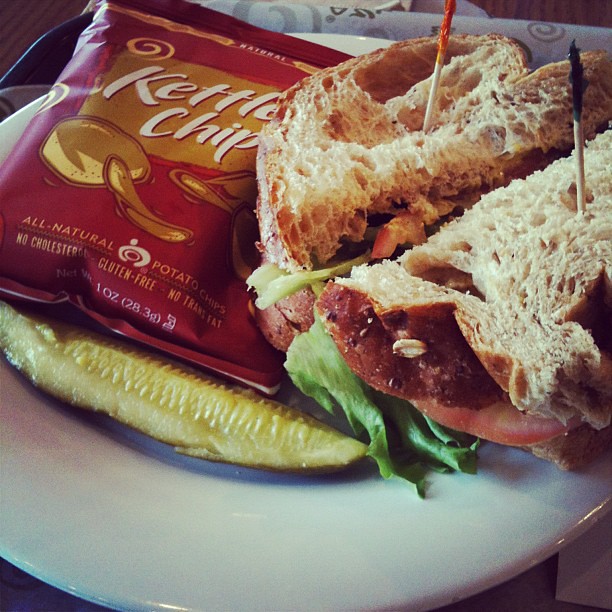
Later, I went to the free lunch we had that day that came with a healthcare system presentation. I had forgotten to sign up for veggie, so I peeled the turkey off my sandwich. As I did, I realized that the classmate next to me was a Catholic (he'd been to a CMA meeting and the White Mass), and I thought I recognized him from Mass.
"Did I see you at Mass this morning?" I asked cordially.
"Uh, no," he answered. "I haven't been to Ash Wednesday yet."
There was a pregnant pause, punctuated only by the sound of potato chips and sandwich paper.
I wanted to say a lot of things, first among which was "Seriously?" followed by "Do you....know that this is a holy day, not an event? And the event is called Mass.... Ash Wednesday is not that big a deal compared to, you know...the second Person of the Trinity truly present in the Paschal Mystery on the altar...." But the presentation was starting, so I simply tried to be obvious with my turkey-peeling, and said "Too bad this [gesture to sandwich] was on Ash Wednesday."
I wanted to say a lot of things, first among which was "Seriously?" followed by "Do you....know that this is a holy day, not an event? And the event is called Mass.... Ash Wednesday is not that big a deal compared to, you know...the second Person of the Trinity truly present in the Paschal Mystery on the altar...." But the presentation was starting, so I simply tried to be obvious with my turkey-peeling, and said "Too bad this [gesture to sandwich] was on Ash Wednesday."
"Yeah," he said, but he missed the hint.
Monday, February 11, 2013
Dark Diagnoses and Extraordinary Forms
A man came into the office, I saw him, and he left with a diagnosis that will either accompany him or hurry him along his walk towards death. And although he feared a diagnosis like that (or at least, his wife did), I truly don't think he expected to get it. His major goal of the day was to figure out what was wrong and fix it, so that he could get back to the way life was before his symptoms were bothering him. But instead, he walked out of the clinic with a dark diagnosis.
His 'dark diagnosis' is one of many that I store in a mental box in a corner of my growing art. Myasthenia gravis, multiple sclerosis, diabetes, some cancers, HIV/AIDS, hepatitis C, congestive heart failure, chronic obstructive pulmonary disease, etc. I am not the master of these diseases, but I am the one who sees the signs of them and shakily opens that slim black case and pulls out the corresponding diagnosis, handing it solemnly to the person as I introduce them to their unwanted companion.
Sorry for getting so very poetic so quickly.

And these dark diagnoses are a kind of death, because I must tell them, "Life is different now. I wish I had different news to tell you, but you can't go back to the way life was before."

I study this dark box often because these diagnoses have many effects and are chronic, debilitating, and common. Many times I had spoken with patients and they had said "and I have COPD" or "I'm diabetic." They already carried their darkness.

But I had never visited with someone, examined him, presented his case my preceptor, and heard that we must open that box. Hearing my presentation (which is made privately outside the patient's room), Dr. H's mouth fell open and he said with raised eyebrows, "You think maybe organ failure?" as if saying, "are you opening that black box?"
And I could have said, "Oh, no! Not that, not for him." I had though his symptoms were from a relatively benign condition. And I liked this patient. We were alike somehow, even though he was a huge man with the build of a sailor, a square jaw, and the bronzed skin and bleached hair of decades of work in the open sky. We had a good rapport. (Maybe because we were both choleric?)
But I instantly knew my preceptor was right: organ failure fit with the patient's story much better than my idea, although my idea was still on my differential. In that instant I swallowed my "No!" and answered aloud evenly and honestly, "I don't know, but..." and I continued with the presentation. I watched as every word I said corroborated Dr. H's diagnosis and the lid of that box opened wider and wider.
We walked into the room and I looked at the patient with different eyes. Now I recognized the signs of that diagnosis in him. Now I saw that he had a dark companion which he did not know about but I did. It was like I could see his future, and I saw that he would become a different man.
(Sadly or happily, this man didn't grasp the impact of that diagnosis. He was relieved to have a pill to start taking to fix the problem so that he could go back to work. Dr. H may have broken the news to him a little too gently for a man so choleric. But I won't go around asserting that I know how to break bad news better than a successful, experienced, and sensitive family doctor. I actually started to see the wisdom of Dr. H's approach: the patient may be more likely to come back for follow-up if he feels his goals were met. And coming back for follow-up is good for chronic and serious diagnoses. The impact of the disease might change based on how the patient fares in two weeks.)
And I can't help it: I have to draw a spiritual parallel because it's not actually a parallel, it's a true instance of what I'm talking about. We all have a dark diagnosis--much, much darker than anything in medicine's little box. The name for people with this chronic, hereditary, debilitating disease (the name for all of us): sinners. Our appetites are not the instrument we knew in Eden: they won't obey us, we can't rely on them.
 And alone with this condition, our future is completely black: we spiral down gradually to eternal death or separation from God, who is all that is loving and good. But God planned mercy, prepared us for it, and executed it beautifully by sending a Physician (or, better), the Cure Himself.
And now we work out the cure in our own souls day by day. Now we have to do special things and change the focus of our lives. And since it is simultaneously a kind of sacrifice, suffering, birth, death, heaven, hell, love, and is altogether of God, it sometimes takes extraordinary forms.
Wednesday, January 16, 2013
Med school strategies to learn the faith (A Summary of Dei Verbum)
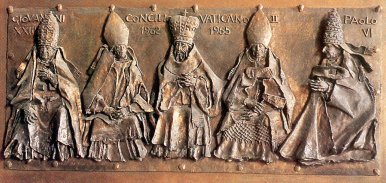
- Read this.
- Realize that Dei Verbum is so awesome and short that you should probably just read it now.
- Read the rest of the council documents.
Purpose of the document: following Traidition, to teach on revelation and how revelation is handed on in order to promote its spread and increase the theological virtues of the whole world.
Chapter 1 defines revelation. It is the act of the supreme and hidden Trinity to share with us Himself. This act is realized in human fashion: in history. God prepared us for the fullness of revelation from Eden through the entire Old Testament, and perfected revelation in Christ, who made clear by His every word and action that "God is with us to free us from...sin and death, and to raise us up to life eternal." There is no new public revelation forthcoming. Revelation includes truths that trancend human deduction as well as truths that reason can attain alone but with difficulty. Our response to this revelation is total, free submission, an act of faith which requires God's grace. Turning thus to God is a lifelong conversion, deepened constantly by the Holy Spirit.
Chapter 2 explains how revelation is passed on. From Christ's first charge of "preach to all men" to the Apostles, revelation has remained in its full integrity in sacred Tradition and sacred Scripture. both of these are from the same act of God and tend toward the same end. Tradition comes from the observances handed down to the Apostles from Christ and the Holy Spirit, passed thorugh their successors; Scripture is the message of Salvation committed to writing under the same Spirit. Scripture supports Tradition (see 2 Thess 2:25, Jude 1:3) and vis a versa. The two form a single "sacred deposit" which the Church treasures, contemplates, and serves: treasures by keeping its precpts and spreading its message; contemplates by continually growing in understanding its contents; and serves by exercise of the teaching office, which exclusively authentically interprents the Word of God. This last guards revelation scrupulously, listens to it devoutly, and explains it, faithful to the inspiritations of the Holy Spirit.
Chapter 3 epxlains the itnerpretation of Scripture. The Old and New Testaments have God as their author and teach without error His revelation. God composed sacred Scripture by choosing men who made use of their powers and, as true authors, wrote in human fashion with literary forms of their time, writing only what God intended. To rightly receive Scripture, its Truth must be searched out. This Truth coheres internally and with Tradition, but is variously expressed in texts of different times and styles. All exegesis is subject to the Church, which guards the word of God, "for the words of God, expressed in human language, have been made like human discourse, just as the word of the eternal Father...was in every way made like men."
Chapter 4 states the puprose of the Old Testament. It tells of God's works "to prepare for the coming of Christ, the redeemer of all and of the messianic kingdom, to announce this coming by prophecy and to indicate its meaning by various types." The New is hidden in the Old and the Old is made manifest in the New.
Chapter 5 states that the New Testament "stand[s] as a perpetual and divine witness" to the Word of God, who was made flesh to manifest God and draw all men to Himself. The fourfold gospel, a selection of the acts of Jesus, is of apostolic origin and faithfully hands on what He did and taught for our salvation. The other contents of the New Testament confirm and more fully state the true teaching of Christ (an example of the Church's mission outlined in Chapter 2), begin the history of the Church, and foretell her fulfillment.
Chapter 6 describes the place of Scripture in the Church. It is to be venerated, and maintained with Tradition the supreme rule of faith. It nourishes and regulates the Church (Acts 20:32, see 1 Thess 2:13), and since it is an encounter with her Bridegroom, she is eager to delve deeper into it. She recommends it as the foundation of all theology and preaching, and encourages all (especially theologians, clergy, and consecrated persons) to study it following "the mind of the Church." It should be made available to all (including non-believers and separated brethren) in various languages in order to spread the Word of God. Finally, all study should be accompanied with prayer, "so that God and man may talk together" and "we may hope for a new stimulus for the life of the Spirit from a growing reverence for the Word of God, which 'lasts forever.' (Is 40:8, see 1 Pt 1:23-25)"
Wednesday, November 21, 2012
Reading the Catechism is awesome.
 I signed up for flocknote's "Read the Catechism in a Year." We're now on day thirty-something and I am SO glad I signed up. At first, I expected that I would get behind and let the daily emails pile up in my inbox like all those 40 Days for Life messages and other action group mass-mails.
But happily, that hasn't happened. I've missed a day here or there, but it's simple to catch up and (honestly) it's really interesting reading. And it's going to get even better: I looked at the Table of Contents in the CCC I have on my phone, and this book has it all: the Trinity, angels, hell, morals, Mary, saints, apologetics.... I can't wait.
I had a few vague expectations when I signed up for this. Mostly, I thought, "I've always wanted to do this and it seems like something I should do." I had no idea how important a thing I was doing! Since I started reading the Catechism, I've realized at least two very important problems in my spiritual life.
Problem One: I think of the Holy Spirit more as a creature than as Creator. Somehow, in my imagination or thoughts, He is not as much God as the Father and the Son. Probably, this is a combination of several things, like:
- His name is less concrete. In our materialist culture (which I can't escape), what is "spiritual" or not a human being isn't real.
- He is always described last and often negatively or by exclusion.
- He is pictured more often as not human. A dove is more like a symbol than a person.
- My spirit-of-Vatican-II catechesis invoked Him so strangely that I've kept my distance since.
As a result, I think of the Holy Spirit as I do of grace (a creature), when in fact he is fully Divine.
Thank goodness I am reading the Catechism, which brought this mistake to light. I'm now working to erase this mistaken way of thinking by praying the Litany to the Holy Ghost (because I'm renewing my Total Consecration) and calling to mind his Divine power and personhood.
Problem Two: my faith is not very robust. I know it's not a sin to have difficulties, but about once a month I have a spasm of secular humanism that makes me think, "wait, Jesus is truly present in the Eucharist?" I wrangle with the thought, trying to bring out proofs and helps to bring my intellect back in line.
We had to take some online courses through the Institute of Healthcare Improvement open school (which, parenthetically, I highly recommend) and one of them was on workplace safety. A hospital/clinic that has a strong culture of safety, the module said, permits a janitor to say to the chief of surgery: "did you wash your hands?" Certainly, often the chief of surgery does the right thing and, in fact, does great things. But in a workplace that is really interested in the good of the patients allows the lowest, simplest person can say to the most senior and qualified, "don't forget the right thing."
Similarly, the highest powers in me (my intellect and will) often do right and great things, like studying theology, obeying my conscience, and loving others. But if I have a strong faith, then the "lowest" part of me (the little Catholic woman with her simple faith) can say to the highest (my intellect or will), "don't forget, God's existence is incontrovertible and He cannot lie."
I realized that my approach to the secular spasm is off: a woman of strong faith will simply say to those doubts, "Yes. Jesus is truly present in the Eucharist. There is no room for doubt." The Catechism helped me realize this by quoting Bl. John Newman's Apologia:
Ten thousand difficulties do not make one doubt.So, if you haven't signed up for flocknote's "Read the Catechism in a Year" it is time. You can catch up with the past month or so here and sign up here.
Monday, October 8, 2012
The Crisis of Modernity: The Past two Popes and the Church of the 21st Century
The first speaker of the CMA conference last week was George Weigel; this was probably vital since the conference had stolen its title right from Weigel's 1999 book A Witness to Hope: The Biography of Pope John Paul II.

Still being in student-mode, I took copious notes. Mr. Weigel, alluding to Alisdair MacIntyre, began by saying that our culture possesses the language of morality without theoretical or practical comprehension of what the language expresses. I vehemently agree! Post-Christian healthcare as it insists on human dignity and simultaneously affirms unbridled human autonomy doesn't realize what it's talking about.
To discover how we got into this situation, Weigel next reviews Marx, Bentham, and Hume: Marx, who thought that the good was some glorious society of men, the pinnacle of evolution; Bentham, that the good was the benefit to the greatest number; Hume, that morality could not be derived from reality. Granted, each of these develops into a different dystopia (for Marx, see 1984 or your history book; for Bentham, see Brave New World or the newspapers; for Hume, see both).
But all three had direct political and practical effects: morality, unrelated to reality, became arbitrarily or socially derived. Politics, unrelated to reason, became a business or utility. The purpose of life collapses into social or hedonist utility and the long-asked, bigger questions about beauty, goodness, and being become irrelevant.
Utility (not dignity) became the measure of a man's worth, because to dismiss these questions (as part of a dismissal of higher purpose, need for salvation, etc.) is to dismiss man's nature, designed to appreciate created and uncreated truth, goodness, beauty, and being. A dismissal of such a particular rational nature includes all that comes with it, including dignity, since man's nature alone (among material creatures) was made in the image of God.
This leads to "a pulverization of the fundamental uniqueness of each human person" (Henri de Lubac). Fortunately, the cure is well-known and easy, if long: we must daily confirm the richness of each person, founded on the Incarnation* and defended by true philosophy. Practically speaking:
Still being in student-mode, I took copious notes. Mr. Weigel, alluding to Alisdair MacIntyre, began by saying that our culture possesses the language of morality without theoretical or practical comprehension of what the language expresses. I vehemently agree! Post-Christian healthcare as it insists on human dignity and simultaneously affirms unbridled human autonomy doesn't realize what it's talking about.
To discover how we got into this situation, Weigel next reviews Marx, Bentham, and Hume: Marx, who thought that the good was some glorious society of men, the pinnacle of evolution; Bentham, that the good was the benefit to the greatest number; Hume, that morality could not be derived from reality. Granted, each of these develops into a different dystopia (for Marx, see 1984 or your history book; for Bentham, see Brave New World or the newspapers; for Hume, see both).
But all three had direct political and practical effects: morality, unrelated to reality, became arbitrarily or socially derived. Politics, unrelated to reason, became a business or utility. The purpose of life collapses into social or hedonist utility and the long-asked, bigger questions about beauty, goodness, and being become irrelevant.
Utility (not dignity) became the measure of a man's worth, because to dismiss these questions (as part of a dismissal of higher purpose, need for salvation, etc.) is to dismiss man's nature, designed to appreciate created and uncreated truth, goodness, beauty, and being. A dismissal of such a particular rational nature includes all that comes with it, including dignity, since man's nature alone (among material creatures) was made in the image of God.
This leads to "a pulverization of the fundamental uniqueness of each human person" (Henri de Lubac). Fortunately, the cure is well-known and easy, if long: we must daily confirm the richness of each person, founded on the Incarnation* and defended by true philosophy. Practically speaking:
- By applying Christ, our Remedy, we can heal. Therefore, promote the Sacraments and Scripture and transform our lives to be Christ to others.
- The culture is not neutral or permissive to passing on the faith. But don't just sit there pouting about it and feeling all righteous. Convert the culture, with a return to virtue ethics!
Long story short: great talk.
Sunday, August 26, 2012
Stepping over the Catholic Line
At one point, I assigned customs and people to points on a "Catholic line" between conservative and (eek) liberal. Guitars in the sanctuary used to make my skin crawl; I used to wince at Novus Ordo Masses in English; religious sisters in suits made me angry. My distraction would be so consuming that I would be unable to focus on the good.
But the more I listened to homilies at these Masses, spoke with these sisters, prayed for humility, read the lives of the saints, and calmed down as the guitars played, the more I realized I was wrong. I was being prideful.
(To the very conservative Catholics reading this: do not be afraid. The need for reverence will never disappear, the radical nature of priestly and religious life is not altered, and the objectively greater beauty of the old Mass is uncontested.)
I find this concept of a line in most Catholics' minds, but let me make it clear for anyone still confused:
On one side of the Catholic line, there are Masses said in the Extraordinary Form. There are religious in full habit (including priests in cassocks, nuns with wimples, and barefoot Franciscans), contemplatives behind grilles, and Latin chant without accompaniment. There's Lectio Divina and much liturgical reverence. There are old words (like "Matins") and a growing number of young people. There is intense devotion to God's will.
On the other side of the Catholic line, there are Masses in megachurches and spontaneous colloquy with God. There are youth ministers, Eucharistic ministers, and parish bible studies. There are lay apostolates, new orders in street clothes, and old orders in suits. There are guitars, lots of Adoration, lots of Theology of the Body, and lots of culture-engaging. There are old words (like "love") and a growing number of young people. There is intense devotion to God's will.
And the truth is: the line is a distraction. There are different customs, but one Church who strives to love her Spouse by every possible means. Striving authentically for this love and supported by our Lord's fidelity, how can She err? What about guitars can harm a Lord unconquered by death?
It's undeniable that there excesses called "liberal" and "conservative," and certainly so many examples come to your mind that I don't need to cite examples. (Canonically illicit lay clothing for religious, liturgical abuse, sedevacantism.... Oops, I just cited examples.) These are all true failures in devotion to Christ. But why should these make us allergic to legitimate devotion?
I am stepping over this line. I am not conservative or liberal. I am Catholic, charged with traditional and commanded to be open. I will boldly pursue this divine Bridegroom wherever He goes, unafraid of a few guitars.
 |
| Source: New Liturgical Movement |
(To the very conservative Catholics reading this: do not be afraid. The need for reverence will never disappear, the radical nature of priestly and religious life is not altered, and the objectively greater beauty of the old Mass is uncontested.)
I find this concept of a line in most Catholics' minds, but let me make it clear for anyone still confused:
On one side of the Catholic line, there are Masses said in the Extraordinary Form. There are religious in full habit (including priests in cassocks, nuns with wimples, and barefoot Franciscans), contemplatives behind grilles, and Latin chant without accompaniment. There's Lectio Divina and much liturgical reverence. There are old words (like "Matins") and a growing number of young people. There is intense devotion to God's will.
 |
| Source: Apostles of the Interior Life |
And the truth is: the line is a distraction. There are different customs, but one Church who strives to love her Spouse by every possible means. Striving authentically for this love and supported by our Lord's fidelity, how can She err? What about guitars can harm a Lord unconquered by death?
It's undeniable that there excesses called "liberal" and "conservative," and certainly so many examples come to your mind that I don't need to cite examples. (Canonically illicit lay clothing for religious, liturgical abuse, sedevacantism.... Oops, I just cited examples.) These are all true failures in devotion to Christ. But why should these make us allergic to legitimate devotion?
I am stepping over this line. I am not conservative or liberal. I am Catholic, charged with traditional and commanded to be open. I will boldly pursue this divine Bridegroom wherever He goes, unafraid of a few guitars.
Friday, July 27, 2012
First Year of War (or, The Old Testament Makes Sense)
As of last Thursday, I have officially lived in one place for twelve consecutive months (a feat I have not accomplished since high school).
More importantly, it has been twelve months since I began to pray the Liturgy of the Hours. I have been amazed by how relevant each day's prayers can be; by how well-suited the Ordinary is to the way my mind works; by how poetic the psalms and the Old Testament are; by how good God is.
I have a friend who tells me that the Old Testament "doesn't make jack for sense." Maybe he is thinking of passages like Psalm 149, which sounds lovely:
More importantly, it has been twelve months since I began to pray the Liturgy of the Hours. I have been amazed by how relevant each day's prayers can be; by how well-suited the Ordinary is to the way my mind works; by how poetic the psalms and the Old Testament are; by how good God is.
I have a friend who tells me that the Old Testament "doesn't make jack for sense." Maybe he is thinking of passages like Psalm 149, which sounds lovely:
Sing a new song to the Lord,until it turns violent:
his praise in the assembly of the faithful...
For the Lord takes delight in his people.
He crowns the poor with salvation....
Let the praise of God be on their lips,"Ugh," you might think. "God sounds disgusting; he unleashes his randomly-chosen favorites on everyone else, calls it an honor, and prizes it as if it's worship."
and a two-edged sword in their hand,
to deal out vengeance to the nations
and punishment on all the peoples;
to bind their kinds in chains
and their nobles in fetters of iron;
to carry out the sentence pre-ordained;
this honor is for all his faithful.
Sunday, July 15, 2012
Getting to Mass means Getting over my Appetites
On clinic days (which begin at 0900) I can go to the 0700 Mass; on surgery days (which begin at 0730), I go to the 1730 Mass.
It's so hard to leave each time! Dr. D normally has three cases each surgery day, and I always miss the second half of the third one because I leave for Mass. I especially loathe to miss the extra incisions I could close! Each surgery day, as 1700 ticks closer, my conscience and my appetites fight. "But daily Communion isn't required!" the appetites whine.
"We've been over this a thousand times," my conscience sighs, not exaggerating. "It is not required, but heroic. It is an act of love. It is the One you love and long to spend the rest of your life and the rest of eternity with."
"It would be rude to leave," my appetite said, trying again.
"We've spoken with Dr. D and explained that we have a previous committment. She has been fine with this and quite cordial. You are not a pivotal part of the surgical team."
"But what about suturing?" my appetites remind me. "It's so much fun, it's such good practice, and you're really good at it."
"Surely you don't think suturing is more important than God Incarnate deigning to descend unto us." my conscience says drily.
"Don't brush it off! It's gold stars for your Dean's Letter and the letter of recommendation that you're certainly getting out of this preceptorship. Plus it feels cool. You're all hatted and gloved and the assistant hands you a needle-driver and forceps and sponges like you're a surgeon! This is good. You're advancing."
"You're right; all of that is true. But we don't always do everything that is good, remember? Remember how we don't eat all the pudding we want?"
"Yeah...," admit the appetites. They still miss that pudding. "But," they grumble, "we don't get anything out of Communion...."
And now they've lost, because my conscience has intellectual guns that make all the appetities' swordplay useless. "Wrong!," my conscience booms, with the magnitude of St. Thomas. "The Sacrament of the Body of the Lord puts demons to flight, defends us against the incentives to vice, cleanses the soul from sin, quiets the anger of God, enlightens the understanding to know God, inflames the will and the affections with love of God, fills the memory with spiritual sweetness, confirms the entire person in good, frees us from eternal death, multiplies the merits of a good life, leads us to our everlasting home, and reanimates the body to eternal life!"
"Oh," my appetites say from the floor. "I guess we'll go, then."
"That's right."
It's so hard to leave each time! Dr. D normally has three cases each surgery day, and I always miss the second half of the third one because I leave for Mass. I especially loathe to miss the extra incisions I could close! Each surgery day, as 1700 ticks closer, my conscience and my appetites fight. "But daily Communion isn't required!" the appetites whine.
"We've been over this a thousand times," my conscience sighs, not exaggerating. "It is not required, but heroic. It is an act of love. It is the One you love and long to spend the rest of your life and the rest of eternity with."
"It would be rude to leave," my appetite said, trying again.
"We've spoken with Dr. D and explained that we have a previous committment. She has been fine with this and quite cordial. You are not a pivotal part of the surgical team."
"But what about suturing?" my appetites remind me. "It's so much fun, it's such good practice, and you're really good at it."
"Surely you don't think suturing is more important than God Incarnate deigning to descend unto us." my conscience says drily.
"Don't brush it off! It's gold stars for your Dean's Letter and the letter of recommendation that you're certainly getting out of this preceptorship. Plus it feels cool. You're all hatted and gloved and the assistant hands you a needle-driver and forceps and sponges like you're a surgeon! This is good. You're advancing."
"You're right; all of that is true. But we don't always do everything that is good, remember? Remember how we don't eat all the pudding we want?"
 |
| "Pwned" does not translate into Latin. |
And now they've lost, because my conscience has intellectual guns that make all the appetities' swordplay useless. "Wrong!," my conscience booms, with the magnitude of St. Thomas. "The Sacrament of the Body of the Lord puts demons to flight, defends us against the incentives to vice, cleanses the soul from sin, quiets the anger of God, enlightens the understanding to know God, inflames the will and the affections with love of God, fills the memory with spiritual sweetness, confirms the entire person in good, frees us from eternal death, multiplies the merits of a good life, leads us to our everlasting home, and reanimates the body to eternal life!"
"Oh," my appetites say from the floor. "I guess we'll go, then."
"That's right."
Wednesday, June 27, 2012
Where does Human Dignity Come From??
 |
| Dr. Daniel Daly |
As a high school volunteer in my local children's hospital, I remember standing in front of a plaque emblazoned with the patients' bill of rights. It began with:
______ Medical Center affirms each patient's right to receive care delivered in a considerate, respectful, dignified and comforting manner.Why? I wondered, as I stood there in my candy-striper polo. Why dignity? Where does dignity come from? Where do documents like the Universal Declaration of Human Rights base their claims on dignity?
That was the beginning of a many-year period of frustration with secularized healthcare that insisted on human dignity. I was glad, of course, that they maintained human dignity. However, I could not discover a source of that dignity, consistent with an agnostic or pluralistic worldview.
And, in fact, it is not to be found. Dignity without God is a relic of a post-Christian society. (A good relic, but an inconsistency.) Dr. Daniel Daly discussed the source of human dignity very lucidly. We are made in the image of God (“imago Dei”): we have intellects, imaging his omniscience; we are social, imaging his Trinity; we have free wills, imaging his will; we have inherent value, imaging his essential goodness. Because we image God, men have transcendent value which cannot be taken away. Moreover, we are all equally valuable, because we all share equally in human nature.
This value is different in kind from the value of the rest of enmattered creation. Non-rational animals, plants, and non-living creatures have intrinsic value--that is, they are good in themselves and should be loved as creatures of God and means to him. Men have this, and more. Men are persons. What is a person?
Thursday, May 31, 2012
On "Deus Caritas Est"
I am reading the encyclicals of our Holy Father, Pope Benedict XVI, in obedience to a homilist who, at the end of last semester, suggested Deus Caritas Est and Spe Salvi as summer reading.
Obedience has seldom yielded more fruit for me! As I read Deus Caritas Est, an encyclical on Christian love given Christmas day of 2005, I could not believe my eyes. The Holy Father seemed to be saying, paragraph after paragraph, what has been on my mind for the past four years. My copy is copiously highlighted and peppered with notes like “BRILLIANT” and “Was just thinking of this….” I am honored and privileged to say that I have the same thoughts, judgments, and desires as a pope.
I wanted desperately to blog about it, writing a critical essay with lots of intelligent comments. I sat down to do just this, but now that I look again at the encyclical all I can say is a total, emphatic “YES.”
I won’t resay what Pope Benedict XVI says so well. So read it! (It’s only 25 pages long, and it’s glorious.) My copy with notes.
Obedience has seldom yielded more fruit for me! As I read Deus Caritas Est, an encyclical on Christian love given Christmas day of 2005, I could not believe my eyes. The Holy Father seemed to be saying, paragraph after paragraph, what has been on my mind for the past four years. My copy is copiously highlighted and peppered with notes like “BRILLIANT” and “Was just thinking of this….” I am honored and privileged to say that I have the same thoughts, judgments, and desires as a pope.
I wanted desperately to blog about it, writing a critical essay with lots of intelligent comments. I sat down to do just this, but now that I look again at the encyclical all I can say is a total, emphatic “YES.”
I won’t resay what Pope Benedict XVI says so well. So read it! (It’s only 25 pages long, and it’s glorious.) My copy with notes.
Subscribe to:
Posts (Atom)