Showing posts with label law. Show all posts

Wednesday, April 29, 2015

Dr. Rebecca Kukla on Ultrasound Laws: a Rebuttal

Recently, Dr. Rebecca Kukla visited the university with which my college of medicine is associated. Sponsored by the departments of philosophy and humanities (and probably women's studies), she lectured on mandatory ultrasound laws regulating abortion. Her thesis: even those who favor restricted access to abortion should reject these laws, since they are bad for women and bad for clinicians.

Bad for women. Dr. Kukla argues that because the first ultrasound has become a very ritualized event (indicated by the prevalence of ultrasound pictures as the baby's first picture, the anthropomorphic language of ultrasound techs, the industry of cute-to-kitchsy merchandise to display the photos) which people use to transform themselves into fathers, mothers, families, siblings, etc. To subject a woman contemplating abortion to this ritual is traumatic and may make her choice more difficult.

Bad for clinicians. Law should not govern medicine, especially about disclosing information; the attempt to do this preoperatively (while noble) has resulted in uselessly long forms that don't demonstrably benefit patient autonomy. Realistically, physicians cannot present all possible information to their patients, nor should they, since this can be unhelpful, overwhelming, and unwanted in some cases. Physicians have the right and duty to select what kind of information is most helpful to the patient; these laws make this impossible by mandating a one-size-fits-all approach.

But it's actually Dr. Kukla's position which is bad for women and their healthcare providers.

Bad for women. I encourage us to look to the reason rituals develop. The first ultrasound has become ritualized because of the power of ultrasound to reveal what the fetus is--it allows us to sense the body and movement that we couldn't see or feel before. An ultrasound reveals a reality that already exists: an autonomous, immature organism of the human species. I agree that parents use it as an announcement tool, but they're not being transformed in any true way. Instead, they're seeing the cause of that transformation for the first time.

This part of the rebuttal relies on a premise that Dr. Kukla would probably reject--the premise that pregnancy = motherhood, that embryo/fetus = child. But even without this premise, I still have something to say, because another fundamental error in this argument is consequentialism.

To subject a woman contemplating abortion to revelation about her condition will inform her choice. I agree that this may be traumatic for her, and make her choice more difficult. But we should not base our decisions on the emotional consequences they incur; we should make decisions based on whether they are right or wrong. We don't avoid invasive procedures, chemotherapy, or psychotherapy because they are painful. We give family members of ICU patients all information about very dismal prognoses, even though that may make their decision to continue or withdraw treatment difficult. Information does not endanger freedom, although it may endanger the likelihood of someone choosing a particular option (such as to abort).

Dr. Kukla or others rightly point out that post-abortive women who are conflicted or wavering about her decision to abort have more symptoms of PTSD. They argue that we should not do anything to cause ambivalence, because this could contribute to a higher incidence of PTSD. I would repeat that we cannot make decisions (such as to perform ultrasound or not) based solely on their consequences. Instead, we should be open about risk of mental health problems and the risk factors that increase them. So, we should counsel patients about the importance of confidence in her decision, to promote her mental health. If she cannot be confident at the time of the clinical encounter, I would encourage her to take some time to consider her choice, and schedule a follow-up visit with her. This ensures that I am truly serving the patient to make the choice she can be comfortable with, not rush into the choice I want her to make.                              

Bad for clinicians. I agree that law should not govern medical practice. Medicine should govern medical practice. Protocols for ultrasound before abortion should come as "standard of care" recommendations from a professional organization, not as a regulation from lawmakers. This stems from the duty of physicians and healthcare providers to provide best practice for their patients.

But one of the duties of lawmakers is to protect citizens from injustice. When "injustice" and "failure in best practice" coincide, lawmakers must be act when physicians do not.

This argument depends on premises that Dr. Kukla would not accept, premises such as the gravity of abortion for a woman and a fetus. Without acknowledgement of the gravity of abortion, it is difficult to argue that "failure in best practice" is occurring in abortion without ultrasound. It is almost impossible to see how "injustice" applies at all.
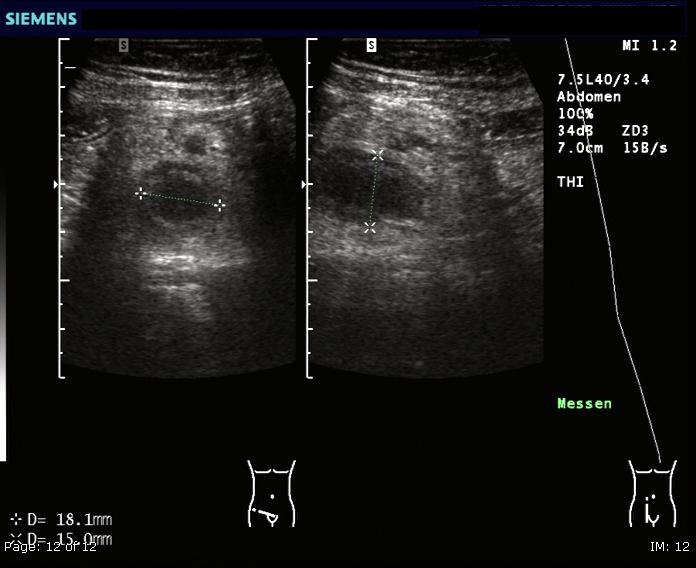
An enormous inflamed appendix. (Want to see a gallbladder?)
So what would I say to Dr. Kukla? I did raise my hand and speak. I said nothing about being pro-life, nothing about fetuses. I also didn't start an argument about what ultrasounds are. I didn't get to finish, but here's what I wish I could've said, in full:

"I wish this policy had come from ACOG. The practice itself makes sense, because it makes terminations like other minor surgical procedures--you know, for gallbladders and appendices. They do ultrasounds for those, and good docs go over scans with their patients before elective surgeries."

Thursday, August 22, 2013

Ultrasounds before Abortions

Have you ever been so angry you couldn't speak? I have been meaning to write about a talk I attended, given by Dr. Rebecca Kukla on ultrasound viewing before abortion. Dr. Kukla argued that ultrasound screening has become a ritual in our society to establish parenthood and add (prematurely and irrationally) a new member to the family. Performing an ultrasound and explaining the findings to a woman desiring to end her pregnancy would thus cause unnecessary and severe psychological trauma. She also argued that this imposed moral harm on physicians as it required them to violate their fundamental duties to patients.

I have been meaning to write this post since January. I have kept the folded-up flier from the talk in my desk since then. There it sat, outlasting the semester, my STEP studying, and my move to a different city. Usually, when I keep a piece of paper as a reminder to complete a task (e.g. a blog post, or mailing something, or running an errand), the having of the paper bothers me just enough to make me want to complete the task. But this time, I preferred to keep the paper rather than write the post. I just couldn't do it.

Every time I sat down to do it I would formulate the ghost of an argument, take out the paper, unfold it, look at it, and recall the tone and content of the argument. The first few wisps of a post that I had would evaporate as I would become angry. Not desiring to be angry, I would just put the paper and the idea away.

Today I realized the pattern. And now the flier is in the trash, but I have a decision to make (I am literally making this decision as I type). I can either write the rebuttal now, or I can just forget about it.

I am still too angry for a level-headed, reasoned argument, so if you read this, Dr. Kukla, please excuse me as still young and full of idealism. I will strive to be professional, though.

Before most minor surgical procedures that require general anesthesia (e.g. cholecystectomy or gall bladder removal), an ultrasound or other imaging is done. Vaginal ultrasound is quite common in gynecology. It also doesn't stand out as uniquely invasive. (Ultrasound for cholecystectomy gets to the bile duct via the mouth, and I'm sure you can imagine how they stage colon cancer). Abortions actually become more like the minor surgical procedures they're touted to be when an ultrasound is performed. I would hope they're done anyway.

Adequate bedside manner during any exam or procedure in which a person is awake but unable to interpret the findings includes explaining the findings. "Mrs. Anderson, your lungs sound normal." "Ms. Patel, the skin biopsy is almost over and your back looks good." "Mr. Deere, this darkish color on the ultrasound means you have a lot of fat in your liver." Let's encourage abortionists to have good beside manner by requiring them to describe the findings. I would hope most of them do anyway.

Dr. Kukla's concludes that ultrasounds like this impinge on the physician's duty to do no harm, but she happily supports the procedure that follows, which will leave 14% of the women who undergo it with full PTSD (slide 42). (For reference, 15.2% of Vietnam vets have full PTSD.) Abortion increases the risk of suicide to 650% (slide 74), substance abuse (61 and following), and depression (9 and following)  is considered desirable, so desirable that even medically legitimate restrictions are deemed morally intolerable.

I think that's all I have to say. Dr. Kukla and I agree that vaginal ultrasound cannot be considered a kind of "rape," and we also agree that it's not ideal that these regulations come through a governing body (we'd both prefer they come through professional organizations). But I find her basic attitude (defending abortion while objecting to an ultrasound) to be inconsistent.

Friday, September 14, 2012

Law, Tests, and Posters

After taking Spirituality in Medicine and Literature in Medicine, I jumped at the newly-opened chance to take something a little more hard-core: Law and Medicine. We're learning all about the role of the expert witness, which is how doctors (who aren't being sued) see the inside of courts most often.

Also, today I took the first Cardio exam! It went well.

Afterwards, I picked up the printed poster I created for the upcoming CMA conference! I am very excited. Here's the abstract that goes with the poster:
Repair of Fallopian tubes (tuboplasty) was the standard of care for tubal disease before the advent of artificial reproductive techniques like in vitro fertilization (IVF). Tuboplasty is a morally acceptable treatment for women with tubal factor infertility. 
The recession and the upcoming compensation changes in the Patient Protection and Affordable Care Act provide stimuli for mainstream medicine to prioritize what Catholic gynecologists know to be the ethically superior treatment. This year, the Practice Committee of the American Society for Reproductive Medicine (ASRM) edited their Opinion on tubal surgery: where they had recommended IVF as the preferred treatment option for any woman with tubal disease, they now recommend tubal recanalization techniques for treatment of several tubal disorders in young women with no other significant infertility factors. 
This presentation aims to review the research prompting the ASRM’s shift and the potential corresponding shift in medical practice. Surgical techniques reviewed include falloposcopy with a linear everting catheter, guidewire cannulation, coaxial cannulation, falloposcopic catheterization, selective salpingography, fluoroscopy, and hydrotubation. The best of these techniques have success rates similar to those of IVF and should be preferred for medical and economical reasons, if not moral ones. 
In conclusion, there are manifold opportunities to increase availability of IVF alternatives in mainstream gynecology, especially to young women who suffer from tubal factor infertility. At the same time, gynecologists have a chance to popularize ethically superior alternative treatments and raise discussions among their colleagues about other morally excellent practices.

(Like NFP.)

Tuesday, September 11, 2012

A Report on the Vital Signs of the Profession of Medicine: We're sick, but we're Fighting it

This post conforms to the blog rules.
I recently sent out a mass email inviting the entire College of Medicine and the entire College of Nursing to an event cohosted by the Bioethics club and Med Students for Life.

(Ooh, I hate sending out mass emails! The trauma of clicking "send" when you know four thousand people will receive the message makes me wince and shiver.)

As you can imagine for an event cohosted by a bioethics club and a pro-life group, the topic is slightly controversial. But this story isn't about the controversy stirred up by the speaker. Ho no! Just the name Med Students for Life generated this response from an unknown physician professor:
To imply, as the name of your organization does, that not all physicians are "for life" is ludicrous. Of course we are. That is why we became physicians--to preserve life. But while I do not personally perform abortions, I do support a woman's right to make decisions regarding her health and what happens to her body. Why not simply call yourselves Medical Students Against Abortions? Or is that not sufficiently charged politically?
Obviously MedSFL has no problem getting enough political charge.

The doctor has a beautiful point, though: doctors preserve life. I was just talking with my probably-pro-choice classmate this morning about how doctors want to make things better. We were speaking about our Humanities selectives and I mentioned that my professor seems like the typical lawyer: he talks fast and a lot, he is opinionated, his vocabulary is sophisticated yet peppered with profanity, and he mentioned in one breath that he had a taste for social work and a taste for blood (meaning the figurative blood of the people he grills in courts). He's a divorce and child welfare lawyer, and acknowledges that half his time is spent tearing families apart. Yikes.

My classmate and I were musing, 'thank goodness we belong to a profession that most people enter to put things back together, to preserve and protect.' So this doctor hits the nail on the head: doctors enter medicine to preserve life.

I'm sorry that this doctor does not feel that the unborn patient falls under our professional jurisdiction, but I don't need to spend space rebutting his position (even though the decision to abort is in over 90% of cases not pertinent to a woman's health and is in 100% not pertinent to her body alone--oh, oops), nor do I need to demonstrate that "against abortion" is not the same as truly "pro-life" (when a consistent ethic of life, i.e. being pro-person and pro-human dignity across all ages, races, abilities, etc is the core any good pro-life group like MedSFL--oops again).

I calmly replied, apologizing for any hurt he felt and gently explaining that our group's name is not designed to degrade doctors, but is meant to encompass a consistent care for unborn patients, pregnant women, and women for whom pregnancy would be dangerous or inconvenient. Calmly as my words seemed, I was a little shaken by the vitriol. Aren't we supposed to be evidence-based people? People eager to hear lectures and read papers, providing that they're scientifically rigorous? Aren't we supposed to let the little things (like student organization names) slide? And would you send something like that in response to an invitation?

Moreover, I was surprised at the age of the argument, that a woman's body is her domain. According to research by Charles Kenny and the Right Brain People (not the political right, the neurological right) showed that women realize that a fetus is alive and has a right to life, but that killing that life is the least of three evils they face when caught in an unplanned pregnancy.

So the email disturbs me on several counts: first, it admits that our profession preserves life while defending the opposite (it's inconsistent); second, it displays a sort of uncharacteristic emotionalism not accepted elsewhere in the profession but routinely accepted on this issue; third, it exhibits outdated perceptions of female patients in a profession allergic to anything outdated and chauvinist. It appears that medicine, not unlike the legal profession, is sick.

Oh, I told myself, at least we're not sick unto death, like the profession of law. Then that the doctor sent a reply to my reply to inform me that "what [I was] saying is that [I] want to impose [my] value system on all patients. But," he asked me, "are you going to force a Jehovah's Witness with a life-threatening GI bleed to accept a blood transfusion? Of course not. You are against abortion. Fine. Then call your organization what it is. Medical Students Against Abortion." I did not reply to this one.

The profession of medicine has a stage IIB (of IV) cancer and we're starting some aggressive chemotherapy. Young doctors and medical students are dragging speakers into their med schools and demanding that others look at the issue and think consistently (drat the decline of liberal education). Check out MedSFLA's fall tour schedule and their 2013 Conference and see what I mean.

This has been your report on the profession of medicine's vital signs. We're sick, but we're fighting it!

Wednesday, July 11, 2012

Affordable Care

Obamacare was passed and deemed constitutional as a tax. I do not feel like political commentary today, however, and I just want to talk about healthcare and patients. This post is a lot of lists.

We have a problem in the first world. The problem is: healthcare has gotten very expensive. What would make care affordable? I posit that this is impossible without a change in mindset. The first world must re-learn a few things (I placed negative principles next to the positive counterparts and bolded what I though were the two:
  1. Death and suffering are not the greatest evils (not even close).
    Rather, holiness is the greatest good.
  2. Simplicity is a great means to the greatest good via the second greatest commandment.
    This means acquisition of wealth is not the greatest good, or the greatest means.
This is, simply stated, justice and righteousness. I'm asking for a lot, and it's not going to happen in every soul in the next twenty years. However, the more we realize these truths, the better off we will be. Just to give some examples of the potential effects:
  1. Physicians' (and other providers') motives shift from moneymaking to taking care of patients.
  2. Legal professionals' motives make the same shift (albeit to protection of justice) and medical malpractice insurance goes down, lowering fees for service.
  3. Patients are less afraid of death and place an appropriately higher value on conservative (cheaper) treatment.
  4. Anyone affected protects the sanctity of life (abortion is chosen as an alternative to a kind of death, or suffering).
  5. Perspective reigns and people across borders are truly equalized: the phrase "first-world problem" is an embarassing testament to our lack of perspective. Although some medical problems are objectively distressing, some that are currently treated ($) could be tolerated if a mindset change occured.
Practical suggestions are almost futile without this large-scale change of heart, but here are a few:
  1. Payment in kind to healthcare providers
  2. Increase in charitable involvment in healthcare
  3. Subsidiarity in healthcare insurance
  4. Movement toward the master-apprentice model of medical education to decrease physician loans
The first steps to affect the change of heart in the medical professionals are probably:
  1. Improve ethics training in medical education (improves physician's choices of medical procedures)
  2. Improve bedside manner (improves patients' self-value and ability to make good choices for their health)
  3. Protect the traditional family (health outcomes are vastly better when families are intact) including elder care as the population ages
I feel like God's calling me to a crusade....

Saturday, February 25, 2012

AAPLOG Conference

As I started to write this post, I had trouble labeling it. "Pro-life," obviously applies, as does "ob/gyn" and "research," but so does "ethics," "spirituality in medicine," "vocation," "advice," "surrender...." I had to stop myself from clicking almost all of them.

Today was the 2012 annual education meeting of the American Association for Pro-Life OB/GYNs. It was in Washington, D.C. (my first time in the capital); it snowed this morning, and the conference was great. I was impressed with the high and rigid standards for publications, recommendations, and protocols. I was fired up to start healing our culture, now!

The highlights:
  • 8:45 Maureen Condic, PhD. “Defining the Beginning of Human Life”
    • Dr. Condic was at the Vita Institute. She condensed several of her lectures into one (because the audience had a more uniform education) on when human life begins.
    • Dr. Condic's white paper probably contains her arguments, although I freely confess I did not read it!
    Credit: euthman
  • 9:45 Theresa Deisher, Ph.D. “Current Ethical Issues in Drug Development”
    • I had no idea that some cosmetics, several vaccines, and some drugs are made in cell lines derived from aborted fetuses (and they contain contaminants from those lines). I'm not advocating chucking all vaccines, but I agree with Dr. Deisher that we should make an effort to find ethical, economical, and technological superior alternatives. Check out some of these companies:
  • 10:30 George Delgado, M.D. “Reversing Mifepristone: Case Reports”
    • Repeated doses of 200mg IM progesterone in oil = stop a chemical abortion. He went through six cases (publication pending). Amazing.
    • You know, it's impossible to reverse a surgical abortion, so I feel that the increasing use of RU-486 is almost a boon.
  • 11:00 Paul Gray, M.D. “Medical and Surgical Naprotechnology”
    • Naprotechnology is incredible. Mainstream gynecology treats menstrual disorders and infertility very quickly with birth control or IVF, without finding the cause; naprotechnology finds the cause of a woman's problems and addresses them to correct the symptoms or infertility (when possible). It corrects a cycle instead of suppressing it. Besides being a theoretically better approach, it also doesn't involve carcinogenic pills predisposing the patient to thromboembolism!
    • If you want to learn more about naprotechnology, you can read up at naprotechnology.com or fertilitycare.org. Please note, I haven't explored these sites, and they weren't mentioned by Dr. Gray.
  • 11:45 Priscilla Coleman, Ph.D. “The Psychology of Abortion: Addressing the Critical Questions to Maximize Patient Care in 2012”
    • WECARE 
    • Dr. Coleman carried out the largest meta-analysis to date on abortion after-effects. She's met with a lot of resistance, but she concluded that (yes; surprise) there is psychological morbidity following abortion, especially in high-risk groups (unsupportive relationship, hx of previous mental illness, ambivalence about the decision...).  
  • 1:15 Frederick Dyer, Ph.D. “Horatio Robinson Storer, M.D. and the Physicians’ Crusade Against Abortion, with implications for the current practicing doctor’s responsibilities toward the abortion issue.”
    • Interesting historical sketch of a gynecologist in the mid-1800s who advocated against clandestine abortion because of the harm it does. I didn't know there was abortion in the 1800s! 
    • Dr. Storer was supported by the AMA and his work led to the laws against abortion that disappeared in 1973.
  • 2:00 Michael New, Ph.D. ‘Analyzing How State Level Anti-Abortion Laws Impact Fertility Outcomes.”
    • Dr. New was at the Vita Institute as well! Never hurts to hear it again.
  • 2:45 George Mulcaire-Jones, M.D. “Safe Passages Program: Confronting Maternal Mortality in Rural Nigeria, Update.”
    • Magnificat Maternal Health Project 
    • Awesome teaching tool; reminds me of the Worth the Wait program, because it treats the disease, not the symptoms (it heals the culture and the family and doesn't just hand out contraceptives to African couples).
    • My thoughts: it works in Africa? Good. Bring it here. I desire to touch the poor here.
  • 3:30 Angela Lanfranchi, M.D.: “The Abortion Breast Cancer Link: The biologic basis and a review of the literature 1957-2011
    • Breast Cancer Prevention Institute 
    • There is a link all medical professionals already agree on: an abortion stops a full-term pregnancy, which has a protective effect.
    • The link people debate about is the "independent" link: an abortion not only removes positive effect, but has negative effect on breast cancer risk. Just look at the physiology! Data supports this, too. (For instance, every time a study finds a statistically significant correlation, it's positive.)
  • 4:15 Byron Calhoun. M.D. “Premature Labor: The At-Risk Patient”
    • Image and video hosting by TinyPic
    • This presentation mostly went over my head. It was the only one that was purely clinical and all about management recommendations for patients, so there were lots of terms and acronyms that I didn't catch.... I learned what a cerclage is, but only because I looked it up on my phone in the middle of the session!
    • The point of this talk was: 127 studies show that women with a previous abortion (surgical, medical, or spontaneous) show increased risk for preterm delivery. It's above a 300% increase for women with combined medical/surgical abortions (e.g. incomplete medical abortion requiring D&C) according to a study from China (Laoi).
I also enjoyed briefly meeting with someone from Students for Life, and also talking with some old OB/GYNs about being countercultural, not being afraid of lawsuits, and doing God's will. It's late and I've got to get up at 4:30am tomorrow to fly back home, so good night!

Thursday, January 26, 2012

March For Life: a Must-See

The March for Life in Washington, D.C. on Monday, January 23 came and went with complete media blackout, well covered by Joe Heschmeyer. I'm posting to report: there are more young women than ever protesting Roe vs. Wade. Why can't our opposition, who claims to be so pro-women and pro-freedom, acknowledge their voices?

Wednesday, January 25, 2012

Sex Education

Yesterday I attended a training session for the Worth the Wait sex education program. (I drove a long way! In the rain and fog, too!) I'm now trained to give the capstone presentation to eighth graders after they've received the bulk of their sex ed. (In this program, a healthcare professional or medical student always gives the capstone talk.) It was so cool.

I was able to get three other medical students to come, too, and I know they don't all share my "beliefs" (that word is so inane, but every time I want to avoid offending people I find myself using it). I feel like I'm sneaking truth under the radar!

Reasons I like this program:
  • It was designed by a Catholic and a mom of (then) preteens
  • It spans 3-7 years and is age-appropriate
  • It's not anti-sex
  • It encourages
    • abstinence until marriage
    • seeing a doctor if you've had sex, for STD treatment 
    • wellness (abstaining from drugs, smoking, alcohol, and dangerous behaviors...not just "don't have sex!!")--it's holistic
  • It doesn't rely on scare-tactics or graphic pictures. It's based on facts and moments of reflection ("what would happen if..." or "where would I like to be in four years?")
  • It gives the facts. All of them: the medical and socioeconomic effects of premarital sex, the bonuses of a healthy life, and the facts on contraception.
  • It incorporates the law (the legal age to consent to sex is 17; statutory rape, etc.)
  • Their data comes from reliable places, e.g. the CDC (see here for the CDC's information on STDs)
Reasons I can't wait to give a talk (once I observe one):
  • I want to show these kids/peers/friends that I care. I want them to have rich relationships and I want them to be physically, emotionally, and spiritually healthy
  • It's urgent! The more lives are affected early, the healthier our society will be.
  • It's fun! I miss acting and teaching from high school and TAC.
Want to get Worth the Wait at a school near you? Visit the website or email me!

Tuesday, November 8, 2011

FQHC's

A federally-qualified health center (FQHC) is a practice that receives grants from the Health Resources and Services Administration (HRSA, the same people that offer rural loan forgiveness to medical students and residents). I read more about them here.

When I first heard of FQHC's, I thought they were a good idea and even thought I'd like to practice in one. It's a good idea to provide care to people who need it, yes? And these are the poorest of the poor, yes?

But on Friday I shadowed a pediatrician in an FQHC. I'm not a fan any more.

I was surprised by the sick-child visits. Children came in with no true complaint. I thought this must be due to low health literacy. (A 99° fever is not a reason to worry, especially if the fever doesn't register on a thermometer and the only reason for the visit is "he feels hot to the touch.") I asked the the doctor I was shadowing about this. She agreed with my assessment, but added another reason for these empty visits.

"It's so cheap" to come in, she said, that patients come in at the drop of a hat. She added that sometimes they are using their visit to skip school. If I were a provider to this population, I would much prefer these patients get good phone advice and go to school! But the doctor again surprised me.

She laughs at these empty visits and says it's "good for the numbers." An FQHC must maintain a certain volume of visits, otherwise it loses its funding. Upshot: he better the education she provides, the worse the numbers. Moreover, the more FQHC's that are established in an area (the fewer visits at each one), the worse the numbers. "Bad for business," this doctor sighed when she told me three satellite clinics were being established this year.

Now I have problems with FQHC's.
  1. The Republican in me: our taxes are paying for what? (Not all these patients are here legally!)
  2. The ethicist in me: where money is on the line, who can provide patient, solid counseling to patients?
  3. The patient advocate in me: this arrangement is worse for patients; they become dependent on the doctor because they are not taught how to take care of themselves, the underlying cause of their visit (problems in school?) aren't addressed, and they receive poor-quality care (this was my experience yesterday and might not be universal).
  4. The idealist in me: why is the patient's good bad for doctors?
There must be some better way to take care of the poorest of the poor; some way that does not involve government programs and conflict of interest, some way to provide true education and quality care. FQHC's make me sad because they're so close to a solution, but at the same time so problematic! Our system seems so misguided.

Friday, November 4, 2011

Conscience Rights

A few newsbites:
I got this summary from an AAPLOG email:
In a nutshell, Health & Human Services (HHS) has adopted the most limited right of conscience language ever to be used in federal law in its new contraceptive mandate to health insurance. Using language developed by the ACLU, the mandate now requires all policies issued to cover all forms of FDA-approved contraceptives, sterilization and counseling with no co-pay. The only entities exempt are those that:
  1. Have the inculcation of religious values as their purpose;
  2. primarily employ persons who share its religious tenets;
  3. primarily serves persons who share their religious tenets; and
  4. are non-profit organizations under section 6033(a)(1) and section 6033(a)(3)(A)(i) or (iii) of the Code.
Practically, this means that ROC protections are limited to churches. The one-in-six hospitals in the country that are Catholic must provide coverage for birth control and sterilization. Christian practices and non-profits that serve the poor must provide coverage for morning after pills.

Tuesday, September 20, 2011

Unjust laws

I did a tiny amount of research on unjust laws between studying the leukocytes and reviewing the anterior abdominal wall. I found an incredible page: a compendium to Catholic social teaching, courtesy of the Pontifical Council of Justice and Peace. §399 and §400 deal with unjust laws, obedience, objection, and resistance.

§400 quotes St. Thomas Aquinas: "one is obliged to obey ... insofar as it is required by the order of justice" (Summa Theologiae, II-II, q. 104, a. 6, ad 3um). St. Thomas defines "the just" in II-II q. 57:
I do "the just" when I render to others what is their right or due, i.e., what is "commensurate with" them in their dealings with or relationship to me.
The order of justice refers to the order in the kinds of law (II-I q. 91): eternal law (God's providence), natural law (principles in us driving us to natural goods), and human law (public law, military law, decrees, statues, international law...).
St. Thomas considers the unjust law in II-I q. 96 a. 4.
...laws framed by man are either just or unjust. If they be just, they have the power of binding in conscience, from the eternal law whence they are derived, according to Prov. 8:15: "By Me kings reign, and lawgivers decree just things."

...On the other hand laws may be unjust in two ways: first, by being contrary to human good, through being opposed to the things mentioned above.... The like are acts of violence rather than laws; because, as Augustine says (De Lib. Arb. i, 5), "a law that is not just, seems to be no law at all." Wherefore such laws do not bind in conscience, except perhaps in order to avoid scandal or disturbance, for which cause a man should even yield his right, according to Mt. 5:40,41: "If a man . . . take away thy coat, let go thy cloak also unto him; and whosoever will force thee one mile, go with him other two."

Secondly, laws may be unjust through being opposed to the Divine good: such are the laws of tyrants inducing to idolatry, or to anything else contrary to the Divine law: and laws of this kind must nowise be observed, because, as stated in Acts 5:29, "we ought to obey God rather than man."
Where do inconvenient laws about ebooks fit? One could argue that control of intellectual property doesn't promote the common good, or is outside the authority of government, or is overly burdensome. These arguments don't seem iron-clad to me. And it's certainly obvious that these laws are not unjust "through being opposed to Divine good" or natural law, or Divine law. Other laws, like the court precedents and healthcare bill promoting abortion, are different. These are against Divine and natural law, and we may object and resist according to Catholic teaching, summarized in §399-§400 of the Compendium of the Social Doctrine of the Church.

It's back to blood cells for me; what do you think of this?

Wednesday, September 14, 2011

More on ebook behavior

Update on the ethics practical: I presented my question to my online peers. Results are below. Disclaimer: small sample, uncontrolled population, so results are statistically useless. But I am intrigued anyway.

Are unpaid-for ebooks common at your school?
Yes (most students have them) 66 72.53%
No (most students don't have them) 9 8.79
Sorta (maybe half the students use them) 15 15.38
Don't know... 3 3.30%
n: 91

Two sample comments:
it is illegal...everyone, including medical students, share anyway...who cares. If you morally object to it, then don't do it[.]
Man-made laws and your own sense of morality are not mutually inclusive.

In my investigation I also learned that this is a matter of civil law (lawsuits), not criminal law (misdemeanors and felonies). But it is still the law. I believe there is a virtue and holiness acquired by obedience to law, whether be it an excellent law, a pure convention, a harmless hoop to jump through, or inconvenient measure. I didn't say all that online, but I did say "I tend to think breaking the law is not moral." Someone called me "naive" twice in one sentence. And someone simply responded:
...I'm afraid you are wrong.


Update: I looked up the Church teaching on this legal-moral-ethical-same-thing deal. Here's what I found.

Sunday, September 11, 2011

AMA Resolutions

Apparently, medical students can submit resolutions to the AMA. I'd love to work one up on breast cancer and contraceptives, or on contraceptives (and not prescribing them), or on abortion (and never advising it).

I am thinking about working on one of these (probably the first one) this summer. In the meantime, here's a treat for you: all the AMA's policies about abortion. (To search among AMA policies, which influence law in this country, visit the policy search.)

Friday, September 9, 2011

Ebooks: ethics practical exam

During the first few weeks of school, everyone was passing around ebooks. I only bought one physical book--everything else was on my computer. How cool, right? Save hundreds of dollars buying books, hundreds of centimeters storing books, hundreds of newtons lugging books...great idea!

Someone posted a comment about the books on facebook, calling them "bootlegged." I became a little alarmed: wasn't this perfectly fine, what we were all doing?

I emailed an M2 who hosted a website full of the books. I asked him what the law surrounding ebook sharing was. Here is his response:
To be legal, you should not obtain these digital copies if you do not currently possess the physical book. To be moral, you should buy the book if you plan to continually use it and keep it. Otherwise I see it as no different than checking out a book from the library, and you should delete them after you are through with them.
I stared at the screen, aghast! We can be "moral" while being illegal?? What kind of doctors are we planning on being?! (Apparently, lousy ones who don't listen to all their elders talk about slippery slopes!)

I have now bought paper copies of all the ebooks I use, and deleted all the rest. I hope some of my classmates do, too...but I hate to bring it up. ("Hey, I think your integrity is being eroded by the possession of those e-books. You'd better buy the physical versions for the sake of your soul and the health of your patients." Yeah...that'd go over well.)

Tuesday, September 6, 2011

The changes in the Declaration of Geneva

The Declaration of Geneva is an international document written in 1948 (after the Nuremburg trials) to replace the Hippocratic Oath. It has since been modified five times. What do you notice? (Besides additions of PC terms like "sisters and brothers.")


          Original Declaration of Geneva:
At the time of being admitted as a Member of the medical profession:
  • I solemnly pledge to consecrate my life to the service of humanity
  • I will give to my teachers the respect and gratitude which is their due;
  • I will practice my profession with conscience and dignity;
  • The health and life of my patient will be my first consideration;
  • I will respect the secrets which are confided in me;
  • I will maintain by all means in my power, the honor and the noble traditions of the medical profession;
  • My colleagues will be my brothers
  • I will not permit considerations of religion, nationality, race, party politics or social standing to intervene between my duty and my patient;
  • I will maintain the utmost respect for human life, from the time of its conception, even under threat, I will not use my medical knowledge contrary to the laws of humanity;
  • I make these promises solemnly, freely and upon my honor.

    Current Declaration of Geneva:
At the time of being admitted as a member of the medical profession:
  • I solemnly pledge to consecrate my life to the service of humanity;
  • I will give to my teachers the respect and gratitude that is their due;
  • I will practice my profession with conscience and dignity;
  • The health of my patient will be my first consideration;
  • I will respect the secrets that are confided in me, even after the patient has died;
  • I will maintain by all the means in my power, the honor and the noble traditions of the medical profession;
  • My colleagues will be my sisters and brothers;
  • I will not permit considerations of age, disease or disability, creed, ethnic origin, gender, nationality, political affiliation, race, sexual orientation, social standing or any other factor to intervene between my duty and my patient;
  • I will maintain the utmost respect for human life;
  • I will not use my medical knowledge to violate human rights and civil liberties, even under threat;
  • I make these promises solemnly, freely and upon my honor.

The Hippocratic Oath, largely unmodified (apart from the effects of translation) in 2500 years, protects life from conception. In the Declaration of Geneva, however, "from its conception" was changed to "from its beginning" in 1984. The clause was removed altogether in 2005.

Hippocratic Oath

More Greek Statues
Today's ethics class was on oaths of medical professionals. I have a strong respect for the Hippocratic Oath due to an excellent analysis by Leon Kass in his Toward a More Natural Science. I highly recommend his one-chapter analysis to everyone. While you read, compare the Oath and the AMA Principles. (These links will take you to scribd.com.)

The lecture was hard to take. The professor stated that the Oath's abortion clause was not a perennial proscription of abortion; rather, it was an example from the writer's time. I wish she could've heard herself! I regret not writing down her exact words, but I have a crisp memory of her point. She said very confidently, "some will tell you that this clause is forbidding abortion and prescribing deadly drugs. That is not true. It is forbidding," and she sort of hesitated, "the harm that these involve, because...ah...when you give the patient that drug you are...harming. But these examples are definitely from their time." It hurts to hear things so false, so ingrained, and held as so irrefutable.

The lecturer also remarked that the Hippocratic Oath lacks the principle of autonomy. As she said this and as the moderator remarked on the fact, I heard condemnation mixed with respectful confusion in their voices. "Certainly," they seemed to say, "Hippocrates is revered, but how could such a grave oversight stand for so long? A travesty, a deep offense to the patient...." I said nothing--so hard for a TACer!--but I wish I could have spoken. The Hippocratic Oath needs no principle of autonomy. Autonomy is like a bandage, correcting a true fault but not with a real cure.

Our discussion afterwards was mixed. On one hand, people identified what I think are key duties of the physician: treat and prevent. On the other, they wanted to include things like "respect diversity." That is another bandage. As the years progress, oaths and codes get wordier and wordier with more and more bandages. At bottom, these oaths just say "be a good person," and if everyone did this, they wouldn't need to be any longer. But to lousier people (or people who make poor judgments) the oaths prescribe the minimum behaviors necessary to avoid punishment...so our oaths get longer and longer. "A thousand laws are needed wherever a single virtue declines" (Statement of the CMA on Healthcare Reform).