Showing posts with label tough cases. Show all posts

Wednesday, August 30, 2017

Quaeritur: Postpartum LARCs and mental illness

I was recently asked:
I recently looked up your article about encouraging a LARC for a drug addicted patient and your subsequent examination of conscience. I have a 27yo G2P1 bipolar patient with current benzo/meth/etc addiction who's 32 weeks and planning on getting a tubal ligation. I did not disagree with her decision, and was considering the morality of this. Did you ever find a conclusion to this "absurd state" of using contraception for those in addiction or mentally impaired patients (mental retardation, schizophrenia, etc)? Did you find any Catholic discussion regarding this? Humane Vitae and the discussion in Catholic Health Care Ethics book all are geared towards a typical person.
 Okay, let's take this apart. I want to say first that I did not encourage that patient in my blog post down any particular path. I never discussed postpartum family planning with her because we were always trying to ground her in the reality of her pregnancy and in circumstances surrounding her safety. It was only after my attending made a comment about contraception and I went to a St. Louis CMA guild event on LARCs in the mentally handicapped that I started to think about HV's possible limitations. (There's a post about that one, too, which you've probably seen.)

There is no good answer that I can find on this issue. The best that we came to at the guild event was temporary sterilization with filshie clips, but the Church is clear that not even temporary sterilization is acceptable. There are a few sets of articles from the Linacre that touch on it (from most to least relevant):

The articles that overtly deal with contraception in the mentally disabled adult or adolescent:

  • Contraception for the Mentally Disabled: A Contraceptive Act? (Napier, 2013)This paper argues that in certain circumstances, a Catholic institution that cares for disabled persons can ensure that some of them conform to a temporary sterilizing intervention. The argument proceeds by observing that the Church permits temporary sterilizing interventions for rape victims, because such interventions are not contraceptive acts, but rather, acts of defense. For similar reasons, some mentally disabled persons cannot consent to sexual intercourse and since rape is defined as unconsensual intercourse, some mentally disabled persons are proper candidates of temporary sterilizing interventions. These interventions do not count as contraceptive acts either. This is the case even if the disabled person in question desires the intercourse. This is so because consent is an intellectual act and desire is a passion. Desire does not entail consent. Although the conclusion reached may look "liberal" or "heretical" the argument shows that it is consistent with firm Church teaching.
  • The demands of human dignity: Sexuality in the young person with intellectual disabilities (Fernandes, 2014)The topic of sexuality among the disabled is often ignored within Catholic seminaries; within pediatrics, it is treated as a “problem” where the best solution is contraception or sterilization. In this article, the authors argue for an approach to sexuality in disabled youth that is grounded in the inherent dignity of the person, borne out of Christ's own humanity. Because sexuality is a part of the human person in his or her totality, it cannot be ignored or obscured; on the other hand, it cannot also be the overriding “problem” which defines them. Rather, by friendship, love, and covenantal solidarity with the disabled person, we can begin to set an example for them and for society that there are goods to be strived for beyond the physical. The demands of dignity require practical changes in seminary and medical education and practice.
  • Contraceptives for Victims of Rape and for the Mentally Disabled: A Reply to Stephen Napier (Tollefson 2013)In this paper I argue for the following claims. First, contraceptive acts are intrinsically wrong, and not merely always wrong within the marital context. Second, in consequence, the defense of the administration of contraceptives in case of rape must be understood under the rubric of the principle of double effect. Third, the existence or threat of rape is therefore not a sufficient condition for the permissible administration of contraceptives; the intention must be upright. Fourth, in the case as described by Stephen Napier, the intention with which contraceptives would be administered is almost certainly contraceptive; thus this administration would be an instance of an intrinsically evil act. Recognition of why this is so is the key to understanding why, despite a prima facie agreement, as noted by Napier, between his own position and that of Germain Grisez, there is nevertheless a rather deep disagreement. I articulate that disagreement, and indicate why I believe the question has not been fully resolved by Napier's essay.


The use of hormones in sexually active patients

  • No Justification for Using IUD to Treat Menorrhagia (Raviele)
  • The Mirena® Levonorgestral-Releasing Intrauterine System and Its Application to the Treatment of Menorrhagia: A Moral Opinion (Mulligan)
  • Levonorgestrel in cases of rape: How does it work? (Raviele 2014)
  • Does levonorgestrel emergency contraceptive have a post-fertilization effect? A review of its mechanism of action (Peck et al, 2016)
  • Mechanism of action of levonorgestrel emergency contraception (Kahlenborn et al, 2014)
  • Appreciation for analysis of how levonorgestrel works and reservations with the use of meloxicam as emergency contraception (Schneider et al, 2016)


The HIV/condom debate

  • “Validity” and “liceity” in conjugal acts: A reply to Stephen Napier on the HIV-condom debate (Arias)
  • Condoms and HIV: The State of the Debate (Newton)
  • The Missing Premise in the HIV-Condom Debate (Napier)
  • Condoms and AIDS: Is the Pope Right or Just "Horrifically Ignorant"? (Wills)

Question used with permission.

Tuesday, August 15, 2017

Quaeritur: Care of Transgender Patients (Part 2 of 2)

This post is a continuation of a conversation about Catholic teaching applied to transition for transgender patients. A medical student asked whether gender dysphoria could licitly be relieved with medical and surgical therapies. Following my reply, the student wrote back. I'm going to interject my responses outside of the block-quoted text from the student.
My initial reaction is that I completely agree with your succinct assessment: “The Popes have said that we are born male or female, and that is our gender. Any distress we feel about our gender is a disorder.” My thought is that for the vast majority of us, this is a clear cut statement. For persons with intersex conditions (and I would add transgender as well), they suffer from a disorder.

I’m going to take intersex cases an example before approaching transgender persons: Some of them are born with ambiguous genitalia and chromosomes. Determining their correct gender is a difficult clinical task involving input from the physicians, parents, and children. I’m sure that Pope Benedict would probably agree that due to the brokenness of the human condition, persons are sometimes born with mixed features from both genders. The existence of intersex persons doesn’t disprove or say anything about Catholic teaching regarding sex and gender, it just confirms for us that we live in a fallen world. Another analogy would be that persons are born with down syndrome, schizophrenia, and many other illnesses that impair intellectual capacity. The existence of these persons obviously does not disprove the existence of the “intellect” or the “will” that human beings, as rational animals, possess. These cases are just more examples of the brokenness of the human condition in our fallen world.

I think (hope?) that the above paragraph isn’t particularly controversial. I’m sure that most Catholic theologians would probably agree with my statements.
"Intersex" is a colloquial term, not a medical one. In medicine we refer to people with ambiguous genitalia, and I think that's more helpful in this discussion, because it's only a physical (and pretty external) defect. "Intersex" is a more emotive term that tends to lead the hearer to believe in a spectrum. Since I know that sex is binary, I find it an unhelpful term, much like "gender-fluid" or "bisexual." These terms refer to things that exist (e.g. a woman who has periods in life or even periods during the day in which she feels more like a man, or a man who finds himself attracted to men and women), but the words themselves tend to make us think of reality wrong. Words should help reveal the way things are; doubtless, many people today believe that "intersex" and "bisexual" reveal the way things are, but since we believe that humans are male or female, I would disagree. I don't mean to be picky, but I do want to draw your attention to the use of a term that is non-medical and possibly unhelpful. I agree, however, that persons with ambiguous genitalia do not prove that sex is non-binary.
I’m going to (try) to apply the same principles to some (maybe not all) persons that identify as transgender. My understanding is that the current scientific theory about gender dysphoria is called the “brain sex” theory. Essentially, it confirms what we Catholics have been saying for a while: Sex and gender are deeply ingrained properties of the human experience. They are the result of many neurological and hormonal puzzle pieces that have to fall into place during development. For most people, all the puzzle pieces align and our biological sex and neurological sex are congruent. Most males feel as though they are male, and most females feel as though they are female. However, like most of human development, there are many other environmental factors that come into play. I am sure, as you have pointed out, that for transgender patients, the experiences of "broken early relationships or abuse, self-hatred, misunderstanding of femininity or masculinity) as well as the co-morbid conditions (domestic violence, high risk sexual behaviors, mood disorders, substance abuse, etc)” are all contributing factors into why they experience gender dysphoria. So, my conclusion is that for these people, they really do have a physiological justification for why their body does not feel right for them. They have a mismatch between their neurological sex and their biological sex.
I think this is likely correct, although the lines between neurological and psychological are difficult to pin down.
Now, this doesn’t necessarily justify any of the treatments or therapies I will describe below for this disorder, but I think that it makes an argument for why these persons may have a biological/neurological basis for their gender dysphoria. I have heard some relatively influential Catholic commentators use the term “gnostic” to describe these persons, and I really do think that this could be a mischaracterization of the conditions these persons face.
I don't understand why people use the term "gnostic."

So, moving on to therapies for gender dysphoria. I completely agree with you that these patients probably do need therapy to help them with: "broken early relationships or abuse, self-hatred, misunderstanding of femininity or masculinity) as well as the co-morbid conditions (domestic violence, high risk sexual behaviors, mood disorders, substance abuse, etc)”. However, and I certainly do not consider myself an expert in this vast and complex field, but my understanding is that there is little evidence that these reparative therapies for gender dysphoria actually work. From my understanding, the APA and American Academy of Pediatrics appear to be against using reparative therapies. Now, certainly, there is a political agenda with these groups and they are fallible organizations, but they are the experts in these fields and I haven’t found any convincing studies that would tell me why I should ignore their advice on these matters (if you know any, please shoot them my way!).
Finally, with regards to some of the more “dramatic” and irreversible therapies such as sex reassignment surgery and/or hormone therapy, my initial thought is that they would be similar to a preventative mastectomy/hysterectomy. The intent would be to relieve the patient of their severe mental suffering, and the sterilization would be the secondary effect in this case. I know that my thinking here is not as clear, but I don’t know if I necessarily agree with the comparison to elective abortion. Elective abortion is a grave evil precisely because it destroys a human life, which has infinite human dignity. There has been crystal clear teaching on this issue throughout Church history, beginning with the Didache. However, with regards to persons suffering from gender dysphoria, I sort of see this an attempt to help relieve them in some way of a neurological/biological mismatch that they are experiencing between their physical appearance and inward state. I sort of see it as a last ditch effort which does have proven clinical efficacy. I don’t like the fact that these patients have to mutilate themselves and recreate their bodies according to their “neurological sex", but I haven’t seen any therapies that are more effective.
Now some clarification: I am not a proponent of reparative therapy, which I understand to be largely in reference to people with SSA. SSA is just a desire and is not a sin, and reparative therapy is not the answer that the Catholic church extends. Unfortunately, many other Christian denominations with less philosophical patrimony, don't understand this yet. My hope is that they can, and the strange well-meaning punishment of people with SSA can stop.

If you're extending the concept of reparative therapy to those with gender dysphoria, you might be referring to therapists who don't help them through "transition" to the other sex. These therapists might try to redirect the person to their biologic sex or (dishonestly) promise transition therapies initially and put up walls, never intending to fulfill their promise. Before I go further, is this what you are referring to? I ask because I've never heard anyone refer to refusal-to-transition as reparative therapy.
I guess to put my point bluntly, I am wondering if (some, maybe not all) persons who identify as transgender could be allowed to undergo the sex-reassignment surgery and/or hormone therapy to relieve them of their distress? It seems to be clinically efficacious. I guess all the long emails before that were trying to justify why I reached this point. I know that this is definitely risky, uncharted territory in terms of Church ethics, which is why I was trying to use analogies to persons with ambiguous genitalia and down syndrome. If I am wrong, could you explain to me why? I am not trying to go against the Church’s teaching, and I also want to help these people and do what is best for them.
I and many theologians would bluntly reply that no persons who identify as transgender should be allowed to undergo sex-reassingment surgery or hormone therapy. Very bluntly: these patients' comorbidities should be managed and they should undergo significant psychotherapy for their dysphoria. Like other patients who are deeply uncomfortable with aspects of themselves (DID patients, body dysmorphic disorders), they should be helped to understand who they were created to be.

Here is my explanation for why. Our gender/sex is sacred and is inseparable from our soul. It's part of the way God makes us to be saints. Men and women are irretrievably different in ways we can only clumsily understand. Philosophers have tried and failed many times to identify what category of quality "gender" is. Poets and thinkers have tried to articulate what "masculinity" and "femininity" are but only come up with generalizations and analogies. This is a hard thing to understand! It's no surprise that people think that gender is something we decide on.

The same thing happened with sex and procreation in the 1960s, when Pope Pius VI commissioned faithful Catholics like yourself to research the idea of birth control. The so-called "birth control commission" concluded that our fertility is something we should manage rationally, like we do every other aspect of our lives. There were parts of the physical universe (chemicals/hormones) that we could use as sons of Adam to change our lives. Shouldn't we do this?

It is hard to see the truth: gender, sex, and fertility are sacred ground because they more than anything in the physical universe are signs of who God is and are avenues to make saints. Luckily Pope Pius saw the truth about contraception in 1968. I think you and I are called to see the truth about gender now. It can seem like a big "no," but just like contraception/NFP, it's a strange and important "yes."

Monday, February 29, 2016

OB/GYN Ethics 201

In OB/GYN Ethics 101, I covered the basics for medical students and residents rotating through OB/GYN settings, and a little for OB/GYN residents. This post is about three sorts of hard cases: induction of labor before viability, emergency contraception, and methotrexate.

In OB/GYN 101, I wrote:
Do not induce labor for inevitable abortion, i.e. when fetal death has not occurred
It is true that uncomplicated inevitable abortion should be managed expectantly, especially if there is a question in diagnosis. However, there are situations in which labor can be induced because of the principle of double effect.

Previable chorioamnionitis
If a woman develops chorioamnionitis prior to viability (either spontaneously or because of previable PPROM), the principle of double effect permits induction of labor if chorioamnionitis is clearly present and either is too severe or too remote from delivery for antibiotics to preserve the lives of mother and fetus. Richard White explains:
The early induction of labor...satisfies the four conditions of double effect. First, it can be assumed that the intention of both mother and physician is to evacuate the infected chorion and amnion. Second, in light of the serious infection and its threat to the lives of both mother and fetus, treatment is needed to save the life of the mother; that the mother’s life can only be saved by inducing labor is a proportionate reason to perform the procedure. Third, since the early induction of labor does not target the fetus, but the evacuation of the pathological tissues, the death of the fetus is not a means to achieve the health of the mother. And, fourth, there is no alternate procedure to treat the chorioamnionitis with the promptness required by the situation. (1)
Persistent Eclampsia (or Complicated Pre-eclampsia)
In the case of a previable patient whose seizures and severe-range blood pressures do not respond to magnesium and IV antihypertensives, delivery can be expedited by induction. The same can be true of a mother with worsening complications from previable pre-eclampsia (e.g. renal failure or respiratory distress), or evolving HELLP syndrome. White notes:
The act of inducing labor, in this case, appears to satisfy all the conditions of the principle of double effect. First, the act removes the offending placenta, which is the cause of eclampsia. This action is therapeutic for the mother and is, thus, good. Second, the intention of the physician and the mother are, presumably, directed towards the treatment of eclampsia, not towards the termination of the pregnancy. Third, cure of the condition is not achieved by removing the fetus, but by removing the offending placenta. Fourth, the mother’s life is endangered by the complications of eclampsia, which have manifested; the various threats to the mother’s life that the complications pose are proportionate to the induction’s consequences for the child. Fifth, all other methods of treatment that would not result in the death of the fetus (i.e., expectant management) have been exhausted. (1)
§

In OB/GYN Ethics 101, I said:
Do not advise the use of any hormonal contraceptive (e.g. mirena) in sexually active patients. Period. This is because of their post-fertilization effects.
It is true that patients should not use hormonal contraceptives because when used throughout the cycle, they will inevitable have post-fertilization effects. But when you, a physician, are in control of when those hormonal contraceptives are used, you can use them licitly to avoid the post-fertilization effects.

Emergency Contraception
Emergency contracpetion (EC) has its own post. But here's quick a rundown:
  1. Hormonal pills: can be licit. Remember that hormones to prevent pregnancy are not proscribed except to the married, and self-defense is licit, even defending oneself against the effects of an act, such as advancing sperm. A pregnancy test is not enough to exclude the potential post-fertilization effects of emergency contraceptives. The Peoria Protocol lays out how to tell with moral certainty that a woman has not ovulated and that the primary effect of EC is anti-ovulatory. It involves serum progesterone (<1.5 is pre-ovulatory, okay to give EC) and urine LH (negative is pre-ovulatory, okay to give EC). Notice I didn't give units. Do not use cutoffs a blog post to determine management of patients requesting EC. You need a working relationship with your hospital lab and you need to be better acquainted with the Protocol's other reference ranges for progesterone before you can use it.

  2. Hormonal IUDs: insertion of a mirena or skyla as EC relies not only on the anti-ovulatory effects of the levonorgestrel, but also on the intrauterine effects, which act after fertilization. Although it may be argued that application of the Peoria Protocol could allow these effects to be avoided, a systemic hormone (to reach the hypothalamus) is more targeted than an IUD (which would also have to be removed if the patient is later sexually active.

  3. Paragard: this relies on post-fertilization effects (which is why it works up to five days after the act of intercourse), and cannot be licitly used.

  4. Plan B: is levonorgestrel, given in one 1.5mg dose or two 0.75mg doses twelve hours apart. Strangely, we can't seem to figure out whether its main effect is primarily anti-ovulatory or post-fertilization. A recent (2015) review of all the data in the Linacre (2) concluded that "arguments used to justify use of [Plan B] as a non-abortifacient drug carry substantial weaknesses; in addition, the preovulatory administration of LNG-EC does not consistently alter sperm or ova flow and function, yet there is absence of clinical pregnancy in cases where fertilization is likely, which suggests that abortion is a likely mechanism of action. Therefore, the claim that moral certitude exists via LNG-EC’s nonabortifacient action is currently indefensible."

  5. Ella: ulipristal is a selective progesterone receptor modulator. It is given in one 30 mg dose. It antagonizes progesterone at its receptors on the endometrium, which mean it only has post-fertilization effects. This is the same mechanism of action as mifepristone (RU486, which is given in doses of 600mg for elective abortions). Although package inserts deny that it is abortifacient, this indicates that a 30mg dose is not suspected to have post-implantation effects. For a Catholic who understands life to begin at sperm-egg fusion, ulipristal is extremely likely to lead to loss of embryonic life.
§

Ectopic Pregnancy
All the above is generally agreed upon. Going forward, I am about to make some people disagree with me. This is because the magisterium has not spoken on this issue and faithful Catholic theologians (who all agree that life should be protected from fertilization to natural end) can legitimately disagree. This disagreement is good and fruitful.

In short: salpingectomy is fine, principle of double effect applies.

Salpingostomy: also fine, principle of double effect applies. (Alert! Not everyone agrees with me, but some of the theologians who thought this was not licit have come to agree. An excellent article by Christopher Kaczor in the Linacre defended this very soundly (3). I am morally certain that this is permissible.)

Methotrexate: has its own post. The same excellent article in the Linacre did not defend this very soundly at all, but I propose a different defense, which takes into account more embryology, more sonography, and more other examples from medicine than I have seen others do.

Like all sinners who want to be faithful Catholics, I submit every word of this post to the judgement of the Church.


References not linked:
  1. Richard White. "Prenatal Complications." The Linacre Quarterly 2009; 76(3), 304-309. DOI: 10.1179/002436309803889098
  2. Chris Kahlenborn, Rebecca Peck and Walter B. Severs. "Mechanism of action of levonorgestrel emergency contraception." The Linacre Quarterly 2015; 82(1), 18-33. DOI: 10.1179/2050854914Y.0000000026
  3. Christopher Kaczor. "The Ethics of Ectopic Pregnancy: A Critical Reconsideration of Salpingostomy and Methotrexate." The Linacre Quarterly 2009; 76(3), 265-282. DOI: 10.1179/002436309803889106

Wednesday, December 30, 2015

Quiz: What's Catholic Teaching on Family Planning? (Shocker)

This post conforms to the blog rules.Catholic doctrine on contraception (including hormonal and non-hormonal, long- and short-acting) is:
  1. Use of contraceptives by sexually active persons breaks up the unitive and procreative aspects of sex, and is grave matter that may constitute mortal sin.
  2. Contraceptives are a band-aid for women's health issues and should not be used for medical purposes in women who are not sexually active.
  3. Contraceptive use is technically occasionally licit (i.e. not objectively wrong), but is always imprudent.
  4. A and B
  5. A and C
  6. None of the above
The answer, shockingly, is F. Humana Vitae (HV) explained why contraception is objectively sinful because it destroys the good in licit sexual acts. The only licit sexual acts occur within sacramental marriages, and HV only touched on contraception in marriage. When sex occurs outside marriage, there is already an objective evil. It is not clear (i.e. it is not yet part of Catholic teaching) whether contraception augments the evil in these actions (like fornication, adultery, and extramarital sexual abuse) or can mitigate it. Theologians who wish to think with the mind of the Church have gone both ways on this issue. Many, like Germaine Grisez and Janet Smith, have opined that contraception is always wrong. Others, like Fr. Robert Landry, maintain that it is not always objectively illicit, but is usually or often imprudent. For more, here's Jimmy Akin.

True or false: It is good that children not come of non-marital sexual unions.

True. It's occasionally uncomfortable to admit it, but it's actually good when children are not conceived outside of marriage. Children have a right to grow up in a family, raised by a father and a mother, and many or most children born today are born with this right infringed. You're not a eugenicist if you think it's good that children's rights are preserved. Don't believe me? Try the next question.

True or false: It is good that children not be born of non-marital sexual unions.

Careful here. It's good when children aren't conceived. But once conceived, their rights must be protected as much as possible, including their right to life. Post-fertilization effects and abortion rob a child of something even more basic than the right to be raised by mother and father.

Catholic doctrine on primary sterilization (mutilating of a human body by removal or altering of otherwise-healthy organs for the sole purpose of destroying fertility) is:
  1. Sterilization is mutilation of the human body, which is dignified not only by creation in the image of God, but also by the Incarnation.
  2. Temporary sterilization is occasionally appropriate even if the principle of double effect does not apply.
  3. The Catechism only specifies that sterilizations on innocent persons are against the moral law.
  4. A and B
  5. A and C
  6. None of the above.
The answer is A. No temporary sterilization, no sterilization ever unless there is a medical reason for removal of a "diseased organ." C is interesting. The second half of a sentence in CCC 2297 states "directly intended amputations, mutilations, and sterilizations performed on innocent persons are against the moral law." But to take this and run off sterilizing prisoners would ignore the first half of the sentence: "Except when performed for strictly therapeutic medical reasons...." With all this information, let's go see a patient.

Case Study: A 32-year-old African-American G5P2113 (pregnant five times, with two children born at term and one born preterm, with one abortion or miscarriage, we don't know which; currently pregnant) at 26 weeks presents to obstetrical triage at Hospital A with abdominal pain. This is her third visit this pregnancy. She consistently maintains that she receives care at the resident clinic at Hospital B, but has likely never established prenatal care. She is unmarried and does not have custody of her living children. She has multiple psychiatric admissions for bipolar disorder, she is not currently on medications, she is currently homeless, and the resident seeing her suspects she just came from selling herself. She has been kicked out of several maternity homes for disruptive behavior. During today's interview in triage, she appears disheveled and emotionally labile. It is clear from her responses to questions about her medical and social history that she is either intellectually disabled or out of touch with reality. She insists that she is full term and that it's time to induce her labor, although her triage workup reveals no evidence of labor, or other obstetric or gynecologic pathology. Upon the patient's discharge from triage from Hospital A, the attending supervising the resident states, "she needs a strong postpartum plan," meaning that she should receive a LARC or be sterilized so that she won't get pregnant again. Hospital A and Hospital B are Catholic. What is an acceptable postpartum family planning option for this patient?
  1. Natural family planning/fertility awareness
  2. Mirena
  3. Paragard
  4. Nexplanon
  5. Essure
  6. Postpartum filshie clip tubal ligation
  7. Parkland method tubal ligation
  8. Depot haldol and social work consult for another group home placement
A: Wrong. There is so much beauty to NFP, but for a woman who doesn't have money for bus ticket and who isn't medicated and out of touch with reality, it is not enough.

B: Wrong. Mirenas can be placed immediately postpartum but rate of expulsion is relatively high. Plus, mirena is a progestin-containing system and has post-fertilization effects.

C: Wrong. Paragard can also be expelled when placed in the postpartum period, and also has post-fertilization effects.
D: Wrong. Can be placed postpartum, but has post-fertilization effects.

E: Wrong. Cannot be placed postpartum, and is a permanent, primary sterilization.

F: Wrong. Even if it can safely be done postpartum and is as close as you can get to a temporary sterilization (you can pop off the clips and re-anastomose the tubes), it's still a primary sterilization and HV condemns even termporary sterilizations.

G: Wrong. That's a permanent primary sterilization.

H: Really? That's the best we can do for her? I am totally dissatisfied with our options. 

This woman is unmarried and her ability to truly consent to sex is in question. Children have a right to be born to a family, raised by a mother and father, and it is better for her not to have children right now. I can't render her sterile because that is objectively wrong. It may not be objectively wrong for me to render her infertile (although it might be imprudent), but all my options for rendering her infertile (aside from condoms, which she can't control) have postfertilization effects.

Conclusion: I want to think with the mind of the Church. I know Catholic teaching, like every appropriate body of law, does not include dicta for every particular situation. But I know Catholic teaching grasps the truth whenever it speaks on issues of faith and morals. And it works, because it's the truth. 

But right now, there is nothing that works for patients like my case study (and I have seen her for three of those four triage visits). Where is the truth here? Do I need to develop something new?

Tuesday, December 15, 2015

"Absurd States," Gradualism, and NFP

This post conforms to the blog rules.I'm going to tie two patients together to illustrate a point about the difficulties I'm facing in a post-pill culture. The phrase "absurd state" in the title comes from the phrase used to describe cryopreserved embryos, who need to be maintained in cryopreservation to avoid likely death. It's a state that would never had existed had we not used technology outside of the truth.

I saw a  patient at one in the morning on call a few weekends ago. My diagnosis was round ligament pain, but we spent most of the visit talking about how she was trapped in a cycle of heroin and cocaine use, and she wanted to get clean. She had overdosed twice in the past week, she told me, and she didn't want that for her future. She told me about her plans to get into a suboxone clinic and a maternity home. She impressed me and I told her so.

Exactly twenty-three hours later (I looked at the clock) she was back after being found unresponsive, having overdosed again. She was brought back with narcan and the emergency department sent her to triage to rule out obstetric concerns. In the words of my second-year who was in triage at the time, she was "high as a kite." I was angry at drugs and angry at her for ruining a life that had such potential to turn around. I'd been told that if drug addicts' lips are moving, they're lying. I grew used to that as a fact during my time on the substance abuse service as a third year med student, but it stung to be reminded.

Three overdoses in a week. "She's going to kill herself," I observed softly to my second-year. One of these times, someone's not going to find her, or she's going to make sure she's not findable.

"That poor baby," added my second-year. Both baby and mother were in an absurd state, brought about by drug developments and the breakdown of marriage, families, and mores.

I saw a different patient in clinic a few days later. This one had been addicted to narcotics and benzodiazepines, but had weaned off her narcs by the time I saw her. She complained that she had missed so many prenatal care visits because she'd lost her job and was now living with her two alcoholic parents. I was less impressed with this person from the start, but I sympathized and tried to connect her with social help to get her better situated. Narcotics and benzodiazepines, more than some other drugs, seem to make people childish.

Not a week later, she happened to present to triage in labor, and I saw her with her mother, who looked exactly like mine. I know people can hide alcoholism more than they can hide, say, meth addiction, but I was even less trustful of this patient than before. She was moving her lips when she called her parents alcoholics; was she lying? I saw her postpartum. She was not handling new motherhood well, and I was again unimpressed. I know the postpartum state is uncomfortable (especially when we aren't giving you your xanax), but I felt frustrated by this patient, and I spoke with a little more sternness than I usually do.

"Do you want to be pregnant again?"

"No," she answered. "Unless I meet Mr. Amazing."

I ignored the comment and dug back to the issue. "What are you planning to use to prevent pregnancy?"

"Abstinence," she answered readily.

I had to recover from an instant of shock, because she was completely serious. "Is that what you used before this pregnancy?" I asked, unimpressed in the extreme.

"Yeah," she said, still serious. "It worked really well until one day I just said '**** it.'"

I was pressing my lips together in frustration at this point. "This time," I said, "I want you to think about another way to avoid pregnancy."

"I don't want my tubes tied."

"I don't think you should have your tubes tied," I rejoined. She was under thirty and there was still hope that she'd stop the benzos and go back to a normal life. "But abstinence didn't work last time, so you can't use it again." I gave her a run-down of the available methods of family planning, including NFP. And then came the time in my life I never wanted to come: I advised that someone not use NFP.

"But fertility awareness takes discipline," I said at the end, "and I don't think that's the best choice for you right now." The words were like a knife in my soul, but I went on: "You either need to make big changes in your life so that you can develop that discipline, or you need to use something that will chemically change you so that you can't get pregnant."

Our culture has become dependent on birth control. There are failings in the culture that seem to now need the crutch of birth control to avoid great evils. There are whole swaths of souls in absurd states. Following in the (unfortunately infamous) footsteps of Benedict XVI, I applied the principle of gradualism during that conversation. Was I wrong? I went to confession and the priest was vague; he told me it was grave matter (which I knew), but did not tell me whether I had sinned or not.

It's in these cases where I begin to feel very culture-of-deathish sentiments creeping up in me. Sentiments like "she shouldn't be able to be pregnant any more," or "it would have been better for that child not to have been conceived." But those are lies. A life can be made right and she should keep her fertility. And that life is precious, and should be cared for (by another person, perhaps).

But does gradualism allow us to avoid the objective evil and choose a lesser evil in situations like this? Not because it's good, but as a bridge to what is good? Can I suggest mirena (not as my peers do, as a panacea for all female woes, but) as a rescue until a person's life can grasp the good?

This post doesn't come to a clear conclusion and I'd appreciate comments and suggestions.
 

Sunday, May 3, 2015

Stacy's Story

This post conforms to the blog rules.A patient I met and, in the wash of clerkships, left behind, left an incredible impression on me even though I barely knew her. Almost every detail about this person is altered to protect her.

"Stacy" was a middle-aged woman who became pregnant under extremely bad circumstances. Her family started to notice that she was acting strange. To their alarm, she began to tell them she saw and heard things they could not see or hear: she was hallucinating. The duress of her pregnancy had affected her so severely that she had become disconnected with reality. She went to the emergency room after suffering a psychogenic seizure, and I rounded on her her shortly thereafter.

As I flipped through her chart before going to see her, I asked the nurse what was going on.

"It's crazy," the nurse said, speaking of the situation. She gave me more and more details as I went through the records, underlining hCG values and the ER course. "And her family doesn't want to keep it," the nurse finished.

I froze. Doesn't want to keep it. They wanted an abortion.

"What does she want?" I asked.

The nurse shrugged. "She can't say, most of the time. She has these good times when she makes sense, but sometimes she babbles and acts bizarre. Sometimes she doesn't know she's pregnant when you ask her."

I continued reviewing records mechanically, and went to see the patient, wondering what I could do. The first time I spoke with Stacy was during one of her lucid times. After introducing myself and seating us in a private and comfortable place, I told her I wanted to talk with her briefly and then gently asked her, "What brought you here?"

She gazed at me innocently, almost emptily, with warm brown eyes. "I'm pregnant," she said simply.

"That's right," I said.

"I'm eight weeks," she added.

"Exactly," I said with a smile. "Do you know what that means?"

She shook her head.

"It means your baby's heart is beating," I said, "and he has all his fingers and toes."

"Oh," she said, her voice inflecting for the first time, a little flicker of a healthy mind. "Maybe I'll keep it."

Those were her exact words, and I cannot forget them. The interview went on, and I wrote my progress note and left. At rounds a few minutes later, the story became even more nightmarish as I discovered that my attending and my fellow students were all hoping that she could get an abortion. Perversely, we carefully looked up what psychiatric drugs she should most safely take in pregnancy and consulted a psychiatrist with experience in that. Even as we hoped that Stacy's embryo would be eradicated, we protected that embryo from possible adverse effects of the medicines we prescribed.


The week churned on and I moved away from Stacy's floor while other students worked on her care. I heard new of her remotely when students would talk about her, and the reports were not good: she had fewer lucid times and finally none at all despite changing her medicines. Meanwhile, her family was trying to arrange for an abortion. I stormed heaven and asked friends and family to do the same.

Stacy's case became very complex and the hospital system ethics committee met over a weekend, weeks after her admission, to decide whether she could have an abortion. Her case was described in detail at our rotation's grand rounds, where another student presented and the general feeling among my peers and professors was annoyance that the "stupid" hospital was keeping this woman from her healthcare. I felt dizzy sitting with them, as if I were in a horror movie or some barbaric country.

After that rotation ended, I texted Stacy's attending and asked about Stacy. It was then that I discovered that the first ethics committee did not approve her abortion, but she ended up having one somewhere else.

I have so many sad thoughts about this case, including things like, should I have insisted on seeing Stacy beyond my time on her ward? It wouldn't have been impossible. Should I have talked with her more about her baby? I didn't want to be coercive but I might have saved a life. Should I have at least documented her desire to keep the pregnancy? I'm sure it might have meant something to the ethics committee if it didn't to her attending and my peers. I was afraid to write it, because I worried that her flip-flopping between options would be seen as a sign of worsening psychosis (which wouldn't be good for the baby's survival or for her), and because I didn't want to be accused of disturbing her "decision."

What a hard case! Please pray for "Stacy" and her family, and her little child. She is apparently back to her normal self and out of her psychosis, but she is not finished dealing with what happened to her this year.


This post was a draft for over a year. I marked it as a "perpetual draft," one of a set of posts that will never be released to protect my career and to protect vulnerable patients. But I decided to release it after I matched, and since it has been such a long time since this occurred.

This post was a draft because I experienced a bit of resistance in my psychiatry clerkship from a pro-choice fourth year (who couldn't believe someone wouldn't do this patient's abortion) and from professors (who called me into an impromptu meeting when I asked too many questions about homosexuality and gender identity disorder). Now, I'm putting it out.

Friday, May 23, 2014

Abortion Hurts Women: I've seen It.

This post conforms to the blog rules.
I witnessed emergency surgery on a woman with complications after abortion. Someone had perforated her uterus, and she was rushed to our hospital.

I only heard about the case incidentally. I was on a different service (not the gynecology service, and not even on my OB/GYN rotation). I happened to be down in the main OR, and I was just leaving when I saw one of the OB/GYN chief residents I knew. I’d been trying to arrange a meeting with him about residency program selection. I was eager to hear what he had to say, because I happened to know that this chief had interviewed specifically to avoid performing abortions, or “terminations” as OB/GYNs often say. We’d never gotten to talk because he was out of town for vacation, I was out of town for the cardiothoracic surgery rotation, etc. When he saw me, he seized the moment to sit down in the physicians’ lounge and give me a list of programs he liked and a list of programs he didn’t like.

As we were talking, I noticed that not only was he there, but so was the third-year GYN resident, their attending, and the medical student on gynecology. This meant they had a pretty intense case. (The rarer the case, the more likely the upper-levels are involved. And to have two residents in on a case is rare indeed.)

The third year resident (R3) noticed that I was counting and surmising. “Something's coming up from the ER,” the third-year said, to explain why they were all there.

“A perf’d uterus from an abortion,” the chief said. The attending sat wordlessly by, watching the television.

“Your dream case, right?” the R3 said to the chief, smiling. From his comment and tone, I surmised that the R3 was probably pro-choice, and was joking with the chief, who had never done an abortion but who (I guess?) needed to log one. “Are you going to count this as an abortion?” the R3 joked.

The chief smiled back good-naturedly. “Yeah,” he said quietly, “ ‘open abortion,’ ” he said, referring to how he would make his incision. What must it be like to be pro-life among pro-choice colleagues for four years of training?

I asked to observe the case, even though I knew I couldn't scrub in (because there was already a med student and two residents, and because I wasn't even on the gynecology service). The attending gave her permission, and I went to see the patient in preop. She lay there on the ER cot she'd come in on; next to her was her significant other. She looked like a woman in pain—physically and emotionally. The other medical student (the one actually on the gynecology service) was scrubbing, so I took my place at the foot of the table, behind a machine and next to the kick bucket (where the used/bloody sponges are tossed).

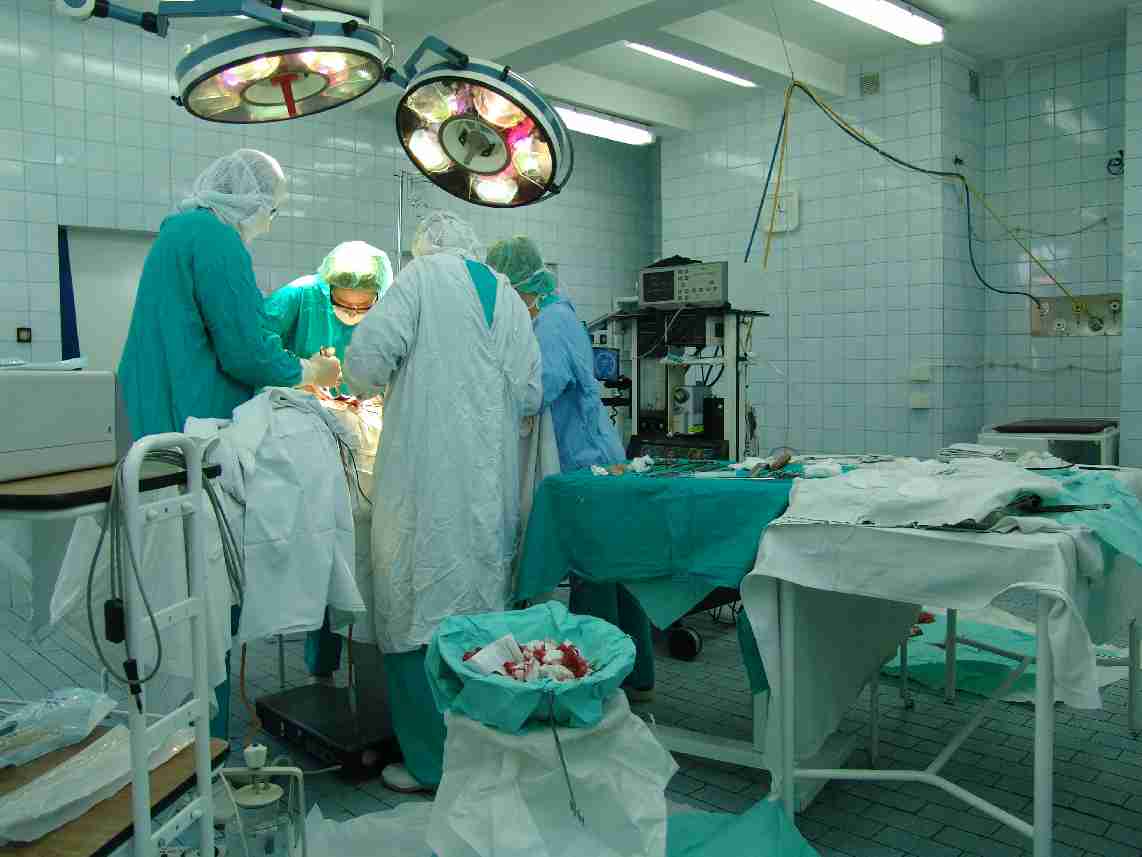
There were a dozen people in the OR. This is a stock photo.
Once the patient was asleep, the chief resident made a large midline incision. Blood and clots came out as he reached the peritoneal cavity. The anesthesiologist ordered two units of red blood cells. I literally had to be careful not to get splashed as bloody sponges were tossed into the kick bucket in rapid succession.

The chief and the attending opposite him pulled the incision open like an emergency C-section, and then the chief reached in to explore the patient’s body with their hands. The chief resident emerged and passed something to the scrub tech, who placed it on her mayo stand, just a foot away from me. It was the head and shoulders of a fetus—a tiny, perfect bust the size of a plum. Next, they found the uterus and pulled it up. I could see it: part of it was a healthy pink, but one corner was mangled, raw, purple, and bleeding. They then explored the surrounding organs, and found the sigmoid colon nearly transected, the proximal and distal limbs held together by a pencil-sized strand of mucosa or mesentery (I couldn’t tell). When they pulled that up, there was an instant of silence as everyone in the room mentally said something between “oh my gosh” and an explicit oath.

“We need colorectal,” the attending said commandingly.

“Colorectal?” repeated the circulator, lifting the phone.

“Stat,” replied the chief resident.

The other medical student, who had already been on the trauma service, turned to me and said, “that’s worse than I ever saw on trauma.”

Again, stock photo. The OB/GYNs didn't need
headlights or loupes (or that sternotomy
retractor), but the rest is accurate.
Then began the fastest and bloodiest hysterectomy I’ve ever seen (and the only supracervical hysterectomy I’ve ever seen). As they cut away the fallopian tubes and ovaries, I heard the anesthesiologist say, “can we get two units stat?” The OB/GYNS continued to work like machines, clamping vessels and cutting uterine muscle, while the anesthesiologist updated them: the patient’s blood pressure was dropping, and he couldn’t get it up. “We need a trauma tray,” he finished.

“Trauma tray!” confirmed the circulator.

The anesthesiologist was starting an arterial line at the patient’s wrist. Beneath the sterile towels he’d draped over her arm, I saw that her fingers and fingernails were white, like the bodies we’d dissected in gross anatomy. The patient had started as a beautiful shade of bronze—she must have lost a lot of blood to be sheet-white like that! I started to pray.

Colorectal arrived—an attending and two fellows. Because I was the only one in the room without a job, I gave them the one-liner presentation. “This is an **-year-old female with perforated uterus and sigmoid after therapeutic abortion earlier today.”

“I heard,” the attending said grimly. He and one of the fellow got gloves and gowns. The OB/GYN attending looked up at them, her bloodied gloves holding two enormous clamps that disappeared into the patient’s pelvis. Her expression was remarkably calm. “We’re almost done,” she said. “We’re taking out the uterus.”

At that moment, my pager went off. I thanked the attending and went to see the patient I was paged about. It was a very boring “trauma,” for which I did nothing and the patient was wheeled (completely stable) to the CT scanner. As soon as I was free again, I went back up to the OR. The case had just ended, and the chief was writing the post-op note in the physician’s lounge.

I only had one question for him: did she make it?

“Yeah,” he said. He told me about the remainder of the case, most of which I don’t remember. I talked with the medical student the next day and he had more information.

“It was a cornual pregnancy,” he said. “So whoever was doing the abortion was going to perforate the uterus no matter what.” He knew I was against abortion, and I expected he said this so that I didn’t go on an abortionists-are-so-incompetent march. What he said fit with the appearance of the uterus—one corner destroyed.

“She also got a colostomy,” the med student went on. “And she didn’t know that. So when I went to round on her this morning and asked her how she was doing with a colostomy, she didn’t know what I was talking about. And she was pretty upset when she found out.”

This woman lost her baby, her uterus, and part of her colon. Although her colon would probably be reanastomosed later, she currently had a colostomy and unexpected time away from work, plus a long new scar and postop pain. Add to this that she was not safe during this surgery: her blood pressure was very low during it, and I was afraid for her life.

*SIGH* Stock again; her baby would have been much
smaller, less developed, and in the horn of the uterus.
I was very unhappy for her. Laws were recently enacted in my area to require preop ultrasound. Would preop ultransound have shown the location of her fetus? Had it been done? Had it been done carefully and well? Did they rule out cornual pregnancy? Did they see it but think they could do it anyway? Did they tell her she had a cornual pregnancy? Did they really give good informed consent?

I left with the overwhelming feeling that abortion clinics don’t provide best medicine to patients. And I already this, but now it was impressed on me forever: abortion hurts women.

Wednesday, February 12, 2014

Preventable Sepsis case (I TOLD YOU SO.)

This post conforms to the blog rules.If I become an intern and have to read med student's notes, I will read them.
If I become an intern and have to read med student's notes, I will read them.

"Because when I was a med student," I will tell my little protégés, "I had an intern that didn't read my note. I realized one of our patients was septic and I recommended fluid resuscitation in my note. And when he didn't do anything, I assumed it was because it wasn't correct and he was too busy to discuss it. And the next day, the patient was GCS 8 [suuuper unresponsive] and had to have not only fluid resuscitation but also pressors and a transfusion and an RRT [a step down from a code] in front of his daughter and had to go to ICU." The patient later died. Now, how much of that was preventable? I don't know. His death was certainly not due to the missed sepsis; he had widely metastatic disease and was frail. But did he have to die in ICU? Did he have to die unresponsive?

If I become an intern and have to read med student's notes, I will read them.

Sunday, January 19, 2014

Internal Medicine

This post conforms to the blog rules.I am one week in to my second month of inpatient medicine, and I am run-down. I have seen a lot of sick people and learned a lot. It has been exciting, emotionally draining, and physically taxing. I wish I could tell you the story of the man with an enormous malignant pleural effusion, the story of the man with a hemoglobin of 1.8, the story of the man whose foot was amputated in the middle of the night, the story of the man with a failing heart, the story of the woman who presented with flu and was found to have leukemia, the stories of the several people found down, the story of the pregnant woman with flu, the story of the man with the three-foot aortic dissection, and the story of the man I thought was having a heart attack but who was really lying to me about his cocaine use....

Daily Mass and meditation have been hard to get to, and that sends me into a tailspin of scrupulosity and humiliation. However, I was able to go Mass almost every day in the past week and formation is still going on. When you read this, please pray for my bishops; they are making some important decisions and need your help!

My schedule now looks like this:

4:50 Rise, MP
5:30 Drive to work
6:00-8:00 See patients and write notes
8:00-12:00 Round with resident or intern
12:00-1:00 Noon Conference with residents (Midday prayer doesn't happen during the week)
1:00-5:00 Lecture, studies, or other learning with resident or interns
7:00 Mass, EP
8:00 Home, mediation
9:00 Bed (NP doesn't happen much right now)

Unless I am on call (working 6:00-9:30), then I exempt myself from Mass and meditation.I am on call every fifth day, and this means that there are some days I work on Sundays and Saturdays. The day after call ("post-call") is also a workday, so if call lands on a Friday, I work Saturday (that happened this past week.) If call lands on a Saturday, I work Saturday and Sunday. The residents call this a "black weekend," but because of the way the call schedule works, it is always followed by a "golden weekend" of both Saturday and Sunday off. Obviously, when call was on Sunday once, I went to an anticipatory Mass.

When I'm on call, my team picks up the new patients coming in to the hospital. This means that I am sent down to the Emergency Room, with nothing but my notebook, pen, and stethoscope, and asked to write an admission note (an H&P or history and physical exam) on the person. This means I need to find out all about them. Why did they come in? If for pain, where/when/how/how bad is it, and what makes it better/worse? Have you had this before? What other problems do you have? Surgeries? Family history? What medicines are you taking? And then, I ask them the "review of systems," basically asking about every other medical symptom I can think of, even if unrelated to their chief concern, so that I have a complete picture and can make an accurate diagnosis. Then, I examine the patient and attempt to make a diagnosis. I meet the intern outside the patient's door or in the physician's work room in the ER, and "present" the patient. "Mr. So-and-so is a 45-year-old white male with a past medical history significant for diabetes and CVA in 2001 who presents with a four-hour history of dizziness...." I consolidate my whole interview and exam with the patient into a one-minute presentation that ideally ends with my assessment and plan. This is all terrifying, but fun.

Two days before the call day, I am "on codes." A "code" or "code blue" is called when a patient goes into cardiac arrest. I carry a special pager on code days that goes off whenever a code blue is called, anywhere in the hospital. When that pager rings, it flashes where in the hospital the code is, and I immediately drop everything and walk/run there. I have been to three total, I think. There are usually plenty of people at a code, so I usually stand in the background. I gave chest compressions once. All three times, the person died. (The survival rate to hospital discharge from a code blue is extremely, extremely bad--don't let the medical dramas fool you.)

What does a medical student do in the hospital? I come early and see the patients assigned to me (usually three, yesterday four). I go into their rooms, (usually) wake them up, and ask them how they're doing. I follow up on their pain, nausea/vomiting, breathing, constipation/diarrhea, urine output, medicines, etc. Then I examine them. It's amazing how natural this is becoming! Then, I update them on any test results that I have seen and they haven't been informed about yet. I always leave big news for the resident or specialist, but if there is something simple I can tell them, I do. I ask them if they understand everything that's been told to them. Often, the answer is "no," and I know enough to help them understand. Then, I ask if I can do anything for them, and if not I leave and find a computer.

I pull up their chart in the EMR and write a progress note, including what I think should be done for the patient that day. Should we continue the IV fluids? Should we give a diuretic? How long have they been on that antibiotic and is that enough? Should he be taking a beta-blocker for that telemetry strip? Should we try an enema? Should he have an ABG? Can we adjust the FiO2? Do we need to consult someone? Can they go home today? If they have multiple problems (and almost everyone does), this takes longer than the actual patient encounter. Juggling lung disease, dizziness, heart failure, and acute kidney injury (for example, as I am with one of my patients right now) is a very tricky business. Managing pain is another huge undertaking. And making sure all the medicines are working for the patient is work as well, especially when they are often on so many! I like to really prune back the list, but sometimes it's impossible. Admission for a single heart attack (with no other medical problems) earns a person about eight drugs, right off the bat.

I submit my notes before 8:00, which is when the interns review my notes and see those same patients. They usually formulate their plan without taking mine into account (my notes are more for my education than the patient's care), but I have had some take some of my text and use it in their notes! Sometimes I round with them, but more often I join the "upper-level," a second-year resident. She has to see all the same patients again, too, because she checks the interns' work (and the attending physician checks hers). This is how doctors train! Daily practicing medicine with less and less supervision.

Rounding with the upper-level, we present the patients outside the door or while walking and then go in and see the patient together. We are supposed to know everything about the person--down to the last lab test result. So, I carry around a single sheet of computer paper per patient, crammed with an organized and traditional shorthand full of medications, symptoms, and results for up to fourteen days. For example, writing numbers in the four "fishbones" at right gives me 22 test results. Because each result has its traditional place (the white blood cell count always goes to the left of the CBC fishbone), I don't have to write down "white blood cell count is" or even "WBC."

Noon conference is mandatory free lunch with lecture. Every day, we learn about something in medicine. I'm sure the upper-levels have heard some repeats, but repetition is the mother of learning. After noon conference, the med students have additional lectures and we also do practice questions or join the interns for some teaching. "Teaching" from a young doctor is different, depending on the doctor. With one of my interns, I trooped up to an ICU and we found a patient on a breathing machine so that he could give me a one-on-one mini lecture (with questions and practice cases all throughout it) on ventilator management. With another intern, we did practice board exam questions. With a third, I was left alone to read and do practice questions on my own.

As you can imagine, I'm learning a lot. This ended up being a respectably-long and mildly interesting post...I dive into IM again tomorrow and have a black weekend the next week, so I probably won't be blogging again soon. Pray for me, and for my bishops!

Friday, January 17, 2014

Can't breathe for the bureaucracy

This post conforms to the blog rules. When I become a resident, I won't delay patient care for the sake of my numbers.
When I become a resident, I won't intubate people without consulting the team.
When I become a resident, I won't forget to consult surgery for a pleurx catheter.
But mostly, when I become a resident, I won't delay patient care for the sake of my numbers.

Because when we do that, people who should have 5+L of fluid drained off of their lungs don't get squat drained for three days, and then they have mental status changes and someone intubates them without telling the team and they get placed in a medically-induced coma and have hypotension and SIADH while their spouse is watching all this heartbroken, slowly adjusting to the fact that he might not get his wife back.... So although the patient was terminal with an occult malignancy, we could at least have palliated during the last few months, instead of ending up on a vent and then withdrawing care because "she would never want this."

When I become a resident, I won't delay patient care for the sake of my numbers.

But when I'm a resident, I hope I still become attached to patients, even though that's painful. (Especially when people delay those patients' care for the sake of their numbers. I think I need some help with forgiveness. Oh look, it's time to pray.)

Saturday, December 28, 2013

Catching up: IM is hard

I am now ending my Christmas break and have finally decompressed enough to blog. (Or, I've finally realized that if I don't specifically carve out time to blog, it won't happen and all I will do is hang out with siblings, clean the kitchen, and do errands.) I am now one sixth of the way through internal medicine: two weeks down, ten to go.

Internal medicine (IM or "I med") is the meat and potatoes of the third year: it represents most of Step 2, and it teaches us basics of adult medicine. Our rotation is made up of one week of palliative care, two month-long rotations with an inpatient team of residents, and two weeks of outpatient care with a practicing physician in the community. Because our Christmas break landed in the middle of one of the month-long rotations, I have one fewer inpatient weeks and one additional outpatient week. (Cue the Alleluia chorus, because inpatient is much more intense and demanding than outpatient; this coincidence will give me more time to study and less time with resident team 1, which is keeping me hopping although I'm learning a ton.)

In one week on this residency team, I saw patients with stroke, sickle cell crisis, cellulitis, heart attack, heart failure, pericardial effusion, leukemia, sepsis, coma, and disseminated cancer. One patient died (I was not present).

The resident quizzes us a lot during the day, so studying is a must. We write notes on the three patients we see, and we see them before 8:00am, which means I'm getting up at 5:00, and that also means I'm usually missing Mass. I'm struggling to work until 5:00pm or 6:00pm, study, pray, and relax. IM is challenging me!

Formation is stressing living as Christ and being the Eucharist for others, though, so I am definitely getting a chance to do that. And St. Faustina says that one Eucharist lasts until the next, so I'm at peace as far as Mass goes. Praying the litany of humility (and just being a third year med student) is also helping me have realistic expectations of what I can and can't do, and how much I should or shouldn't know at this time in my life.

In other news, all during the OB/GYN rotation I either avoided or bumbled through explaining why I wouldn't prescribe contraceptives. Today, at coffee with my high school friends, one of them asked me about it and I explained *~beautifully~* why I thought what I did. Yay! I can have that conversation! (One down, a million to go.)

Thursday, July 5, 2012

Tough Case 1

This post conforms to the blog rules.
I met "Lisa" right before her surgery. She is not much older than I am. She was surrounded by her parents, her sister, and her young husband.

Her physician had seen something suspicious on an ultrasound, and so the procedure she was scheduled for was a "ovarian cystectomy, possible myomectomy, possible RSO." In other words, she could be in for a 45-minute removal of a cyst, a several-hour removal of a fibroid, or the loss of an ovary at a very young age.

In pre-op, the surgeon promised her that "in somebody so young" the ovary would only be taken out if it was absolutely necessary.

Once Lisa was moved to the OR, anesthetized, and prepped, the surgeon asked me to feel her mysterious mass. To my surprise, I could feel it (medical students usually aren't good at that). I didn't feel how large it was, but it was as hard as an uncooked potato.

The procedure began, and once the camera was placed in its trocar, the assistant raised Lisa's uterus and, with it, the mass. It was a fibroid, almost as big as the uterus itself, and attached at the uterotubal junction. The surgeon began making shallow cuts into it, and called for methyline blue, a dye.

A fibroid at the uterotubal junction is very bad news for a young woman. Fibroids are bad enough: they're painful and recur throughout life. But Lisa's fibroid was growing where her fallopian tube met her uterus, so it was possible that that tube was blocked, and very likely that this would be difficult surgery. I pictured her young husband and wondered whether they were planning a family. The surgeon was calling for dye to inject it into Lisa's uterus and see whether the affected tube was patent.

The surgeon kept cutting, and I mentally cried out, "Stop! Wait until the dye arrives."

I didn't speak because of the difference in status and personality between me and the surgeon. By the time the dye arrived, there was a decent-sized cauterized area. The dye entered Lisa's uterus and turned it a bright blue. But dye dribbled out of the cauterized area, indicating that the surgeon had cut into the uterotubal cavity while waiting for the dye. Beyond the fibroid, the affected tube was pink, indicating that it was not receiving any dye (either because it was blocked, or because dye was flowing out of the cauterized area before it reached the ampulla of the tube).

Worse, the opposite tube was likewise pink, indicating that it was also blocked.

Lisa was infertile, unless the diseased tube was still patent at some point along its length and was reattached to the uterus at the open uterotubal junction. This would be a time-consuming and technically demanding procedure. I expected (correctly) that this procedure would not be performed.

Thus, Lisa was infertile. The suddenness of the discovery shocked me. Infertility is something that people usually have time to become aware of. Here, in an instantaneous and unceremonious way (a glance at a picture, an absence of color) Lisa's condition was announced to a roomful of relative strangers. She would probably be the last to know. My heart broke for her and her husband. And I wondered: would the dye result have been different if the surgeon had waited? Did this surgeon just cost Lisa her fertility?

If the tube had never been patent, then there was only the tragic discovery of infertility for this young woman. There was nothing lost by the surgeon's too-early cauterization. Perhaps because of this, the surgeon began to voice aloud what I knew was impossible as she continued to dissect the fibroid away from the uterus. "Strangest anatomy I've ever seen...the tube connected to the fibroid and not to the uterus." Lisa, said the surgeon, was probably born like that. (That is highly unlikely, according to what I know about embryology and fibroids.)

This denial made me more certain, in an irrational way, that this surgeon just lost the patient her only patent tube. Admittedly, there was no clear evidence of destruction of a tube which was patent along its entire length; there was only evidence that the surgeon diminished the validity of the dye study by opening the uterine cavity and making it possible for a patent tube to remain pink even when dye was injected into the uterus.

The fibroid and tube, assumed to be useless, were removed. The ovary (which was to be protected "in a woman so young") stayed behind; nevertheless, it lost its most exalted purpose.

To the surgeon's credit: later in the surgery we spoke more about the patient's anatomy and (after some mention of embryological orgins) the surgeon said that the tube must have emerged from the uterotubal junction and the tube was originally connected. The surgeon told the Lisa's family that the fibroid "dissected the tube away from the uterus" as it grew, an explanation that I think is likely.

If I had been operating, things might have been different. I would have waited to cut so that the dye study could show for certain whether both tubes were blocked. And regardless of the result of the dye studies, I would have attempted to save Lisa's fallopian tube, since tubes can be reopened. Perhaps this surgeon assumed that the tube was blocked and ordered the dye as an insurance policy for the removal of the tube. Or, perhaps the surgeon was not bothered by an inconclusive dye study. Or, perhaps the surgeon didn't see any reason to save a tube for recanalization when the patient would probably just get IVF.

But what if the patient (or her husband) were Catholic? What if they were too poor for IVF?

I left the OR feeling sad for Lisa and her family, and sad for this surgeon.