Showing posts with label homosexuality. Show all posts

Saturday, December 30, 2017

OB/GYN Ethics 301

In OB/GYN Ethics 101 I went over topics for medical students, residents rotating through OB/GYN settings, and OB/GYN interns. In OB/GYN Ethics 201 I reviewed topics for OB/GYN residents in generalist settings. Now I need to review a few subspecialty concerns with a fine-toothed comb, especially those not focused on pregnancy and maternal/fetal vital conflicts.

Please remember that I'm not a moral theologian. I'm one resident talking to another, and I am happy to engage in discussion and to retract whatever is in conflict with Church teaching.

REI

Img credit: RWJMS IVF Program, Wikimedia commons.
As in OB/GYN 101, observation of almost everything is okay. Observing gives you a better ability to talk to non-healthcare practitioners (e.g. patients, parishioners, priests, even ethicists) about things they may never see.

You can participate in and perform follicle scans, simple procedures such as transvaginal cyst drainage, medical management with provera (or other progestins), letrozole (or other aromatase inhibitors) clomid (clomiphene), follistim (urofollitropin), trigger shots (b-hCG), GnRH pumps, and anything else that won't have post-fertilization side effects.

You can participate in prenatal genetic diagnosis (or screening) with great caution. PGD is a biopsy of a large percentage of a human embryo's body; it's a significant procedure for that little person, but in itself it's a biopsy, not an act of killing or mutilation. If you know or suspect that the embryo being tested may be rejected (destroyed or cryopreserved), this may be proximate cooperation in evil and you may incur some of the guilt in that act. It's rare that the embryologist would let you do this, anyway.

You can observe but not participate in semen washing, egg harvests, and intrauterine insemination (IUI). These replace or interrupt intermediate steps in sex (semen washing replaces filtering and capacitation of sperm; egg harvest interrupts local motion of eggs; and IUIs replace local motion of sperm after ejaculation. (To clarify for those who have done bench research: semen washing of animal samples or of human samples intended for research does not carry the same gravity, even if the human samples were obtained through masturbation. The participation in masturbation is remote, mediate, material cooperation in the evil and does not confer guilt in the act.)

Family balancing by selecting embryos after prenatal genetic diagnosis is immoral; family balancing that includes embryo destruction is gravely immoral. Selective reduction is gravely immoral. Avoid witnessing destruction of embryos or selective reduction. Counsel against selective reduction.

The standard of care is now clomid/IUI for unexplained infertility, followed by homologous or heterologous IVF with embryo transfer (ET) if that doesn't work. But you'll find a lot of acronyms in Catholic bioethical literature. These are mostly from the early days of IVF when people were attempting to find techniques that boosted success rates. Eventually, REIs and ASRM realized that IVF/ET was easier and nothing else made a difference, except for ICSI (see below). Bearing that in mind, here is a quick list of acronyms, defnitions, and comments that you might encounter from bioethicists:
  • GIFT/TOTS: gamete intra-fallopian tube transfer, not permissible because it replaces the marital act, if sex is every involved (e.g. by collecting sperm in a perforated condom) it is only accidental
  • ZIFT: zygote intra-fallopian tube transfer, ethically analogous to ET, which transfers an embryo into the uterus (see below)
  • LTOT: low tubal ovum transfer, moving an egg from the ovary to the isthmus of the fallopian tube or even to the uterus, without removing it from the body is LICIT when there is intention of fertilizing it with an act of intercourse and not IUI.
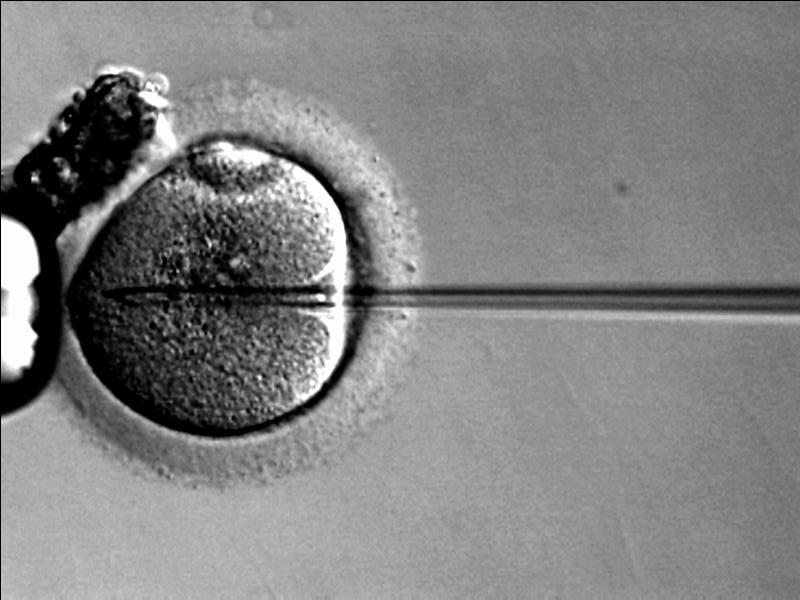
Img credit: RWJMS IVF Program, Wikimedia commons.
Intracellular sperm injection (ICSI) injects a sperm directly into an oocyte (see left). It's used for very abnormal or poorly motile sperm and low sperm count. It replaces part of the sexual act and is not licit; do not participate, although you may observe.

Embryo transfer is a slightly hot topic within bioethics. However, I don't see it as that contentious. Fertilization has already occurred, and the sex act has been totally replaced. The local motion of the embryo into the uterus is actually a step in gestation. It seems that ET, therefore, is not illicit and you should actually rejoice that an embryo is being given its rightful place instead of being condemned to that "absurd fate" of cryopreservation.

INVOcell is a new technology being marketed as "mini-IVF," and it basically replaces the embryology lab with a small plastic capsule carried inside the patient's vagina during a several-day incubation period. This conserves funds used to pay an embryologist, maintain sophisticated lab incubators, and maintain multiple federal standards. INVOcell still involves removal of the egg from the patient or use of a frozen egg, masturbation or sperm donation, fertilization outside the body, and ET. It can still involve PGD and embryo destruction or cryopreservation. Treat INVOcell as you would IVF.

Third party reproduction is use of a gestational carrier or use of donated gametes. As a trainee, there is little to nothing you can do about it, as most couples will come to their REI already with a gestational carrier in mind or will elect to use donated gametes without your counseling. If offered the opportunity to counsel on third party reproduction (especially gestational carriers), offer the patient the complex legal truths surrounding these entities, and recommend they speak to a lawyer, to trusted friends and spiritual leaders, and to seriously consider the possibility of adoption.

Transgender medicine is a misguided effort to alleviate real suffering that individuals feel due to a mismatch between their phenotypic sex and their psychological perception of their gender. Hormonal treatment in these cases, like in cases of fertile women seeking contraception, is manipulation of a healthy organ and not medicine. Surgical transition is mutilation of healthy organs. Do not participate.

Sexual Health

There is a lot of material in treatment of orgasmic disorders that amounts to pornography and masturbation. You may teach a woman the location of her own organs with diagrams and even with a mirror, but be very careful to maintain clinical professionalism and (obviously) always have a chaperone in the room. You may explain the function of these organs and how women experience orgasm (including how they experience it differently). With the magnificent teachings of the theology of the body, reassure women that sex is good, that it is meant to be enjoyed.

You may recommend a patient to psychological or psychiatric services for comorbid disorders. Be careful when recommending her to mental health services simply for her sexual dysfunction, as they may recommend illicit methods to become more comfortable with sexuality. Do not refer her to explicit websites or video series. Do not recommend self-stimulation. Do not recommend experimentation with more than a spouse.

Psychiatry

A relatively prominent problem that has come up since I've started this blog is quality of psychiatry services. Some mental health professionals, especially those who adhere to the whims of the APA, not only have incorrect ideas of sexuality but also have incorrect ideas spirituality and medications. Others are incompetent.

I've seen OB/GYN residents and fellows of all stripes struggle with conflicts with consultants. Bottom line is: if you don't think the provider will offer benefit to your patient, don't consult them. Consult someone else. If there is no one else, use experts available in other venues (online, prior institutions) to answer your clinical question.

Vulvar care

As with sexual health, anything amounting to masturbation should be avoided. In general, the other meds, lubricants, behavioral modifications, and hygiene counseling in vulvar care is licit.

End-of-life (GYN oncology)

Futility of surgery: many, many times residents in my program have operated while not being excited about it, although we're young and maybe don't understand everything. If your conscience moves you to protest a surgery based on a patient's medical fragility, say so and consider escalating it to the ethics committee if you have an appropriate way to do so.

Some oncologists do not give percentages for success for treatment unless a patient asks. Others always deliver expectations. If a patient asks for a percentage of success, always give an evidence-based, up to date number or offer to ask someone for the answer and do not rest until the patient gets an answer or says she doesn't want one after all. If you believe someone is being led to chemo or to hospice out of a wrong idea of percentages of success or failure, ask the attending and ask the patient what their view of the situation is, before wading in.

Ethics committees are great except when they're ineffective or pancretist. When faced with an ethics committee that cannot find the moral truth, many trainees are powerless. It is licit to withdraw your opposition in the face of impossible odds, but it is best to make it clear that you still maintain your position and beliefs.

Hospice is great except when its not. Sadly, since I've started this blog I've realized that not all hospice programs are focused on the patient's autonomy. If hospice personnel at the program that will be covered by the patient's insurance demand code statuses that the patient does not want, or demand POLST or other documents the patient does not want, offer to provide similar services (e.g. narcotic and benzo scripts, DME scripts, megace/nutritional scripts, anticholinergics) through the resident clinic or another venue. Never participate in physician-assisted suicide. Counsel actively against it.

Sunday, January 11, 2015

Residencies' Reactions to My Choices

I interviewed for twelve categorical (four-year) OB/GYN positions at programs all over the country. Overall, most of them received my choices (not to prescribe, sterilize primarily, or abort) well. This surprised me. In retrospect, I think this largely had to do with careful selection of the programs and the fact that I was a very, very good applicant. (I scored in the 96th percentile on STEP 1 and the 80th percentile on STEP 2 CK, and most OB/GYn applicants in last year's match floated just under the 50th.)

Some programs challenged me, though. I was told at one program that my counseling on contraceptives would have to be observed and checked off (not usually a skill that needs to be observed and checked off), so that the program director could be sure I was being unbiased and using evidence to talk about NFP. I was told at another that I couldn't teach NFP in the clinic because it would be (to paraphrase) a disservice to the women of a certain demographic (poor women with less education). A third program said that my choices would not be compatible with what they saw as mandatory for the education of an OB/GYN (I won't be ranking them).

Everyone was polite. But it was clear in those three settings that what I am choosing to do is not an
equivalent alternative to mainstream gynecology.


There were other programs that were off-putting because of their liberal cultures. The program where "every" resident had "their" IUD and carried little Mirena samples on their ID badges to show to patients. The program where the endearing favorite professor was dear because he was the "gay friend" to all the residents, and heroically did sex-change surgeries. And finally, the Catholic hospital that repeatedly reassured us that the ERDs "do not get in the way of providing what your patients need."

But I'm happy to say that I have a strong top six programs, at any of which I would be happy. Truth be told, I'd be happy to be an OB/GYN at any of the programs I'm ranking, so I'm very grateful to God that he made all this possible!

Thursday, April 4, 2013

Quick Takes

1

I had my second-to-last test in clinical skills. A group of about 25 second-years came into a room in the simulation center. Two of the three course directors were already there (the course directors are primary care physicians and very earnest about physical diagnosis, professionalism, and accountability...I don't know any better examples for us) and they explained the way the exercise would test our knowledge of history-taking and physical exam skills (taking an "H&P").

We would have a patient come in and pretend that we were doing a full H&P to admit this person to the hospital. Names would be drawn at random from a box and the students whose names were drawn would complete sequential parts of the H&P. This is meant to ensure that we all know the H&P very well (not unlike random selection of students to demonstrate propositions in freshman math at TAC).

Surprise! Our "patient" was the third course director, dressed in overalls and a John Deere hat. That made us laugh! It took away any potential intimidation that we'd feel, doing our exam on a teacher and doctor. It was fun. As a group we were well prepared, although I think I was not as well-prepared as some other people. I have my final test next week.

2

I am in my last block before the second year ends and I spend a few months on STEP 1 before third year. The musculoskeletal/integument (bones, joints, muscles, skin, hair, nails) block has been pretty easy so far. We're all tired and can't wait to only study for one thing (STEP) instead of two (STEP+school). 

3

We had a presentation on third year today at lunch with some current third-years. We asked "what exactly is 'rounding'?" and about weekends, calls, and schedules. What did they wish they knew? What would help us shine? The general gist was: be humble. The third-year medical student is the lowest on the totem pole and should acknowledge it and be comfortable with it, using her time to diligently learn, work hard, make other people's lives easier and not harder. She should be professional, not mind the lowly tasks, get used to feeling out of place, be open about her knowledge deficits, and roll with the punches. "We all just have to be humble," one third year said in closing, using the word 'humble' for the first time. "Pride is your biggest enemy third year."

4

The end of the ERHS (endocrine/reproduction/human sexuality) block was the "HS" component, and I am really striving to let everything roll off my back instead of getting depressed about all the sin/mess/wounds/errors/backwardness currently accepted as love/awesome/healthy/normal/progressive, especially touching sexual "orientation," sex "changes," sexual practices (before/during marriage/"marriage"/any relationship with whatever person(s) consent)....

But you know what's interesting? My Catholic faith is strengthened by the fact that we couldn't leave the block without someone talking about the Catholic Church. One lecturer in particular, who was supposed to teach about the specific healthcare needs of the LGBT community, spent most of his time talking about the Church. At one point, I doodled in my notes, "why are we talking about women priests?" We also covered how Pope Francis would be so much better than Pope Benedict, celibacy, chastity, St. Teresa of Avila's transverberation (shudder), exclamatory prayer (double shudder), biblical hermeneutics (his term), repression (moan), and indulgences (yawn). There was more, but I might bore you. The upshot is: you know it's Truth when it is maligned to justify insanity.

5

Interestingly, that talk made me realize how much scandal is given by Christian dis-unity. This lecturer used the fact that people have different bibles (e.g. zero or two or three books of Maccabees) and that there were apocryphal gospels and different interpretations of scripture to justify his rationalization of homosexual lifestyles with Leviticus 20:13. If we were more unified, we could set a clearer example for the world. I didn't realize that the world needs Christian unity as much as the Church does.

6

I've also learned recently (during the Triduum) that to be called or perfected isn't to leave our sins behind, as though you only become a saint or "get" a vocation when you're all perfect so that you'll look good in your halo. No: we are called and redeemed at the same time and out of our muck. 

One of the hardest things I'm dealing with is the guilt of hurting others, and that comes to a pinnacle when I think about Good Friday and the Crucifixion, when I hurt the Incarnate Word who was suffering me so that he could have me with Him in heaven forever! This Lent/Holy Week/Easter was very good for me. Thanks be to God! I hope it also was for you.

Thursday, September 13, 2012

Struck by Dignity

This post conforms to the blog rules.
Another opportunity to think on my feet: I was told to see a returning patient who was following up on pain problem.

The patient told me about her pain and that she figured out what started it all: holding the phone with her head for hours while working around the house. At that time, a new relationship was beginning for her, and she would spend a lot of time on the phone. After a few more minutes of history, I asked her conversationally about that relationship.

She told me it was great! They were finding so much in common and it was a great source of enrichment and joy for her. I could see that it lit up her face. Then, between sentences about how the relationship was flourishing she said, "now, I won't lie to you, it's not a man--it's another woman, and..."

I stopped hearing her for a few words, feeling as though I had been struck. Everything was so normal until that sentence. Now what do I do? Instantly I began to determine how I should receive this news: it is clear that this relationship is more than friendship and I know that homosexual acts are naturally disordered and spiritually harmful. But I am not this woman's doctor and am, in fact, a stranger and a medical student visiting the office for education. But will I give scandal if I calmly smile and nod? I am wearing a crucifix and am therefore a representative of Christ for this woman, who is surely observant enough to notice my necklace.

The patient was concluding, saying that she felt valued in her relationship. I decide to say true things but withhold the truth that is inappropriate to provide. "I am so glad that someone can make you feel the dignity you have as a person, can appreciate your worth," I said.

Her response was almost as shocking to me as the original admission. She was delighted! She said, "that's exactly it," and that I completely understood. She went on about her partner while I went off into thought. Untangling my thoughts later, I wondered:
  1. This woman only found appreciation of her transcendental value in this relationship. This is terribly sad: everyone can appreciate everyone's human dignity...we don't need intimate relationships for this (although I'm sure this love is crowned with greater intimacy).
  2. Is hunger for this appreciation fueling homosexual intimate relationships and the gay marriage drive? 
  3. If there someone else made this woman appreciate her human dignity, her , would she ever want a homosexual relationship?
  4. This woman is missing out on a unique element of marriage: self gift as a woman, to a man. There is so much more to marriage than simple (though profound) appreciation of human dignity.
The patient later told my preceptor that I was "an excellent human being" (I guess, the highest praise of the secular world?). I think I was at least excellent in one thing: I saw what she loved about being loved.