Sunday, July 5, 2020

My experience with covid-19

World map of covid-19 cases.
Source: wikipedia, licensed for reuse.
A friend of mine has been keeping a "plague journal" during this time in which our lives have been heavily impacted from the coronavirus pandemic. She then emailed a bunch of her friends to ask for guest entries, and this post is mine. It's going to be a bit messy because I've never allotted a lot of time to editing this post, but enjoy!


#

I became aware of a novel coronavirus in China at a medical conference in the first week of February. There were murmurings of it, like there were murmurings about H1N1 in its early days. But it wasn't yet dominating small talk like Ebola was when I was a fourth-year medical student. We were focused on our conference. I was learning Twitter, which I had gotten a few years ago but never used. As February ended, a moratorium on travel to and from China began. This impacted me because coworkers had recently gone to China and were planning to go to China to learn CVS and amniocentesis at high volumes. Those trips stopped completely and those who had just come back had to call our employer for 14 days and check in as afebrile.

Healthcare worker donning PPE. Src: DOD.
Licensed for reuse.
Then, in early March, a small natural disaster happened in my city, prompting most locals to go into mini-crisis mode and stocked up, got gas, boiled water, etc. In my hospital system, flow was diverted and shifts were changed at the last minute, which increased the feeling of "Something is different and we're adapting and life is thrown to the winds to take care of patients." By this time in March, I had enough insight about covid-19 coming to the U.S. as a pandemic to remark to friends that this small natural disaster was preparation for covid-19. March 13 (a Friday the 13th to beat all Friday the 13ths forever) was my last Mass and last hug for some time. The very next weekend our obligation to attend Mass was lifted, and I did not go because I had just spent a week huddled over a manuscript with someone who was now febrile and super sick at home (turned out not to be covid-19 but still). I felt quite conflicted about it then, but now would feel extremely good about that. Interesting how my sensibilities have changed!

I was on a month of outpatient clinic in March, and starting from the beginning of March we were making drastic changes to the way outpatient obstetric and gynecologic care worked. We were postponing all postponable visits (e.g. well woman exams) and we were spacing out obstetric visits whenever possible ("I see you're 13 weeks. See you at 20 weeks!"). Even for women with pregestational diabetes who had very complex insulin regimens with weekly changes, we converted all insulin management to outpatient visits (telephone calls and virtual visits with diabetic educators). People senior to me did most of the design of how visit scheduling would change, but I was the one to comb through clinic schedules and say when people could be put off to. Clinic work began to leak outside of the (admittedly light) schedule and I did work from home a little.

Person in PPE. Src: Google images.
Licensed for reuse.
I signed up for the emergency physician pool in our hospital system, which could call upon physicians to work in various needed disciplines if our medicine and ICU volume began to peak due to covid-19. I volunteered to work the ED and wound care clinics as well as OB and GYN shifts if they arose. In the mean time, I began to prepare for the next month, during which I was scheduled to work an average of six 12-hour shifts per week on our inpatient antepartum service. That schedule had been made long before the pandemic, but now it turned out that I would be working inpatient during my city's predicted peak of cases. I was nervous, but not anxious. I was not preparing for the right catastrophe.

The peak in March never came, and the peak in April never came. We successfully flattened the curve in my state and city, and we were working at about 50% capacity the entire month in terms of ICU beds. In fact, there were relatively few pregnant covid patients during my month. (50% may sound disappointing, but please remember that with exponential functions like x^2, each step is doubled and perhaps the step after 50% would be 100%. So I was very happy with 50%.)

N95s. Front left and front right are the types I've used the most.
Back row is actually worse for because it has a valve that allows
unfiltered breath back out. I donated some of those to our system
because paint guys still gotta paint and I don't want t
hem using our healthcare-grade ones. We resterilize 10 times.
Src: pxhere, licensed for reuse. 
Many of my friends who are conservative and drink a little more of the red koolaid than I do were very dissatisfied with the lockdowns, etc. I listened (I even listened while eating on patios and in people's homes for a little while), but I couldn't empathize. Perhaps this was because I got onto Twitter in February at that conference, and #MedTwitter is usually drowning in blue koolaid if anything. I felt very, very uncomfortable with the tension between my couple of right-reactionary-conspiracy-theory family members, my Trump-loving-friends, my extremely-progressive coworkers (I'm in OB, what can I say?), my rad-trad pastor (who nonetheless has been a staunch advocate of masking and social distancing), and the schizophrenic news cycle. All this plus the strain of April's average of six 12-hour shifts per week and I was spent. There was plently of workplace strife surrounding all this (safety and tradition driven, compromise averse), and that made it stressful, too.

May saw me transition to a lighter outpatient rotation. Where March and April we had spaced out ultrasound visits, in May we started to go back to normal because covid-19 cases were declining. This was just in time for my ultrasound rotation that had been scheduled in May, and I was very excited about that. This rotation was known to be the most formative in terms of ultrasound skills for the first year fellows. It didn't disappoint, it was a great rotation. I'd been universally masking since mid-March, but it was still somehow odd to wear a mask in an ouptatient setting. It had been drilled into me as a student and then as a gynecologist that wearing a mask outside the OR was rude for me. Occasionally anesthesiologists, CRNAs, or ICU personnel would have one around their neck or on. I guess I'd seen them on healthcare workers during flue season who weren't able to get the flu. And all those years, it had seemed a silly look. Sort of out of place, unnecessary, dorky.

Source: pxfuel.com. Licensed for reuse.
Now I shudder when I see a photo without masks. (Sometimes to absurd levels. I saw a photo of St. Theresa of Calcutta and Pope St. JPII without masks and thirty-some years ago, and I still had a visceral reaction before reminding myself "They're not giving scandal, they're just in the 1980s.") The debates between Republicans and Democrats on social media blew up. I saw liberal friends who wholeheartedly trusted bodies like WHO and CDC quietly retract their early support. I made futile attempts to convince alt-right loved ones about virology. And I watched Trump go from strong-economy-unimpeachable odds at re-election to I-and-those-I-chose-botched-two-major-events-in-history odds at losing to Joe Biden. I watched Catholic and pro-life figures choose the wrong side of biology and the wrong side of the racism debates...so disappointing. (It strips any of us of our credibility, it urges people away from the truth! My whole work/prayer/life is about urging people toward the truth about hot-button topics, and boy do I feel undermined.)

In June I took two weeks of vacation, because I had to "use" them because "they won't roll over." Interestingly, for separate reasons many of the faculty were burning vacation days at home because the department (like most hospital departments that rely on elective cases) was issuing physician pay cuts and requesting the voluntary use of vacation time in large blocks to spend down excess. The first week of "vacation" I spent basically doing a normal week, half-heartedly trying to take it easy. The second week I just hauled out to visit friends in another state (plane trip very not socially distanced, but with reduced seating and universal masking). We didn't do anything too scandalous, although I did break down social distancing barriers between two households. 

Src: navy.mil, licensed for reuse.
Now we're in July. I've been stressed because 50% of my job is technically research, and not a lot of that got done in three months of clinical work and one month of nervous vacation and housework catching up from said three months of clinical work. So now I'm trying to start over, giving my day structure with exercise and work from home and occasionally from clinic. Cases in my city and state are rising again because of reopenings. I'm on genetics (a lighter clinical rotation that should let me catch up on research), and all genetic counseling had been made remote during March and April. Just in May it had returned to in-person, but now in July it's being made semi-remote again, especially after there was a small cluster of covid-19 positive workers in one of our clinical sites. 

I haven't gotten off the rollercoaster, but I've found a new normal. Strange to say that the new normal is putting on N95s with tally marks to show how many times they've been reused by different people. Strange that the new normal is texting with one neighbor about the positive cases at her job and offering to collect her nasal swab, and meeting another for the first time because of an Amazon mix-up (I rarely if every got stuff from Amazon before this). I've weathered it overall well--economically I was unscathed, and work basically flowed through my normal rotations. But psychologically it's been a strain, more because of the political battle and the drama these stakes can create in a medical workplace, rather than any physical strain or apocalyptic hospital scene.

Src: whs.mil, licensed for reuse.
I have come to expect and accept that I may get covid-19. I was ready for it in April, now I'm expecting it in August. But I'm living with structure. My prayer life has been steady through this, with times of consolation and times to desolation. Some of the sweetest experiences come when one thinks about one's own death, and finally shaking off this life and going to be united with one's Spouse! Other times the exhaustion and failure to prepare for mental prayer made meditation more like a duty. I went without Mass for 7 weeks. I watched overly scandal-given Catholics make this into another bishop scandal, rolling my eyes as I did. (Parenthetic rant: The Church suspending the obligation for weekly Mass is not impossible or unprecedented, and it is not for the laity to complain about it! The trads who were having tantrums "on the timeline" about it are making the same mistake some followers of Vatican II did when they overpriestified the laity. The clergy have legitimate authority, be obedient to it! "One communion lasts until the next," as St. Faustina wrote. Many Catholics went years and generations without the Mass, let alone without the Eucharist. Chill out!!)

This July fourth, I will not be going to Mass or going grocery shopping (even though I need both) because cases are surging. Our ICUs are full at my hospital, although the community hospitals are not full yet. A prominent children's hospital has begun to admit adults. In a way, perhaps it's a particularly bad time to write a covid journal, because covid is very much not over. But it's a start. I pray that the future brings economic stabilization for the less fortunate, lower death rates for the sick, listening and neutrality back to public discourse, unity back to Christians, and adulthood back to politics.

Monday, June 22, 2020

Picking up the Postconciliar Pieces

Let me tell you what it's like to be a Catholic millennial.

I am an older millenial, who remembers the days of dialup, and I'm obviously stuck in the past of the individual blogger. I remember the language of the "new springtime in the Church," the new Advent, language of the 90's and early 2000's. But I didn't realize that during my lifetime, the Church would have to pick up so many pieces we didn't know existed after the sexual revolution and after Vatican II. No matter what you think of the council, you have to acknowledge that we have a nuclear fallout level of cleanup to do. This post catalogs my realization of the size of the work to do, and my thoughts about it.

Some people may have realized that Vatican II would lead to radically irreverent liturgies (think "clown masses"). That is a travesty, but it's largely over. The disappearance of these liturgies was more or less spontaneous: there were outcries, there were reprimands, there was unhealthy silence on the matter, and then the people interested in those types of things left Catholicism behind in favor of openly irregular parishes, non-Catholic charismatic communities, or life without religion. Every time that something like this happened again (beach Mass, dog "receiving communion," etc) the conservative whack-a-mole arose again, but its machinations usually weren't needed. Slowly, parishes and parishioners that favored those things aged. Even now, those ideas and that architecture are being phased out.

A residue of bad architecture, bad catechetical materials, and liturgical carelessness remains. A casualness about parish announcements, extraordinary ministers, and the Real Presence persists. Even priests who would never experiment with the Mass ended up committing subtle and not-so-subtle irreverences and liturgical abuses, probably through poor formation. Mass even without gross ("clown") irreverence is, in most English-speaking Novus Ordo rites, celebrated more like an important human tradition (think Memorial Day salutes to the dead) and less like an act of divine worship (think Crucifixion). It's hard for priests to fight this, although for the good it is becoming easier and they are making it easier for others.

Some unexpected effects of the radically irreverent liturgies include the steep rise in unbelief among those who still call themselves Catholic. This seems stranger to me than those who want the moniker but want contraception or divorce. The Real Presence is an entirely intangible belief that (while difficult) has no real-world perceivable gains by its denial, as might contraception or abortion. Why are we denying it now, all these years after the Enlightenment has taught us that the physically measurable and useful is all that is? Why now, all these years after much of protestant theology has made Christianity out to be symbolic and practical for prosperity? I see it tied to a failure in orthodoxy and orthopraxis. We didn't do it or say it (lex orandi) and we don't believe it (lex credendi). Humans are cultural animals: when we aren't inculcated to the truth, it's much harder to grasp.

Another unexpected effect of radically irreverent liturgy is the fragmentation of conservative liturgical groups. The more decades pass between the origin of the SSPX and the present day, the more difficult it becomes to untangle all the events, souls, and teachings (both praiseworthy and troubling) involved. Add the FSSP and various media outlets (Church Militant, the Remnant) and it's a dizzying cacophony of voices that all want orthodoxy back, but are opposed to each other in various ways for various reasons, whether good or not.

In the aftermath of Vatican II, there was an enormous breakdown in trust in an authority, followed by the unveiling of significant scandal which further compromised current ecclesial authority. This breakdown in trust seeds discontent among allies, a purism that makes it hard to work together. This not only affects Catholic organizations, but others of similar mission, such as pro-life organizations. Certainly, many good ministries and collaborations have arisen, such as the Ruth Institute and Women Speak for Themselves. But so much damage has been wreaked among the most important organizations, such as SSPX and groups of sedevecantists, has been far more deleterious than the perceived benefits from other organizations. In particular, I have perceived a rise in sedevacantism since Francis became pope. I imagine this is like what St. Augustine felt among the Manicheans or Pelagians, or St. Nicholas among Arians. When I meet one who says he is "Catholic," is He like me? It is a very wounded Church we live in.

And I predict that after covid-19, Mass attendance in many parishes will drop even further. Where there is no belief in the Real Presence or the authority of the Church, why will there be Mass attendance when people have seen how little their lives are impacted without a homily on the values they hear about in TED talks or in the online sermons that were already being put out weekly by the nondenom church nearby?

Some parishes which are better catechized or more tightly-knit may not suffer this. But I expect this double blow (the "spirit of Vatican II" and the abuse scandals) has had and will have had far-reaching effects for parish life. It has had and will have effects in ministries like EWTN, Word on Fire, Church Militant, and others. Is had and will have more effects on individuals and their vocations to married life, consecrated life, and holy orders.

We will be picking up the pieces for a long time, and we will discover pieces (like sedevacantism and conservative infighting) that we never expected to have to glue back together.

Monday, June 8, 2020

Quick Takes

We're still in pandemic times, so here are some quick but fiery opinions.

#1

Whatever you think of external fetal monitoring, the fetal heart rate strips remind me a little of Adoration. The fetuses have be watched constantly, and the culture of OB/GYN labor and delivery teams is to want someone to watch them. If we're going down to get snacks, we think about who is watching while some of us go. If we get distracted by something, we look up and make sure what we just missed looked okay. If the system breaks down and we can't see the strips the way we usually do, we find a way around this to watch the strips. In Adoration, you can't leave the Blessed Sacrament alone. He is vulnerable. You may not be able to see him as usual sometimes, or you may have to leave, but you're solicitous about Him never being alone. When you get distracted from Him, you check right back in.

#2

I recently heard an argument that it is more merciful to do a KCl termination followed by an induction of a dead fetus, rather than to deliver a live fetus and have it painfully gasping for air. "I couldn't bear watching my baby gasp for air," the argument goes. While I empathize with that emotional response, a KCL termination is different in the objective nature of the act--it directly takes the life of the unborn, and we don't know if it's painful or not. A gentle induction which doesn't take that life directly can be followed by perinatal palliative care. Just like for an actively dying adult patient, morphine can be given for air hunger. Even so, it is not clear if extremely preterm babies feel this, but they can feel pain and much of their skin is not keratinized. (The air hunger question is particularly important because that's the emotional hinge of the argument, but fetuses under OB/GYNs' management are constantly experiencing difficulties with acid-base balance and we don't consider this painful.)

#3

Dear Editor,
NaPro technology is a little bit primitive and behind the evidence-based-medicine times. And it sort of likes that. But it's not really ready for prime time in medicine right now, so let's stop pretending that it is. Instead, why don't we work on getting it there?
Sincerely, a Catholic OB/GYN

#4

I took care of a lesbian patient who was overjoyed to tell me about her coming out. I told her I was glad for every step she took closer to real love. This story happened before the blog issues related to LGBT posts. I'm still angry about this misjudgment of me sometimes. (But forgiveness sometimes doesn't take away all the emotions connected to an experience. So I suppose that's okay.)

Monday, May 25, 2020

Discontent with Arguments against Birth Control

Get ready for some ideas that have been stewing in me for some time, but are coming out now as a rather unedited blog post because we're in the middle of a pandemic. As a board eligible obstetrician and gynecologist, I don't like some of the arguments and language used to explain why contraception is wrong. Comments are open, content is subject to the Church's teaching.

"Birth control is a crutch."

I don’t like the arguments made by certain bioethicists that hormonal birth control is a "crutch," and therefore it’s wrong. This is certainly not the only argument they have against birth control. But let’s think about crutches: they’re actually a really useful medical treatment to take a load off of a healing joint. If this is an apt analogy, then birth control is a really useful medical treatment for...something? What do these bioethicists claim we are bridging towards with birth control? I think their position is actually that birth control is intrinsically problematic and it is being used lazily and problematically. But “crutch” is absolutely the wrong word for that. When making analogies about medical things to medical people, at least make your analogies accurate.

The real scenario is actually more like the analogy and less like the intended meaning. In its best form, birth control is a bridge to something better according to gradualism.

"Birth control is bandaid therapy."

Furthermore, I also don’t like the word “bandaid” in these analogies. Birth control as “bandaid” therapy is an oft-used phrase in Catholic gynecology. Rather than solve the PCOS or dysmenorrhea or whatever (so goes the argument), physicians prescribe birth control to “cover it up.” Can we talk about how this is not a good summary of what birth control is doing here? The best example is PCOS. Certainly, we are not solving PCOS at its root cause, but that is because we don’t know its root cause. And NaPro, regardless of how much more natural it is, also doesn’t address the root cause. A sign of this is that medical NaPro has to keep treating and treating and treating its patients with cooperative E and P. (Ovarian wedge resection is the closest thing we have to addressing the root cause, which is part of surgical NaPro.)

But OCPs being used for PCOS do more than just "cover up the problem." They don’t simply hijack, replace, or cover up a woman’s natural cycle. They interrupt the failed cycling that a PCOS patient has, which is much closer to stopping the problem at its source than the "bandaid" argument makes it sound. PCOS is possibly best conceptualized as a failure to move through the menstrual cycle, instead getting stuck somewhere close to the LH surge, which produces the effects of hyperestrogenism and hyperandrogenism due to aromatase (including abnormal hair growth, endometrial hyperplasia, glucose intolerance, and abnormal blood lipid concentrations).

Birth control (unlike cooperative E and P) puts a stop to this arrested cycle at its origin, the hypothalamus, by suppressing secretion of GnRH. It upregulates sex hormone binding globulin (SHBG) which sops up extra estrogen in the blood and eases the effects of hyperestrogenism and hyperandrogenism. It hits a reset button on the CPU of a woman’s cycle: not natural, but sometimes needed for normal operations. It’s not a bandaid, it’s actually a pretty sophisticated cocktail of shelf-stable hormones that work by a clever mechanism of action to stop dangerous effects that PCOS can have on a woman's body.

I will happily admit that birth control as a "bandaid" is a much more apt analogies for conditions like dysmenorrhea, where it may actually mask conditions like endometriosis. But even here, there is a legitimate role for nonspecific medical therapy before surgical treatment in many common conditions, such as anemia of unknown cause or back pain. Why should we belabor gynecologists for wanting to do something that will most likely be helpful, as long as it's not illicit?

"The pill kills."

We really need to stop saying “the pill kills” as an argument against contraception. This holds no intellectual weight with any kind of opposition. All medications have side effects, and many medications have caused death. Many very important medications cause more death than the pill. The doses of estrogen are lower than the doses in the original pills which could be classified as carcinogens.

True, women don’t need these medications the same way they need warfarin or vancomycin or even Tylenol. And true that even small doses of estrogen can, over long periods, affect multiple body systems and we continue to see effects of hormone therapy in women of all ages. But “the pill kills” as a soundbyte-turned-argument is not serving us well. Admit that the pill is actually a pretty clever and pretty safe medication, and then debate whether its small panel of side effects should be taken on for fertility (a good)—you then have a more robust argument without so many holes, and an argument that better resembles the true problem with hormonal birth control.

Saturday, February 29, 2020

Why Medical Matins was private, even after residency was over

As you may have read, this blog was private from December 2017 to February 2020. While I was thus censored by my institution, I continued smilingly recruiting for it, and then serving as a chief resident. It made the last year and a half of residency (already difficult because of the responsibilities of the role of an upper-level resident, the added weight of administrative chief duties, and the process of applying for fellowships) a white martyrdom.

Inside the Student Jail, Heidelberg, Germany.
CC License. Wikimedia Commons.
Gradually I opened up to more people about this event. But during it, I could tell few people how painful this was: two friends in the residency, one attending who happened to also be a personal friend, my family, and a few friends outside the program. I want to share a short post which was originally written on March 23, 2018. Writing this post two years ago, during outward silence, felt like scrawling on the walls of a strange prison. The topic of the post was what I should do with the now-private Medical Matins.
What should I do with the blog itself? I am tempted to post a lot of very unedited content while the blog is private, then launch it again as public when I am no longer employed by this institution (and no longer bound by amiable agreement not to publish it). I am tempted to leave the blog derelict, floating in the massive amount of online content, for others to find. I want this so that I don't have to do any more work, and yet so that others can think well of me if they find the good things available on the blog. 
I know derelict internet things die, and I don't want Medical Matins to die. It's a helpful outlet for me. The blog gives me an occasion to pray the litany of humility (which I set as the default text of each post before I replace it with the actual content of the post), and then organize my thoughts and prioritize my emotions using the blog.
And I think Medical Matins is good for others. At least half a dozen (I've never counted and I'm trying not to over-estimate) medical students and others have contacted me through this site to ask about pro-life and pro-NFP residency. And it's been found by others who have disagreed, and resulted in dialogue.
So why, you might ask, didn't the blog pop back up in July 2019 after I graduated from residency? Well, at the close of residency, I didn't ever want to fight anyone, ever, again. I didn't want to be called into offices, I didn't want to give explanations, I didn't want to be chastised. I didn't want to diplomatically meet with others about whether my chastisement was just. I didn't want to write letters and discuss issues. To show you why I felt so deeply cowed, here is some more writing from March 2018, three months after I took down Medical Matins. I wrote this post into a draft which remained unpublished for the past two years. (It's also important that you know that I wrote it after a long week of nights, and after some additional personal disappointments, and I know my emotional milieu was messy.)
Should I continue blogging? It has caused me so much pain. This is a blog about my experiences, and I always return to that mission when I feel like a post has strayed. And the experience of my blog being censored is one of the most painful experiences of my residency. Why would I not write about it? Why would I not continue to write after this censorship is over?
I'll tell you why. I am an introvert, I am vain, and I am proud. This is a terrible combination in someone made to fulfill a public vocation, to train long into adulthood and be corrected by others, and to witness publicly to unpopular truths in an unfriendly culture. My introversion and faults are punishingly heavy because of my recent mistakes and failures, with a background of my censorship and another large-scale issue that I might open up about soon. My soul's problems can be a prison, without anyone's censorship! A prison that I am sadly used to, and one that I am striving to grow out of. The introvert grows quickly exhausted with people, and the vain person grows depressed and angry with failure. Perfectionist, the vain and proud cannot cope with failure. So I walk into a prison of my own making whenever I am corrected, disliked, or discovered as less-than. This is one reason why I don't think I can restart MM--I can't spring back when I have so many prison doors between me and the future.
Dore's depiction of Lucifer, as described by Dante in the Inferno.
CC License. Wikimedia Commons 
Faith shows the reality in all this turmoil. Humility makes me acknowledge that yes, I am correctable, not always likeable, and lesser in many ways. But Christ welcomes me in my humility and does not wait for me to become loveable to embrace me. In a way, I say "Thank God!" because to be loved before becoming worthy of love is a warm relief in the coldness of others' disapproval. But in a way, my pride interferes with God's unconditional love and says "But I want to perfect in se, I want to be admirable before I approach God." 
I stand where Satan stood, able to lock myself into a self-made prison. Let me avoid it. I must let go of the desire for any merit in myself and only look to love God and find comfort in doing His Will. If I do this, I will find strength to fight again. I will find the ability to restart MM if that is what God wants.
Inside the Templar's Prison.
CC License. Wikimedia Commons
Let's pull up that litany of humility one more time:

O Jesus! meek and humble of heart, Hear me.
From the desire of being esteemed, deliver me, Jesus.
From the desire of being loved...
From the desire of being extolled ...
From the desire of being honored ...
From the desire of being praised ...
From the desire of being preferred to others...
From the desire of being consulted ...
From the desire of being approved ...
From the fear of being humiliated ...
From the fear of being despised...
From the fear of suffering rebukes ...
From the fear of being calumniated ...
From the fear of being forgotten ...
From the fear of being ridiculed ...
From the fear of being wronged ...
From the fear of being suspected ...
That others may be loved more than I, Jesus, grant me the grace to desire it.
That others may be esteemed more than I ...
That, in the opinion of the world, others may increase and I may decrease ...
That others may be chosen and I set aside ...
That others may be praised and I unnoticed ...
That others may be preferred to me in everything...
That others may become holier than I, provided that I may become as holy as I should…

Please pray for me as I continue occupying this small part of the internet with my own opinions, for my own good and perhaps the good of others.

Why didn't MM's author fight censorship?

CC Andrela Bohner
As I've described before, Medical Matins was a private blog from December 20, 2017 to February 29, 2020, to fulfill a requirement from my graduate medical education department after my blog was discovered and I went through an administrative process which examined the blog content.

My first reaction was deep shame. I have been conditioned over several decades to please others, and to be disciplined was very difficult. This was also my first reaction when I was called into the office in medical school for bringing a fetal model to a lecture containing material on elective abortion.

My second was confusion. What was going on? Was I really in the wrong, or was this about the truth of my opinions on issues like marriage, transitioning, and contraception? When it was over, I felt outrage. I was censored because of the nature of the blog and what I wrote about. (It is my firm impression that had I held the opposite opinions, I would not have been censored.)

Good came from this, and even during the process I could appreciate it. First, I learned to care a little less about pleasing people. If I have something true to say, I should not be ashamed when people are upset. Second, in a safe space with few or no long-term consequences, I went through my career's first little trial for the truth. Third, I encountered persons who I realized need a great deal of prayer and sacrifice, and I believe it is my duty to pray and sacrifice for these people in particular.

However, I felt that the end result (censorship) was not acceptable in a university environment. I know secondary education's lost its soul, but if the university is not the setting for professional, intellectual exchange, what is? I began to go through channels so that the institution would have some intellectual honesty about the importance of different opinions on issues.

Then, I abruptly stopped, and today I want to write about why. 

Shortly after the blog issue was concluded, a patient was admitted for excision of a cesarean scar ectopic. I was on night float, and at first I heard with trepidation that there was CSP admitted because I feared that there would be an ethical mis-step. However, the surgical plan sounded like it would meet the ERDs' definition of an "indirect abortion" and satisfy the principle of double effect. Relieved that I would not have to get involved, I waited for the scheduled procedure a few days later. Then, a few evenings later, the day team announced that the surgical plan had changed. The new plan involved fetal dismemberment. Aware of the culture that anyone can "stop the line," (link if that one is broken) I nevertheless had to think what I could do to help while I was working at night and going home in the morning. I emailed the director of the Ethics Committee, just to notify him of the change in the surgical plan. 

I came back that evening to anger. The other residents perceived that I had been judgmental, holier-than-thou, obstructive, shifty, and simply wrong. I was corrected by one of the residents in front of everyone at evening hand-off. 

Ultrasound appearance of a uterus after a C-section,
with scar between the yellow arrows.
CC License. Wikimedia Commons.
As in other situations, my first reaction was shame. I was basically silent, although (since no one on my night team knew I'd done this) I did have to offer a half-sentence in explanation to them, which I had not planned to do and certainly not in that setting. Later, I formally apologized to a few attendings and the residents involved. There followed a very uncomfortable month when I felt highly disliked. Stray comments praising BTLs and LARCs and disparaging the ERDs (ordinary fare otherwise) felt sharper.

In this milieu, I felt that just finishing residency without being hated would be great, so I stopped seeking further attention regarding the blog censorship. As of this writing (which occurred originally in March 2018), I just hope to quietly finish residency with no more moral discussion.

Good things came from this CSP episode, too. I had a fruitful conversation with the Ethics Committee meeting that month (which I could only attend because I was on nights and I was off-duty at that hour), and recommended an article on CSPs that I think makes a stab at the truth. And the Ethics Committee saw that there were some communication, personality, and practice concerns surrounding the issue, and my "stop the line" email was not the most concerning aspect of the case. It is a relief that at the end of these two episodes, at least some dialogue occurred. 

Welcome back to Medical Matins

It's my pleasure as the original author of Medical Matins to reopen the blog and resume posting, with the original mission of producing original content as a Catholic, who has now graduated from residency in obstetrics and gynecology.

Medical Matins became a private blog on December 20, 2017, due to censorship by my employer. My residency program discovered the blog and discovered that it was mine. Because of my patient stories and posts about Catholic teaching, they supported concerns that readers and patients could find it offensive and could be repelled from seeking medical care as a result. The issue was escalated to a professionalism committee, which reviewed the blog content and heard my position in response to the concerns which were raised. They considered what type of action to take to address my behavior, and among the options was to suspend the blog. This was the option they chose. In addition, I had to read a young adult gay romance novel and write an essay about it. Beyond a few posts (here and here) discussing why I didn't fight this decision and why the blog was still private for about 6 months after residency, I won't dwell on the event much. I want the blog to continue to be what it had been before: a window into thoughts from a Catholic OB/GYN and consecrated virgin. I have so much more to say and do besides moan over unpleasant things of the past. But this blog is, after all, the blog of a Catholic OB/GYN's experiences, and this was one heck of an experience, so it may crop up in future posts as I reference its effects in my life.

There will be two changes now that I'm resuming content creation on Medical Matins. First, the focus may shift somewhat. Importantly, this is not a result of what happened to the blog; instead, it's because my day-to-day experience has changed. Now that I have finished OB/GYN training, ethics is less of a daily concern, although it still piques my interest. You may see fewer clinical stories or posts on ethics, and more content on topics relevant to Catholics outside of medicine. One such topic is the struggle that accompanies the return of tradition to the post-conciliar Catholic Church. Second, the posts will be more sporadic since my focuses have shifted now that residency is over. I did, after all, do without MM for two years, and I have significantly increased time I give to other projects.

Medical Matins will continue to be anonymous. As always, I ask readers to please respect my anonymity both online and IRL.

Thursday, March 15, 2018

How I Plan to Repay Loans in Fellowship

Credit: free pictures of money, flickr
Sorry if all the financial posts are not interesting to you. Just one more answer to a question and then I'll get back to medical ethics. In my defense, financial solvency is a part of my vocation!

After reviewing how I repaid small college loans in residency, I wanted to answer questions about my more aggressive plans for fellowship, presuming I match into an MFM seat. My remaining loans are all direct Stafford loans at a fixed rate of 6.55%. Listed from smallest principal to largest, there is a $8500 loan (the only subsidized one), a $15,175.53 loan, a $17,974 loan, a $19,959.60 loan, and a massive $41,000 loan (#fourthyearinterviews).

Many physicians are motivated to repay loans early (i.e. residency, fellowship, early attending years) and aggressively before investing because they're still in low tax brackets. Debts are paid in post-tax dollars and $2500 of interest on student loans is deductible with a resident's or fellow's salary (under $60,000). For residency and fellowship it would seem wise, then, to pay off (at minimum) at least as much debt as you could deduct.

Credit: stevepb, pixabay
What about your attending years? By putting money into pre-tax accounts like 403b/401ks, traditional IRAs, backdoor Roth IRAs (if you exceed the $107,000 limit for contribution to a Roth IRA), and HSAs you could place yourself in a lower tax bracket for years while working. Although this still doesn't allow me to deduct interest paid on student loans, it does make payback less painful. (The government is taking away less of each

However, I have an extra concern: I'm not sure how much I'll be earning as I start a practice, so I'd like to minimize my debt as much as possible for two reasons. First, I would hate to default as a young attending; in residency, you're still eligible for deferment because you're (technically) in training. As a young attending, the only option when you're unable to pay loans is default, which is terrible for credit scores and future interest rates. Second, the more you pay off the lower your monthly payment, which prevents defaulting.

Even so, if I invest my (projected) surplus of $9,000 per year in a low-cost index fund that represents most of the U.S. market, I can grow $1,000,000 in 37 years. (That number came from a start age of 30 with zero savings and $750 in monthly until I was 67, growing at 8%, in Dave Ramsey's retirement calculator. That seemed optimistic to me, simply because there are two commas in a number that pertains to me. But I ran it through MMM's calculator and I actually got two million with the same variables.) In comparison, my $120,000 in debt grows to $200,000 over 10 years (in this calculator and in this one, treating the loan as an asset; note the difference in number of years, since the government would never let me continue repayment for 37 years).
Credit: Skitterphoto, pixabay

I plan to behave proportionally, more because I can't find a better way to do it. I'll put one-fifth of my surplus into debt repayment (or whatever minimum the federal government extracts of me) and one-fifth into investment.

Wednesday, February 28, 2018

How I Repaid College Loans in Residency

Img credit: FFCU, wikimedia commons
I have been asked how I paid off college in residency. The answer is mostly preventative medicine: I didn't go after an expensive school, I got good need-based aid, I worked during college to avoid as much debt as possible, I lived frugally, and I borrowed a large amount from family ($11,000, which is not acquiring interest and is not being collected until after my federal loans are paid off). I don't know whether it's possible to pay off $100,000 of Ivy League undergraduate debt in residency, although perhaps extreme frugality could help you hide away $25,000 per year.

Now, to nitty gritty: I will have paid off about $13,200 of college loans during residency (and $12,000 of medical school loans) in addition to monthly payments on all my federal loans. TAC does not offer merit-based financial aid. As a result, I took loans from Navient. During the academic year that I was an intern (AY15-16), I earned $51,360 pre-tax. AY16-17 it was $52,380 and AY17-18 it is $54,308.

My first year of residency, I paid my two smallest loans: a $491 direct unsubsidized Stafford loan at a fixed rate of 5.96%, and a $3000 direct unsubsidized Stafford loan at a fixed rate of 5.16%. At the time of payoff, these cost me $524.37 and $3,356.85, respectively. This required savings of $325 monthly. My second year, I paid off a $3904 subsidized federal Stafford loan with a fixed rate of 5.35%. At the time of payoff, this cost me $3851.31. For this, I projected a need to save $340 monthly and had some left over. This year, I plan to pay off a $4500 unsubsidized direct Stafford loan at a fixed rate of 6.55% by saving $500 per month.

These were not my highest interest rates. Paying high-interest loans first makes more sense with math, but Dave Ramsey pioneered a technique called the Debt Snowball that helps you pay off small debts first and accelerate towards quickly paying off large debts. While I didn't exactly snowball, I chose to pay off the small debts first for two reasons. First, I knew my intern-year salary would be the smallest I'd earn in residency, and I'd already spent a chunk of it with moving and furnishing costs. Second, I thought the psychological benefit of paying the smallest debts first was valuable (and I was right).

An unexpected benefit of loan payoff is a lower monthly payment. December of my intern year, I paid $180.56 monthly. Despite my higher salary, I now pay $86.13 monthly, just by paying my smallest loans. You might argue that my true loan payment was $180 + $325 ($505), compared to $86 + $500 this year ($585), and point out that my payment is not truly lower. While my total amount put towards loans is about the same, the amount that the federal government requires me to pay is much lower, which protects me. Suppose, for instance, that I have a car accident or an unexpected medical expense; the government doesn't know about the $500 per month that I've earmarked for loan payoff, allowing me to use it for emergencies.

Img credit: 401(K) 2012, wikimedia commons
Looking back at my decision, I wonder whether it would have been better to direct that $13,000 to one of the higher rate loans. (The remaining loans are 6.55%; nothing to freak out about, but definitely higher than the 5% loans discussed above.) I wonder whether I should've maxed out a Roth IRA in the first three years of residency, rather than waiting for my PGY-4 year.

I think psychology trumped math in my case, but I also don't think losses were major during these three or four years. Was paying down debt a bad choice? Certainly not. Was it the most dollar-efficient choice regarding my future net worth? Maybe not; but honestly, I'm not sure. I certainly don't have enough expertise about the market's fluctuations, my 403b, and Roth IRAs. I certainly didn't have the expertise (or the time) as an intern to figure this out. I have more knowledge now, because I've spent some vacations and car trips listening to podcasts, but I'm still a financial novice. So did I do the right thing? Maybe or probably so. Am I upset about it? Not really. I'm happy that my parents provided me with some financial literacy and that I've picked up some more since then, and happy that all my federal college debt is paid off.

Thursday, February 15, 2018

The Usefulness of Bank Accounts

Img credit: startupstockphotos.com, wikimedia commons
Putting money in traditional bank accounts is equivalent to stuffing it under your mattress. Mattresses are fine, but they won't grow. However, both checking and savings accounts still have a useful role in the highly-automated but still human (read: emotional) financial life.

My checking account is part of my software secretary. My bank automatically sends checks to pay my rent, phone bill, and all my various dues to professional organizations. I just check the amounts of the dues when I get an email to make sure organizations haven't raised them, and then I just forget about it.

Savings accounts are tools to protect and manipulate money for small recurring expenses. I have several small or medium expenses each year that I distribute over twelve months. For instance, I pay $150 for an NCBC membership every January 1, and the rest of the year I set aside $12.50 each month to distribute the cost. To protect this money from myself, I send the monthly total for all these small expenses (monthly total for all my annual dues, annual renter's insurance, car insurance paid every six months, etc is $688) and use direct deposit to siphon that off my paycheck and place it into my savings account. Then, the bank automatically transfers a certain amount out of the savings account and dumps it into the checking account, from which dues (etc) are automatically paid.

Tuesday, January 30, 2018

Financial Independence

Img credit: James M, wikimedia commons
I grew up in a financially aware environment. My mother taught me about frugality, savings, and long-term goals. My father taught me about low-cost investments, buying the whole market, and avoiding emotion-based decisions. I also believed that credit cards were inherently disastrous and that all debt was evil. I no longer believe the last two, because I've fallen in with the FI/RE crowd, who aren't as anti-debt and who feel free to use credit cards, especially for travel hacking.

Briefly, FI/RE (financial independence/retire early) is a combination of two choices involving discipline for freedom. People who want to be financially independent invest enough capital to live off of non-earned income. This allows them to retire early, "coast" with a job they enjoy, pursue more risky endeavors with security (e.g. start a business or non-profit), travel the world, or just continue to build wealth. 

I've already applied some good habits to my student loan debts. I went to a state medical school, where I lived frugally and only took out the maximum loans my senior year. The other years, I took only what I budgeted and I returned any extra principal, rather than take it on and pay it back with interest. By this June, I will have paid off--during residency--all of my college loans. (As Dave Ramsey advises, I paid the smallest one first. There really is a psychological benefit to that method when you're new to paying back debt.) By next June, I will have paid off $12,000 of private medical school debt. I'll have $125,000 of federal student loan debt left, which I'll hopefully pay off in 5 or 10 years. I'm saving enough to avoid change in my retirement savings as I approach a $7,000 interview season and a $2,000 board exam cost and (maybe) relocation cost. As soon as I pay off my senior year of TAC, I'm going to max out a Roth IRA. I plan to balance investing with slow repayment of these federal loans.

Img credit: James Petts, wikimedia commons
You can rapidly acquire a bunch of knowledge with a day or two in the FI/RE community, especially if you have an elemental financial vocabulary, like my parents gave me. I learned a lot about tax sheltering by maxing out 403b/401k accounts, traditional IRAs, Roth IRAs, and HSAs. I learned the names of the funds that my dad taught me to look for. And as I approach interview season, I want to travel hack! (This requires the use of credit cards but does not include plans for credit card debt. Sorry not sorry, Dave.)

Unfortunately I think FI/RE has a lot of advantages for intentionally single people and childfree couples. Having children is a big challenge that this community discusses, although it's positive (see Mr. 1500, Go Curry Cracker, ChooseFI). I am reminded of St. Gianna Molla's quote, "we were too happy," and I'm aware of the dignity of work. Although a lot of financially independent people start businesses, write, and give back, others really use their funds selfishly.

I would like to use the principles of FI although I might not retire early. A high savings rate comes naturally to me as a consecrated person, and my income will be relatively significant. I can see using the principles of FI two ways: one, I can spend a lot of money in the first ten years of my career (starting a practice offering a lot of in-office gynecology) and start at 40 with a 90% savings rate to catch up to a modest retirement. Alternatively (and I like this better), I can max out savings early and become financially independent by 50, then ask very little in earned income, allowing me to subsidize low-income patient populations. I love the ideas of tax sheltering to avoid paying for chimeric research, abortion, and contraception. I love the idea of freedom to avoid traditional healthcare insurance and subsidizing contraception, participating instead in healthcare sharing ministries (and perhaps putting in a little more than I take out, since I'm not having babies) and paying ACA fees.

More to come. My finances have not been very exciting during the lifetime of this blog. Basically, college was "Acquire Debt and Work a Few Nominal Jobs for Med School Resume." Medical school was "Exclusively Acquire Debt." Now I'm repaying debt aggressively and I'm going to start investing more formally. I'm in a very important period for my future financial life: I'm beginning to acquire enough capital to start investing, I'm moving my net worth to zero, and I'm preparing to (possibly) start a practice. Expect to see more financial posts in the future!

Monday, January 15, 2018


I post fireworks when I publish something in a peer-reviewed journal. This is partially to celebrate, and partially to explain why I didn't do anything for the blog for these two weeks. The impressiveness of the firework attempts to be proportional to how important this publication is to me.

Saturday, December 30, 2017

OB/GYN Ethics 301

In OB/GYN Ethics 101 I went over topics for medical students, residents rotating through OB/GYN settings, and OB/GYN interns. In OB/GYN Ethics 201 I reviewed topics for OB/GYN residents in generalist settings. Now I need to review a few subspecialty concerns with a fine-toothed comb, especially those not focused on pregnancy and maternal/fetal vital conflicts.

Please remember that I'm not a moral theologian. I'm one resident talking to another, and I am happy to engage in discussion and to retract whatever is in conflict with Church teaching.

REI

Img credit: RWJMS IVF Program, Wikimedia commons.
As in OB/GYN 101, observation of almost everything is okay. Observing gives you a better ability to talk to non-healthcare practitioners (e.g. patients, parishioners, priests, even ethicists) about things they may never see.

You can participate in and perform follicle scans, simple procedures such as transvaginal cyst drainage, medical management with provera (or other progestins), letrozole (or other aromatase inhibitors) clomid (clomiphene), follistim (urofollitropin), trigger shots (b-hCG), GnRH pumps, and anything else that won't have post-fertilization side effects.

You can participate in prenatal genetic diagnosis (or screening) with great caution. PGD is a biopsy of a large percentage of a human embryo's body; it's a significant procedure for that little person, but in itself it's a biopsy, not an act of killing or mutilation. If you know or suspect that the embryo being tested may be rejected (destroyed or cryopreserved), this may be proximate cooperation in evil and you may incur some of the guilt in that act. It's rare that the embryologist would let you do this, anyway.

You can observe but not participate in semen washing, egg harvests, and intrauterine insemination (IUI). These replace or interrupt intermediate steps in sex (semen washing replaces filtering and capacitation of sperm; egg harvest interrupts local motion of eggs; and IUIs replace local motion of sperm after ejaculation. (To clarify for those who have done bench research: semen washing of animal samples or of human samples intended for research does not carry the same gravity, even if the human samples were obtained through masturbation. The participation in masturbation is remote, mediate, material cooperation in the evil and does not confer guilt in the act.)

Family balancing by selecting embryos after prenatal genetic diagnosis is immoral; family balancing that includes embryo destruction is gravely immoral. Selective reduction is gravely immoral. Avoid witnessing destruction of embryos or selective reduction. Counsel against selective reduction.

The standard of care is now clomid/IUI for unexplained infertility, followed by homologous or heterologous IVF with embryo transfer (ET) if that doesn't work. But you'll find a lot of acronyms in Catholic bioethical literature. These are mostly from the early days of IVF when people were attempting to find techniques that boosted success rates. Eventually, REIs and ASRM realized that IVF/ET was easier and nothing else made a difference, except for ICSI (see below). Bearing that in mind, here is a quick list of acronyms, defnitions, and comments that you might encounter from bioethicists:
  • GIFT/TOTS: gamete intra-fallopian tube transfer, not permissible because it replaces the marital act, if sex is every involved (e.g. by collecting sperm in a perforated condom) it is only accidental
  • ZIFT: zygote intra-fallopian tube transfer, ethically analogous to ET, which transfers an embryo into the uterus (see below)
  • LTOT: low tubal ovum transfer, moving an egg from the ovary to the isthmus of the fallopian tube or even to the uterus, without removing it from the body is LICIT when there is intention of fertilizing it with an act of intercourse and not IUI.

Img credit: RWJMS IVF Program, Wikimedia commons.
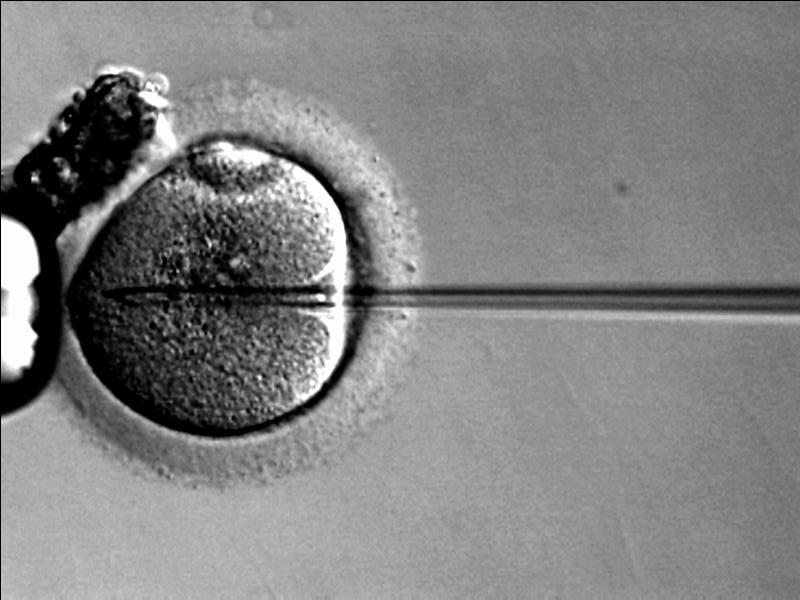
Intracellular sperm injection (ICSI) injects a sperm directly into an oocyte (see left). It's used for very abnormal or poorly motile sperm and low sperm count. It replaces part of the sexual act and is not licit; do not participate, although you may observe.

Embryo transfer is a slightly hot topic within bioethics. However, I don't see it as that contentious. Fertilization has already occurred, and the sex act has been totally replaced. The local motion of the embryo into the uterus is actually a step in gestation. It seems that ET, therefore, is not illicit and you should actually rejoice that an embryo is being given its rightful place instead of being condemned to that "absurd fate" of cryopreservation.

INVOcell is a new technology being marketed as "mini-IVF," and it basically replaces the embryology lab with a small plastic capsule carried inside the patient's vagina during a several-day incubation period. This conserves funds used to pay an embryologist, maintain sophisticated lab incubators, and maintain multiple federal standards. INVOcell still involves removal of the egg from the patient or use of a frozen egg, masturbation or sperm donation, fertilization outside the body, and ET. It can still involve PGD and embryo destruction or cryopreservation. Treat INVOcell as you would IVF.

Third party reproduction is use of a gestational carrier or use of donated gametes. As a trainee, there is little to nothing you can do about it, as most couples will come to their REI already with a gestational carrier in mind or will elect to use donated gametes without your counseling. If offered the opportunity to counsel on third party reproduction (especially gestational carriers), offer the patient the complex legal truths surrounding these entities, and recommend they speak to a lawyer, to trusted friends and spiritual leaders, and to seriously consider the possibility of adoption.

Transgender medicine is a misguided effort to alleviate real suffering that individuals feel due to a mismatch between their phenotypic sex and their psychological perception of their gender. Hormonal treatment in these cases, like in cases of fertile women seeking contraception, is manipulation of a healthy organ and not medicine. Surgical transition is mutilation of healthy organs. Do not participate.

Sexual Health

There is a lot of material in treatment of orgasmic disorders that amounts to pornography and masturbation. You may teach a woman the location of her own organs with diagrams and even with a mirror, but be very careful to maintain clinical professionalism and (obviously) always have a chaperone in the room. You may explain the function of these organs and how women experience orgasm (including how they experience it differently). With the magnificent teachings of the theology of the body, reassure women that sex is good, that it is meant to be enjoyed.

You may recommend a patient to psychological or psychiatric services for comorbid disorders. Be careful when recommending her to mental health services simply for her sexual dysfunction, as they may recommend illicit methods to become more comfortable with sexuality. Do not refer her to explicit websites or video series. Do not recommend self-stimulation. Do not recommend experimentation with more than a spouse.

Psychiatry

A relatively prominent problem that has come up since I've started this blog is quality of psychiatry services. Some mental health professionals, especially those who adhere to the whims of the APA, not only have incorrect ideas of sexuality but also have incorrect ideas spirituality and medications. Others are incompetent.

I've seen OB/GYN residents and fellows of all stripes struggle with conflicts with consultants. Bottom line is: if you don't think the provider will offer benefit to your patient, don't consult them. Consult someone else. If there is no one else, use experts available in other venues (online, prior institutions) to answer your clinical question.

Vulvar care

As with sexual health, anything amounting to masturbation should be avoided. In general, the other meds, lubricants, behavioral modifications, and hygiene counseling in vulvar care is licit.

End-of-life (GYN oncology)

Futility of surgery: many, many times residents in my program have operated while not being excited about it, although we're young and maybe don't understand everything. If your conscience moves you to protest a surgery based on a patient's medical fragility, say so and consider escalating it to the ethics committee if you have an appropriate way to do so.

Some oncologists do not give percentages for success for treatment unless a patient asks. Others always deliver expectations. If a patient asks for a percentage of success, always give an evidence-based, up to date number or offer to ask someone for the answer and do not rest until the patient gets an answer or says she doesn't want one after all. If you believe someone is being led to chemo or to hospice out of a wrong idea of percentages of success or failure, ask the attending and ask the patient what their view of the situation is, before wading in.

Ethics committees are great except when they're ineffective or pancretist. When faced with an ethics committee that cannot find the moral truth, many trainees are powerless. It is licit to withdraw your opposition in the face of impossible odds, but it is best to make it clear that you still maintain your position and beliefs.

Hospice is great except when its not. Sadly, since I've started this blog I've realized that not all hospice programs are focused on the patient's autonomy. If hospice personnel at the program that will be covered by the patient's insurance demand code statuses that the patient does not want, or demand POLST or other documents the patient does not want, offer to provide similar services (e.g. narcotic and benzo scripts, DME scripts, megace/nutritional scripts, anticholinergics) through the resident clinic or another venue. Never participate in physician-assisted suicide. Counsel actively against it.

Friday, December 15, 2017

Servant and Doctor

As every July intern (and July upper-level) knows, becoming a physician requires a certain authority, almost a certain hubris. While any leadership role requires poise and prudence, the physician is uniquely in charge. Physicians delegate tasks and they're called "orders." Orders are to be followed, or else the physician is to be called and the orders are to be discussed. Healthcare is team-based and multidisciplinary, but there is still a captain of the ship, and his or her orders are the final word.

It is difficult to maintain an attitude of Christian charity and servanthood while executing this role at work. Worse, I get into habits that make it difficult to be an ordinary person in other settings and to be a receptive soul at prayer. I have noticed that I have to intentionally "switch gears" when I am an ordinary parishioner in the Young Adult group, a cantor at Mass, one of the newest and youngest virgins in the Archdiocese or at the convocation. Even more, I have to be humble when I've been in the wrong in a conflict or when I've been a bad friend and have not kept in touch. I would like to integrate the clinical hubris with the virtue of humility (and common sense) but it seems difficult. Perhaps it will become easier when I'm no longer a trainee, when those in my workplace haven't seen me as an intern who knew nothing. Perhaps it will be easier the more comfortable I am with my scope of practice; perhaps I will have to aggrandize less authority and will simply carry it.

But it seems like a long shot to rely on something spontaneously happening to make it easier. I think I'll have to continue to struggle with changing gears for now, and hope that it becomes easier to drive the stick-shift of my soul through all its settings.

Thursday, November 30, 2017

Burnout: There is No Fix

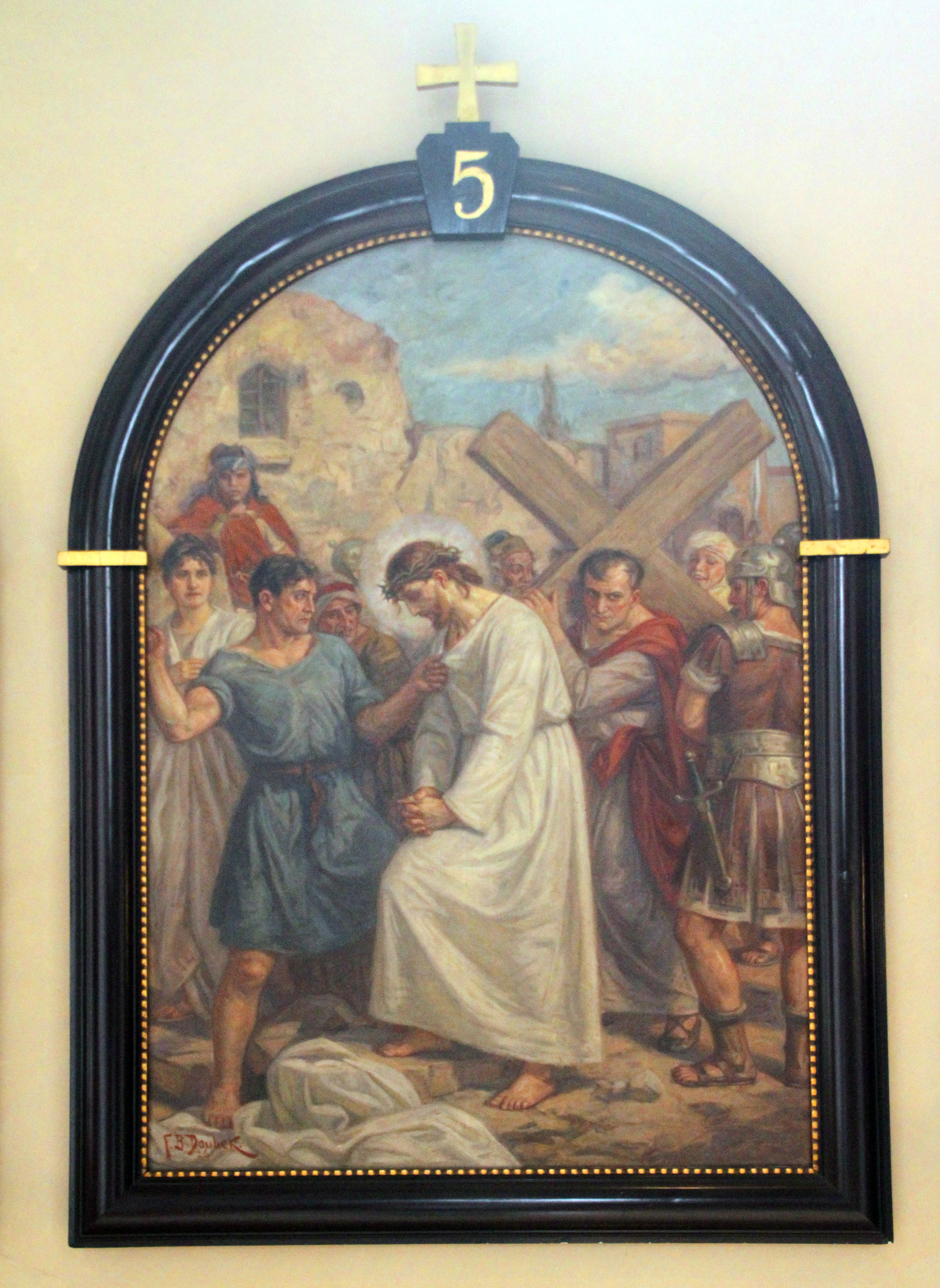
I like the contrast between how resigned Simon
is to this situation, and how resigned Christ is.
I couldn't go to the recent CMA conference, but several friends told me it was great. It focused heavily on burnout, as have the past five or so years. One of my parishioners, a family med resident who attended, reported that the talks were very holy and quoted lots of saints, but finally she didn't feel like there was a real "fix" to burnout.

My experience of the last two CMA conferences I've attended have been similar. Lots of discussion of personal holiness and the sacraments. Lots of discussion of holistic medicine and the importance of relationships and integrity in practice. Lots of discussion of hope, courage, and mercy for times of desolation. Not a lot of easy fixes. And I think that reflects the truth.

There is no easy fix for burnout. There's rest, hobbies, leisure, exercise, healthy eating, meditation, good marriages and friendships, and patience through desolation. None of those are easy. You have to force yourself to make time to rest (and then actually use that time to rest), you have to force yourself to exercise, you have to force yourself to develop relationships, you have to force yourself to pray. There is a lot of violence in pursuing the virtuous life. And, if you believe Augustine (and I do), we never get to the easy part of habitual virtue by ourselves. God's grace makes a way for us to become saints.

There's a small amount of relief whenever you acknowledge an unpleasant truth, be it some personal imperfection or some fact you can't control about the outside world. There is no "fix" for burnout, just the continued pursuit of a virtuous life and patience through desolation.

Wednesday, November 15, 2017

Quaeritur: Is there an obligation for Catholic medical students to become OB/GYNs?

I was recently asked:
If most OB/GYNs were Catholic already, I would not consider the specialty. I certainly enjoyed my OB rotation, but I also enjoyed other specialiteis just as much. Therefore, why not do a specialty that would allow me to spend more time with my my wife and children? Do you think that a Catholic OB/GYN could help women, marriages, and families in a significantly different way than a standard OB/GYN? Is a Catholic OB/GYN that big of a deal and worth all the extra time, effort, and controversy? Do you think by being a Catholic OB/GYN, I could lead more souls to Heaven? Are these questions too spiritual? Should I be focused more on the medicine, my interest in various specialties, and traditional decision making for most medical students?
"The Dedication" by Edmund Blair Leighton
Img credit: Micione, Wikimedia Commons
These are excellent questions. These are the questions you will be glad you asked yourself when residency makes life tough. I do think that a Catholic OB/GYN is a much better doctor for women and for our country than a standard (contraception-prescribing, napro-not-recommending) OB/GYN. I love to persuade people to become strong, Catholic OB/GYNs. But I would not push you that direction.

Your vocation is the way God made for you to become a saint. Your vocation is that of a husband and father, and this will always come before medicine. Your first responsibility is to the salvation of your soul, followed closely by your wife's and your children's. If you save a hundred souls by being a Catholic OB/GYN but aren't available to your family, what good is that?

Most OB/GYNs aren't Catholic, pro-life, or pro-NFP. It is generous for any Catholic medical student to consider the need for more Catholic OB/GYNs, just like it's generous that young men consider the priesthood even if they end up called to marriage. God is so grateful for your generosity. But the existence of a need does not mean you have to meet it. Your family's needs come first. OB/GYN residency is 75 hours a week, on average, and sometimes you're at work for twelve or twenty days in a row.

This calls for careful discernment and a well-trained spiritual director can help open the doors to God's light.

Monday, October 30, 2017

Quaeritur: Transgender follow-up

Img credit: Bill Barrett, Wikimedia Commons
Some time ago a medical student and I had a great interchange on
care of patients with gender dysphoria. The student followed up some time later with the following email:
I’ve come to the conclusion that nobody can change their gender. ...[O]ur maleness and femaleness are defined by our participation in the ability to create life within the marital act. So, “maleness” shouldn’t be defined as a Y chromosome, male genitalia, or a “male brain” (whatever that means). This means that if a man who has fathered a child suddenly claims that he is actually a woman “on the inside", this is an impossibility. The same would probably apply to all people who are born with functioning and properly developed reproductive organs.

With all that being said, I consider all the proposed treatment options for transgender persons not as actually changing someone’s sex or gender, but providing a coping mechanism for their gender dysphoria, which is a mental illness with a biological component. So, I would probable propose the least irreversible “treatments” first such as maybe wearing clothes typical of the opposite gender, and then if the gender dysphoria does not resolve and their mental health worsens, I would even consider some more drastic, irreversible steps such as hormones and/or gender-reassignment surgery.

I understand that many theologians see the concept of changing one’s gender an impossibility and I agree! However, I think that in some cases, especially for a patient with severe gender dysphoria the more drastic measures could be taken following all other options fail.

I know that many moral theologians have difficulties with this topic, and I understand why! I’m still exploring and keeping an open mind, and I know that if the Church were to propose an answer that definitely concluded that these “treatments” are immoral then I will gladly stand behind her judgement!
I really admire that you're committed to obeying the Church's judgment should she speak in a definitive way on this topic. I wish more Catholics were like that. I'm that way about embryo adoption: I think it's licit, and I'm going against some big names in that. But if the Church were to come out and say that I am wrong, I would accept that.

Women with AIS and related DSD.
Credit: Ksaviano, Wikimedia Commons
I agree with you that gender is not modifiable. It's really interesting how you define it! You define it by a person's ability in the marital act. (Did I read you correctly?) If a person is able to father a child with a woman, he is male. If a person is able to conceive a child with a man, she is female. For some reason I think that's amazing. I struggle to identify exactly what gender is. It's not a phenotype, or a set of traits/likes, or even (I hesitate) a genotype. (AIS, anyone?)

I think we disagree on whether medical and surgical transition therapies are good for men and women. (I'm not sure about dressing differently but I even think complete cross-dressing is not a good treatment.) Dysphoria should be addressed at its root and a man helped to love his masculinity, a woman helped to love her femininity. In the process of helping this love, societal roles should be tossed if necessary and clothing/hair should be evaluated objectively and not with too many cultural attachments. But I don't think dysphoria should be palliated by altering or amputating parts of the body or creating imitations of genitalia. Mutilation is wrong.

Sunday, October 15, 2017

Quick Takes as Fellowship Comes Closer

#1

Professionals of all stripes use LinkedIn. Basic science researchers use ResearchGate. Private physicians use Doximity. And, of course, everyone still needs a paper CV or resume. This sets up an obvious problem for the (hopeful) academic physician with a strong community presence. Aware that tl;dr has its own meaning, I affectionately call this resume problem "TLDR." Whenever I have something to put on my CV, it has to go in four places: Text, LinkedIn, Doximity, and ResearchGate. (And I haven't even mentioned the fact that NRMP, the "common app" for residency and fellowship, makes you build yet another CV in its system.)

#2

This month I went to wedding, two conferences, and a strategic planning meeting. One of the conferences overlapped with call, so I flew back through recently-flooded Houston the night before I showed up for a 24-hour shift. I feel like I'm always leaving friends and family behind, never present to them. All in all, I am traveling 4 out of the 5 weekends of this month. (I spent the other weekend TLDRing.)

#3

Hello Internet is a podcast by CGP Grey and Brady Haran. I used to watch a lot of YouTube science, so I knew the creators and listened to a bunch of the podcast while collecting data for a research project. One interesting episode talked about time management across four categories: work, family, health, and friends. Grey made these categories analogous to four lightbulbs, and posed the question of time management in terms of how bright (or dim) each bulb is or should be, given limited wattage for all four. He related personally that his "health" bulb hadn't been on in the early years of starting a successful YouTube channel. As I listened to the podcast, madly collecting data, I felt similar. I, too, am self-employed in a way. I'm in that phase in my career that involves aggressive self-improvement. I'm looking for excellent skills, rare opportunities, good connections, advantageous relationships, and strategic projects. And that "health" bulb is really dim! I'm trying to turn it up a little, but the wattage limit and my chronic ambitious habits are making it really hard.

#4

I'm homesick. When I applied to residency, I had few incentives to stay in my hometown because the public hospital rejected my ethical choices, the good private hospital had residents I didn't want to work with, and I thought the other private hospital was a dead-end career choice. Now I might be able to wedge my way back in, and I'd really like to. I don't like being the stranger at Christmas, that "older sister" who is never present to my siblings' lives. I want to be near my parents and be in the city I know and love. I can't tell how important these feelings are, though. Should I prioritize training in this important stage in my career? Should I go somewhere for the sake of a key mentor or a key set of experiences? And the all-important question: will they take me?

#5

You know the fable of the man who started with a piece of straw and ends up a millionaire? I feel that way sometimes. I started in homeschool and traded up to a good private elementary school. This allowed me to trade up to an academically decent but philosophically terrible private high school. From there, I could have jumped academically higher (and philosophically lower) into college, but instead traded overall "up" to TAC. But TAC is a "straw" in terms of the rest of the world. (All the Thomists may now laugh at TAC being straw.) But I was still able to trade up to get into medical school. From a community program, I traded up again to an academic residency. I wonder whether fellowship will be another trade "up," or whether I've maxed out my potential. 

#6

Can I admit something? It relates to "maxing out potential." There is a barely perceptible but real glass ceiling over me because of my moral choices. I can't go to top places because they don't want someone with my "limits." I am not comfortable putting a list of places I'm blocked from online, because I still have steps left in my training and don't want to close doors. But I have this long-lasting frustration with being inferior. I guess it started at TAC: I felt like I took the moral high road, and my high school classmates who had gone to better colleges were getting into better med schools. Then from my state med school, I felt that again I was getting fewer competitive interviews. In any given city, there's a glass wall between me and the big hospital and the big research projects. It makes me irrationally hungry to go to those places and do that research. There is a lot more funding and networking in those places, and I could do more. Wouldn't it be good if I could do some animals studies to further the possibility of ectopic rescue? Wouldn't it be good if I could study methotrexate more?

#7

I look at the last quick take and part of me thinks: "Networking and funding are fancy words for power and money. Don't look to those things. The Lord doesn't want you to do things independently. He wants you to be His Bride and He will make all the rest possible for you, even if it requires more work and you do not meet with success." There is more purity of heart in this response, I think. Less slavishness to ambition and outward things. More peace. Please pray for me, that I can have this peace and trust in the Lord, rather than anxiety over worldly things that I miss because of adherence to the truth. Please join me in that trust, in whatever opportunity you have in your life.

I will start applying for fellowships in July of 2018. I will start preparing my application around December, when interview season for the entering intern class of 2018 is over. Please pray for me! If there are priests reading, please consider saying a Mass for me.