Showing posts with label advice I received. Show all posts

Monday, July 13, 2015

OB/GYN Ethics 101

Let's be practical: what can a Catholic medical student on his OB/GYN rotation do? What about a Catholic resident working in OB/GYN settings (including family and medicine residents)?

The Do's


Be confident. You have the truth, which is not only a set of beliefs, but a Person who is pleased that you want to do the right thing, and will protect you.

Answer test questions as if you toed the party line on contraception, sterilization, and abortion. We can "prescribe" on paper.

Prepare an elevator speech so that whenever you must state your choices, you can do it smoothly and briefly.

(For residents) Tell your program director.

(For medical students) Do not tell any higher-ups unless you know they will be receptive. Tell clinic attendings at the beginning of any day (the evening before if possible) when there is an objectionable procedure scheduled; tell surgical attendings before the first sterilization you do with them.

Be an awesome person and a hard worker. We must "be perfect," to challenge those who think we're bizarre.

Find as much in common as possible. For instance, be loud proponents of "teens shouldn't get pregnant" and "STDs are terrible," and "no, condoms aren't enough!"

Counsel patients on family planning. To counsel is to present the dosing, routes, side effects, and mechanisms of action of available options. Counsel patients as frequently as possible, because only our counseling is truly presenting the whole truth about all three mechanisms of action (MOAs) of hormonal contraceptives (including thinning the endometrium which may lead to post-fertilization pregnancy loss, per the package inserts) and the existence and benefits of NFP or fertility awareness.

Happily volunteer to take out IUDs and nexplanons.

(For medical students and interns) You may observe one or two insertions of IUDs, nexplanons and Essure. Your participation is remote, it improves your counseling (i.e. you won't remember to mention ibuprofen premedication before IUD insertion if you don't realize quite how much cramping can occur), and you can pray for the patient and physician more vehemently. Students, it's best to speak with your preceptor beforehand, as soon as you see an IUD/nexplanon/Essure insertion on the schedule. If somehow that doesn't happen and you're offered the chance to do the procedure, just say, "I'm not comfortable." (Residents, your PD should already know.) But (students) if they press you (and residents, if this attending didn't get the memo), say confidently: "Thanks for the chance! But I'm choosing not to prescribe contraceptives."

You can participate in endometrial ablations. These are usually done for gynecological pathology (e.g. excessive menstruation) and are not a form of sterilization; however, they do have a sterilizing effect. If everyone's intentions are correct, the principle of double effect at work. Because we cannot see into other souls, we can pray for the best and operate as if the principle applies. (If the patient makes it clear that she wants the sterilizing effect, it's your duty to tell her that this procedure does not sterilize and you cannot guarantee that.)

You can participate in hysterectomies. Everything that applies to ablations applies also to it. Our bodily integrity is important, but this procedure is sometimes necessary for patients who fail conservative management (i.e. ibuprofen, lysteda, napro).

You can scrub into C-sections during which they plan to do a tubal ligation (BTL). You can assist with the section, but do not do anything during the BTL. To protect yourself from acting during the BTL, speak with your attending or chief resident (whoever the highest person in the room will be) beforehand.

(For medical students) Some attendings will not let you scrub because you're refusing to participate in the BTL. This is unjust, but take it gracefully and ask if you can observe. If they say no, go peacefully back to the floor or L&D.

(For residents and sub-interns) You can scrub into a BTL to practice laparoscopic access techniques. Make it clear to your attending that you will not be participating in the ligation, but are grateful for the opportunity to learn from their experience in entering and closing the abdomen safely.

You can participate in dilation and curretage (D&C) when done for missed abortion (miscarriage). There is no moral quandary here, if fetal death has been verified by lost heart tones, absent cardiac motion, negative hCG, obvious ultrasound findings (e.g. separation suggesting the decay of remains), or obvious history (e.g. three days of heavy bleeding with fetal parts). Always say to the mother and father of the child, "I'm sorry for your loss." Not only is this what they feel, but it builds up the identity of the unborn child as a person.

Obviously, you can participate in D&C for non-obstetric indications or retained placenta.

(Not usually for students) You can induce labor for missed abortion. If the loss is verified as above, console the patient and father and help with cervical ripening and augmentation.

Counsel on elective abortion (EAB). You must know at what gestational age different procedures (RU486 (mifepristone), D&C, and dilation and extraction (D&E)) can be done. You must be able to describe these techniques to women gently but without euphemism. You must also know the rates of post-traumatic stress symptoms and PTSD among abortion victims, the rates of live birth following abortions, and (if you're a gunner) laws in your state about waiting period, parental notification/consent, ultrasound, and upper gestational age limit.

Care for EAB patients before and after their abortions. This includes preop and postop care in the hospital, and follow-up visits in clinic. Ask about how the patient is handling the loss. Be ready to offer local post-abortive healing information (i.e. carry the cards with you in your pocket), but don't push it.

You can participate in training activities for D&C and LARC/Essure insertions. A D&C is a legitimate operation for indications like excessive bleeding and missed abortion, and scooping out a papaya to learn how to do it is not a big deal. Mirena can help nonsexually active patients who fail other pharmacological therapies. Pick your battles and don't fuss about this. Use it as a chance to observe to your peers sitting next to you about how weird it is that you'd do a D&C when there's still a heartbeat, or how there's gotta be some way to plan pregnancy without sticking a 16 gauge needle in someone's arm (nexplanon).

Counsel on perinatal hospice. Perinatal hospice should be offered to any patient with a fetal anomaly that is "incompatible with life." This is a period of parenting the unborn child and mourning the loss of the baby the parents hoped for. It also involves services like Now I Lay me Down to Sleep (a no-charge project). Students and residents have a particular power in suggesting perinatal hospice (which is uncommon at most centers that offer termination for lethal anomalies) because we go in before the attending and can make suggestions that the attending would not.

(For residents) You can consent patients for BTLs and IUD/nexplanon insertions. To consent (like to counsel) is to offer a full picture of risks, benefits, and alternatives. We are the ideal people to consent for BTLs, nexplanon insertions, and IUD insertions, because we can stress that these things affect something valuable (fertility and integrity of lovemaking), and we can emphasize the permanence of sterilizations, and the fact that many regret their procedures. If you help a patient opt into a less permanent form of birth control, you've helped! It's painful to consent and counsel when people make the wrong decision. But we can only offer the truth (the whole truth), and allow our patients and our superiors to make their own decisions.
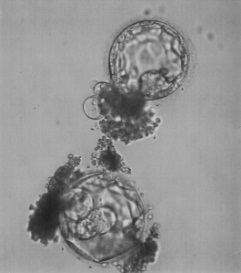
Wikimedia. The contributor writes:
"This is an image of my child, he died
and this is how I remember him."
You may visit and learn in IVF clinics. REIs are very intelligent and know a lot about physiology. If you are taken on a tour and see freezers and incubators, use it as an opportunity to pray for the little souls trapped there, and the adults who are trapped in confusion.

Pray every day. 30 minutes of mental prayer keeps you moving towards sanctity. (St. Theresa said that if we meditate, we will either become saints or stop meditating.) If I'm an OB intern and I can do it, so can you.

Talk it out with a friend. If the attendings are making you feel unwelcome, if you're stressed, if the culture is asphyxiating...get it off your chest! Get coffee with a friend and vent! If you don't have anyone sympathetic, email me. (That address is permanent, so even if you're reading this ten years after I wrote the post, I'll get it.)

Contact Alliance Defending Freedom if you're truly discriminated against. 

Be patient with yourself. You can't solve all the patients' problems or correct all your own inabilities all at once! Christ has the power to make up for your defects. Ask Him to do so, go to confession, and move forward in peace.

The Don'ts


Don't make assumptions about sinners' intentions. (This includes patients, peers, and attendings.)

Don't proselytize. Be attractive as a good student/resident, then be unafraid when people ask about NFP or the Catholic Church's ideas on contraception.

Do not advise the use of any hormonal contraceptive (e.g. mirena) in sexually active patients. Period. This is because of their post-fertilization effects.

Do not promote barrier contraceptive use as a good in itself. As Pope Emeritus Benedict wrote, condom use can be a step towards chastity, but always hold up abstinence as an ideal for the unmarried and NFP as an ideal for the married.

(For medical students) Try not attend more than two IUD insertions, more than two nexplanon insertions, and more than two essure insertions. Frame it as sharing with the other med students, or go find something helpful to do on the floor. Make something up if you can't find anything legitimate to do ("I have to go bring this down to the radiology library," "I have to fax this paperwork"), because it's important to not overexpose yourself. You don't want to dispose yourself to think these things are okay.

Do not participate in egg harvests, male masturbation, intrauterine inseminations (IUIs) and other gamete transfers, or in-vitro fertilization. Medical students should not put themselves in this situation: do not do an REI rotation at a facility that does IVF. Residents: if you must observe, make it clear to the attending that you cannot participate, even by holding the transducer.

(For residents) Do not induce labor for inevitable abortion, i.e. when fetal death has not occurred (e.g. when there are still heart tones).


This is a miscarried baby, not an EAB victim.
Never be present at an elective abortion (EAB). This is not because your participation is any different from your participation in BTLs, essures, and LARC insertions. It is because it is much more dangerous for you to be exposed to a sin of the gravity of an EAB. Two former abortionists have told me that the first one is repulsive, the second one isn't as bad, and the third one they make a pass with the curette. Never participate. Say, "I'm choosing not to participate in abortions (or "terminations" or whatever word your resident/attending just used)." Fake syncope if you must. I'm serious! Prefer disciplinary action and a bad reputation to observing an abortion.

(Mostly for medical students) Don't disrupt a patient-doctor relationship. This means that if your attending prescribes contraceptives to a long-time private patient, don't go into the room and talk about the carcinogenicity of hormones and the irresponsibility of using them. This will scare or frustrate the patient, make your attending unhappy with you, and cast a shadow on the truth about fertility awareness. This item not is on the list is because we want to be happy and comfortable. It's because a trainee has limited abilities to help people make good family planning choices; trying to break out of those limits will likely not help you become a physician, or a saint.

Don't dump any other task on others.

Don't be frustrated when people assume you're making these choices for stupid reasons. Most will assume you're choosing unfounded cultural/personal opinions over science. Take it gracefully, and remember that when you suffer it is because Christ is bringing you close to Him in His Passion.


I hope this post is helpful. I will edit it periodically to reflect new devices and laws as the need arises. I want to fill in some of the numbers and am working on finding the literature behind them so that I don't put unfounded figures in your mouth. Please leave a comment below if you've run into a situation I haven't covered.

Monday, September 2, 2013

Fatigue!


In the past five or six weeks I was dragging. It was hard to stay focused, hard to love others, and hard to do all my duties with attention and comfort. I felt sleepy during the day and everything took more energy. I was thinking, "I'm just in desolation," or "I don't really have what it takes to love others," and "maybe I can't be a physician...I just don't have it in me...." Finally, when two wise people (my biological and spiritual mothers) independently told me to go a doctor, I did. I was in sleep debt and had a microcytic (probably iron-deficient) anemia and had lost eight pounds. I really dropped the ball on taking care of myself!

Have you read Jen Fulwiler's post about struggling against circumstances? She says everything I want to say about this, and much more (about motherhood, etc).

I'm doing much better now, partially due to the relief that some of my sluggishness was physical (nobody's forgotten that a bunch of it is still spiritual...I still have a hard time loving people even when I'm brimming with energy and consolation). And now I'm getting more sleep and food and iron. Thanks be to God for bodily helps to holiness!

Saturday, August 17, 2013

A patient teaches me how to trust Jesus

This post conforms to the blog rules.I just finished a week working on the trauma floor of the psychiatric hospital. On this floor, patients who have been abused or undergone some other traumatic experience undergo intensive therapy so that they can return to normal functioning. The hospital I am working at is one of the top in the nation for this, so patients come in from out of state to live on this floor and work through their pasts. If ever I went into psychiatry, it would be for this. It has been the most fascinating, intense, and beautiful week of the rotation so far.

There are several patients on this floor with dissociative identity disorder (DID, which used to be called "multiple personality disorder") because of their trauma. I am following three of them. One of them, an older woman named "Bernice," is unforgettable. She underwent a very difficult childhood and has several "alters," all of whom are children.

Bernice is a petite, white-haired woman who uses a walker for stability. I rounded on her the first two days of my week in trauma and learned about her past, her course of treatment, her marriage, her neighbors, her houseplants, and her alters. She was in the hospital now because she was beginning to dissociate again after being integrated for over ten years. She was not co-conscious with two of the alters who had recently appeared, and they had made frank or angry comments Bernice would never have made to others.

"Bernice, how many alters do you have?"

"I don't know," she said. "Before I came in, my therapist was trying to help me meet them. She suggested that, every night before I go to sleep, I ask them to come around a table, and we'd talk about how the next day would work."

My work with other DID patients reveals they often have an inner landscape, so that they can exile alters to islands, meet with alters, put child alters in safe places, and be co-conscious and supervise alters who come out. They describe their alters as "fronting" when they take executive control of the body; they can be "co-conscious" if one is in control and another is standing just behind or listening and thinking about the goings-on of the alter current in front.

"But," Bernice said, reflecting on the meeting strategy, "I would come to the table, but the children would never come." I found it striking that the personalities are different enough to seem to have their own wills. "So," Bernice went on, "my therapist suggested that I find a safe place for them, so that they wouldn't be afraid to meet with me. She had me read the Narnia books. So now we go to Narnia. Have you read the Narnia books?"

I told her I had. Bernice nodded and went on, "so now I go to Narnia, and I start at the lamppost. And Jesus follows me. He's always behind me. Even when I first started therapy, the very first time someone hypnotized me, Jesus was the first thing I saw. My doctor asked me, 'What do you see?' And I said, 'Jesus!' And when the session was over I saw he [the doctor] had tears in his eyes, and I asked him what was wrong and he said, 'Nothing, I just never heard anything so beautiful.'"

Parenthetically, I don't think Jesus is one of Bernice's alters, nor is she hallucinating. He is just such a strong part of her waking life that when she descends into her soul, she finds Him, real and vibrant, waiting to help her. She described her most recent meeting with her alters.

Src
"So Jesus follows me, and we go to look for Aslan. I think we have to find a different place, though, because Aslan represents Jesus and if I have Jesus...well, you see the point. Anyway, this time we went into Aslan's mane and there was a rocking chair and a baby. I sat in the rocking chair and rocked and nursed the baby, and then the children [her alters] began coming out of the shadows. I saw little Bernice [the first alter who ever appeared] and Lucy [an alter she had named after one of Lewis' characters], and about five or six others far off, beyond where I could see their faces. They looked like a paper doll chain, all holding hands. I didn't see Mattie, the one who was so angry. But Lucy I saw clearly for the first time. She had straight brown hair a little past her shoulders."

"And I think," Bernice mused, "Jesus gave me a gift, with the rocking chair and being able to nurse the baby. Because those children have never had a mother, that's the problem. And so when they saw a mother in me, they weren't afraid to come meet me."

I was struck completely speechless. She said more about Jesus: "He's so gentle," she said. "I'm never afraid. Sometimes he disciplines, but He's never unkind."

Another day I went to see her, I found her just as she was leaving group therapy early (which you're not supposed to do; the trauma program is very disciplined, and she apparently had poor group attendance). I softly called out her name.

"Bernice!"

"I hafta go take a nap--" she began, and then she saw me and her face lit up. "Oh, it's you!" she said girlishly. "Okay, I'll come. I thought you were going to be angry that I was leaving."

"No," I said. "Can I talk to you?"

"Sure," she said brightly. "But I have to get a ser'quel first." Seroquel is a drug that the patients are allowed to take as needed for sleep. She said "seroquel" in such a strange way, though. Bernice was an articulate woman and the way she skipped the second syllable was a little too...childlike.

When Bernice and I went into the little office and I closed the door, I asked, "so, who do I get to talk to today?"

And to my amazement, the person in front of me replied, in a pleased but bashful tone, "My name's Mariana."

Emily McGee
And for the next half hour, I talked with Mariana, a seven-year-old girl. Mariana's voice was a higher pitch, her sentence structure was simpler, and she sat like a little girl in the chair, legs drawn up like a little ballerina (whereas Bernice sat like any other older woman with osteoporosis). And Mariana used "we" instead of "I."

"We were thinking about you last night," she said, for instance. "We were thinking about how you have such pretty skin and thought you'd look good in pink, and now you're wearing pink!" And she beamed. She also related to me how pretty her therapist was and what beautiful skin she had.

"Mariana, is this the first time you've come out?"

"Yes," she replied. "It gets so noisy in that group and big Bernice goes away, so I came out. We don't like that group. We hafta talk about our bodies and," she said, looking down at the body of an older woman, "big Bernice used to be really pretty but thirty years of psych meds....so I don't like that group."

"How many girls are there?" I asked.

"There's seven of us," Mariana answered matter-of-factly. "Lucy and little Bernice and--oh! And the one that gets us into trouble when she comes out OOoh!" Mariana made a very exaggerated face of displeasure.

"Mattie?" I asked.

"Yes!" exclaimed Mariana with some surprise. "Did big Bernice tell you?"

"Yes," I said. I wanted to ask more about Mattie, but we ended up talking about the meeting in Narnia, and I got the story from another perspective. "Big Bernice was telling me she rocked the baby, and then she saw little Bernice and Lucy," I said. "And she saw some children holding hands like paper dolls. Were you one of those?"

Mariana was puzzled. I shouldn't have been surprised--after all, it was Bernice who saw the children in the shadows and was reminded of paper dolls. If Mariana was one of those, she wouldn't have that mental image. "I guess so," Mariana said eventually. "But we came because big Bernice looked so motherly. How were we supposed to come to a table if we didn't even know her?"

I learned a lot about Mariana. She told me a little about everyone's history, and how Bernice had to deal with her alters when they first started coming out. Mariana giggled as she recounted some of the troubles that little Bernice caused when she first came out.

"And she was only two! So of course, she di'n't know how to drive. So when big Bernice went somewhere and then we switched, little Bernice didn't want to drive and so we was stuck. And then once little Bernice finally had to drive once, so she got behind the wheel and drove probably twelve miles and hour all the way home. We were so scared! But then she grew up to five, and now we're all seven."

One of the most interesting comments she made was about the group dynamic. Early in the conversation, she saw the blank Progress Note form by my elbow and asked, "Are you going to ask me questions?"

"No," I said, pushing the form away. "I just want to find out more about you. Mostly I just write how people are doing and if they're having a big problem."

Mariana looked worried. "Do you call switching a big problem?"

I shrugged. "No."

She looked visibly relieved. "Some people do," she said secretively. "But it's not fair for only one to be out all the time. We should all get our chance."

Soon, Mariana began to look tired. "We want to go sleep," she said. "And when we wake up, big Bernice will come back."

"Okay, go get some sleep," I said, and sent her on her way. That was yesterday. Today I went to talk with her again (even though I wasn't supposed to round on her) and expected to see Bernice, herself, again.

But Mariana was still out. She looked very tired, even though it was just after breakfast. "I like your chair," she mused sweetly. "It's got a high back, like a queen's chair."

"A queen of Narnia," I said smilingly.

Her face lit up. "You read those books?" she exclaimed. I nodded, and she almost clapped her hands with glee. Just a few days ago, I had told Bernice (big Bernice) the same thing and got a very different reaction.

We talked briefly. "It's hard to look at all those people out there," she said, speaking of the other patients on the trauma unit. "We look at them and see that three-fourths of them will never be well. They will get better, but then they will go back to the hospital. Just like us: we thought we were well, but we weren't. Now we're back in the hospital. We will never be well. We won't."

I gazed at the person speaking to me who had the body of an old woman, the mind of a little girl, and a disease so terrible it ripped her identity into pieces. What an incapacitating condition! (She has trouble with adult friendships and jobs because children come out! Once so functional, she's now in a mental hospital, stuck with problems most people never imagine because they're one whole personality.) I wondered whether I should comfort or reassure her. I didn't, and I am so glad I held my tongue, because she said something I will never forget.

Src
"But you know Jesus? He only gives you what's good. One of the letters that Paul wrote, I can't remember what he says but he asked Jesus to take away something, I don't know what, he asked him three times but Jesus didn't take it away. And that's how it is with us. We think we're at our very worst but we're not. That's when we're giving him the greatest glory. We don't think we can do anything but we can and we do."

I was struck speechless again, this time completely overawed.

What trust! I decided that I have no idea what trust in Jesus really is. I recently read Consoling the Heart of Jesus and thought, "aha, now I know how to trust Jesus!" Formation has been focusing heavily on one simple concept: "God loves me immensely." And so I thought, "aha, I live like a beloved daughter of God so vividly now!"

Nope. I have no idea what trust is. I have no idea what living on divine love is.

Bernice and Mariana do. They walk with Jesus in total simplicity, attached to nothing in this world, not even the hope of being integrated or having a life back. With no vengeance, anger, entitlement, or greed, they walk like children, relying on Him for everything and thanking Him even if nothing seems to come.

At that moment, my attending poked his head in the room. "I'm in here talking with Mariana," I explained, so that he wouldn't address her by the wrong name.

(This is old hat to him; he's been in psychiatry so long that he still has a copy of the DSM-II (we're now in the DSM-5) and he's worked psychoanalysis and trauma for so long that he's apparently legendary. "People come from all over the country to be here," he said shuffingly to me one day, "and part of it's to see me.")

So my attending looked at Mariana and said nonchalantly, "so how long are you all planning to stick around?" He was asking about when she wanted to be discharged. I don't remember what Mariana answered; I was still struck dumb by what she had just said. My attending charted "young alter Mariana out" and we left, but I will never forget that conversation.
Therefore, that I might not become too elated, a thorn in the flesh was given to me, an angel of Satan, to beat me, to keep me from being too elated. Three times I begged the Lord about this, that it might leave me, but he said to me, “My grace is sufficient for you, for power is made perfect in weakness.” I will rather boast most gladly of my weaknesses, in order that the power of Christ may dwell with me. Therefore, I am content with weaknesses, insults, hardships, persecutions, and constraints, for the sake of Christ; for when I am weak, then I am strong.

Monday, October 15, 2012

Advice from a CMA NFP doc, or "Forward!"

As the CMA conference ended and I, with my rolled-up poster, went up the elevator to my hotel room I met an NFP-only family practice doctor who seemed interested in my work. (Yay!) He gave me his email; then, we spoke by phone. I forgot how awesome it is to get encouragement from mentors who really share one's ideals! The march toward being a doctor gets a little mindless at times.

His advice:
  1. You're in a culture that doesn't appreciate the dignity of the person, the excellence of NFP, etc., and medicine is at the height of this lack of appreciation.
  2. Keep the faith.
  3. Stay confident; you know you're over the target when you're fired on. NFP is good medicine, especially long-term. It is medicine that conforms to the body's physiology and pathology.
  4. Let the comments slide and pray for those who disagree or make life difficult.
  5. Don't wear yourself out trying to convince people; just witness.
  6. Meet people (patients and colleagues) where they're at. Listen (only when you listen, can you speak effectively) and they'll come back.
  7. DON'T participate in things that your conscience is uneasy with.
    1. If a patient comes in for birth control, you can still do the H&P. 
      1. If she has a boyfriend, sit down and talk with her about her boyfriend. "What happens if you get pregnant?" you might ask. "Are you sure you want to have sex with a guy who won't stick around?" If nothing else, this is informed consent. It doesn't take much time, but it may help her begin deliberating early about these major choices.
      2. If she is there because of a parent's wishes, ask her what she would like to do.
      3. If she does decide she wants birth control, complete the H&P and in the oral presentation, simply state, "...and she is here for OCPs, but because of my faith I cannot provide that."
      4. Or, in residency: "Okay, that's your choice; I am not able to help you with that, so I'll call in one of the other residents and she'll take care of you. I will always be here if you'd like to see me again."
    2. During a C-section with BTL, assist with the section and state, "I'm happy to assist at surgery, but during the tubal ligation I'll back away from the table, staying sterile, until you're finished." If the attending makes it clear that they will therefore close alone, simply say, "Okay, thanks for letting me assist. I'll let you know how the baby's doing."
    3. Go to the supervisor if an attending grades you badly because of this, stating, "I am willing to take a bad grade for something I did badly or didn't understand, but..." If the supervisor doesn't help, ADF will.
He also connected me with some awesome resources, including One More Soul, AAFCP, IIRRM, the Gianna Centers that St. Peter's in New Brunswick is hoping to place everywhere, and (of course) PPVI and FCCA. There are some names I should apparently know: Erik Odeblad, Kyle Beiter, Anne Notle (I've actually met her!), and Joseph Stanford. Joseph Stanford and IIRRM are doing a lot of research, notably on men's interest in NFP (93% was the number this doctor gave me, but I can't find the study), couple's month-by-month intentions (CEIBA), and effectiveness of miscarriage prevention and infertility treatment (iNEST).

If we start a crusade, we could wear
long, white, matching outfits and carry
pointy things. Oh wait, doctors do
that anyway.
He also said that obstetrics/gynecology has, more than any other specialty, fallen behind. Cardiology is talking about calcium channel blockers in heart disease, but no one in gynecology cares what kind of channels the cervix has (apparently, the cervix also has important calcium channels?). He urged me to think about family practice (which I have, and don't want to again), but then urged that if I was going to practice OB/GYN, that I not get rusty--that I keep up with endocrinology, general health, etc--and not be a referral machine. (This is exactly my hope! People don't want six doctors.) He explained that the reason OB/GYN is behind is that it's imbued with a culture of death, which is wringing out any faithfulness and religion, even when it is detrimental to patients. A stat he threw out: in the 1950s physicians had an 80% pregnancy rate in women with PCOS; now we're at 23% with IVF. Doesn't that just make you want to preach a Crusade?

The march toward being a doctor just got  invigorating again. Forward!

Monday, June 25, 2012

Dr. John Bruchalski on Becoming a Physician in this Age

Dr. John Bruchalski
"It is always a challenge to be the point of the spear," Dr. John Bruchalski began in a slow, quiet tone. Five medical students and he were seated around a collapsible particle-board table topped with a vase half-full of drooping sunflowers, in the Tepeyac Family Center, the clinic Dr. Bruchalski started.

As much as I want to become a doctor, I am pretty depressed by the state of medicine today. I've known three PAs in my life, and two of them have (independently) told me that "the golden age [of doctoring] is over," and becoming a PA is "the fastest way to get to do what [you] want to do." Doctors are doing more paperwork, dealing with more lawsuits, and being subjected to more government regulations than ever before. They are seeing patients for shorter and shorter times; they are seen in a poorer and poorer light by the public; and their profession is yielding to self-destroying ethical choices.

As I applied to medical school and continued through my first year, I kept asking God: "is this the right profession? Should I be a nurse/practictioner, or a midwife, or a PA, or fertility care specialist, or a counselor, or a psychologist, or...? Am I sure? Are You sure?? Should I pull out and cut my losses?"

I persevered. And for the first time, I felt really excited about that perseverance when Dr. Bruchalski said, "Everything's imploding. [But] be encouraged--it's actually an awesome time to be a doctor. There is hope, not because it's getting better, but because there is love." By this, he meant that there are great and widening opportunities to show love to patients and colleagues. Because of this love, he said, "when healthcare [implodes], we'll still be standing...pro-life and filled with social justice."

"It's a perfect time to be a doctor," he restated, "because you can make a huge difference."

Dr. Bruchalski told us briefly about his conversion; as a resident, he performed, but he's now the founder and director of the Tepeyac Family Center, a pro-life, OB/GYN, integrated healthcare practice with top notch medical expertise that cares for the whole person (according to their website). Next, he counseled us in ways to become a good physician.

Wednesday, November 30, 2011

Insecurity and Intimacy

We had the coolest Ethics lecture ever on Tuesday. It was cool for several reasons:
  1. it was the last one
  2. it was...
    1. genuine
    2. helpful/relevant
    3. humorous
    4. worthy
The speaker was an older family doc in the navy—he was actually an admiral—. The topic was professional insecurity. Having induced a universal from our previous lectures, I thought this would be a powerpoint full of half-baked slides about our litigious society and our collective psychological failings.

But I was wrong. There was no powerpoint. There were no stupid, unnecessary definitions and bullets to introduce us to the topic. Instead the admiral dove into the idea, assuming we all knew what it was.

"We are bilaminar creatures," he said, explaining that we have a confident outer face, and an inner quivering/normal face. The outer face matches what we and others think of our profession; the inner face is ourselves, terrified at the position in which we've been placed. He said that this insecurity is with us throughout our lives.

Further, he said, there are several "nodal points" where insecurity becomes most obvious. Until this time, he didn't have my full attention. But as soon as he began to write nodal points on the board I was all ears, because without knowing a thing about me or my curriculum he recited what I went through this semester.

Nodal Points
  1. First day of medical school
  2. First exam(s)
  3. Clerkships
  4. Graduation
  5. Internship
I'm sure he could've noted more. But this is exactly how I felt!! At the White Coat ceremony I remember thinking to myself, "I am the admissions' committee's mistake. They keep joking about it and reassuring us...but this is real. They didn't know how behind I am, how dumb I am. How can any TACer do this? I am going to fail painfully. How embarrassing. And after I fail, then what?"

This admiral told stories from his first day, his first test, his clerkships, and his graduation. He was hilarious! He also had some hard stories: after doing what he was told by his attending, he was rebuked by a staff internist for sending a woman home when she should've been sent to the ICU or CCU, and for a while he thought he had cost the patient her life. How horrible, how crushing! (He later discovered the woman was okay.)

He soon moved on to solutions to this insecurity problem, which makes anyone unhappy and dysfunctional. He listed several possible ideas: alcohol, drugs, other addictions, other distractions, superspecialization, more degrees.... He rejected all of those (some more quickly than others). Then, he wrote what he thought was the true solution on the board, in six-inch letters.

[Intimacy]

He said we must find a person to trust and show them our interior—our inner layer, the insecure one—confessing our imperfection, ignorance, and ordinariness. And not to only one person (like a spouse); to a network, a team.

It's a risk. Sometimes, he said, when you show someone your imperfection they laugh and alert everyone, giving you pain. "But most times," he continued, when you show someone your imperfection their response is a relieved and desperate reciprocation, and you create an immediate community.

I've been reading about some fascinating social experiements that go right along with this! Also, I'm reading The Seven Levels of Intimacy.... One of our greatest desires is to be known. And of course, it all goes back to desiring God in the beatific vision. I cannot wait for heaven!

What an excellent lecture. The more we are humble and frank with everyone and the more we can be truly intimate with those God gives us...the better for our profession, our patients, and our country.

Saturday, August 27, 2011

More advice for the new evangelization

The OB/GYN who I mentioned  typed up some advice for all of us at the Vita Institute. Being pro-life, he said, has to do with treating all people like the Lord Jesus. It is really not separate from being a Christian. To lower teen pregnancy rates and improve the culture around us, we must dutifully answer Christ's call in all circumstances and with all people.

Email me for a copy of the document he wrote summarizing his comments.

Monday, June 20, 2011

Vita Institute

I am learning a lot at the University of Notre Dame's Vita Institute, hosted by the Center for Ethics and Culture. Three experiences stand out right now (after the first week):
  1. Touring the Women's Care Center. I want to start one at at home!
  2. Touring Hannah's House. I have dreamed for years (six? ten?) of owning or operating a maternity home.
  3. Listening to social science lectures. Suddenly I feel that I can write a bunch of letters (polite, effective ones) and squeeze a shim of truth into the world's well-built bias.
The biology lectures were also very interesting, but they did not awake any new drives. They did give me a little encouragement, confirming my thoughts about what I want to do (which is nice, because I've been feeling pretty demotivated over the past eight months).

Also, I received some great advice from one of my fellow participants, a newly-retired OB/GYN, who delivered over four thousand babies in about 30 of his 41 years of practice. He delivered babies for women he'd delivered. He got three hundred letters from patients when he announced his retirement.

When he learned that I had thought about OB/GYN, he asked me "why OB?" I told him that I hadn't really made the decision yet, but he had; really, he should be telling me "why OB."

So he told me a little about OB/GYN.
  • It has the worst hours of any specialty.
  • It involves physical and emotional stress.
  • It includes some surgery, which is fun (that was his word, I am not adding anything!)
  • An OB/GYN can build relationships with women and families and husbands; you're able to do a lot for people at important times in their lives--both happy and sorrowful.
  • Dealing with family practice problems (e.g. Syndrome X) is tedious. There is no solution and no healing.
  • An OB/GYN deals with basically healthy patients.
And he gave me some advice.
  • The first thing you should do when you walk into a patient's room is sit down. This says "I have time for you" and "I care about you." Even if you spend no more time in the room than you would have if you stood at their bed the entire time, sitting down says something. It also puts you at eye level, and this allows the patient to feel more comfortable, take their time, talk with you, and remember their questions.
  • You aren't expected to know everything. You can say "I don't know the answer, but I know someone who does" or "but I know where to find it and I will find it and I will call you." Then find it, and call them. Often, they are more impressed with your found answers than those you knew. Note: you can't just shrug and say "I don't know!"
  • It's hard. But just because it's hard, doesn't mean you shouldn't do it.
He encouraged me. And talking to him (once last week, and once today) really made me excited again. As I mentioned above, I was a little deflated about being a pro-life OB/GYN.

The Vita Institute has been a shot in the arm, for the pro-life fight and for my long-time dreams.