Showing posts with label ectopic. Show all posts

Saturday, February 29, 2020

Why didn't MM's author fight censorship?

CC Andrela Bohner
As I've described before, Medical Matins was a private blog from December 20, 2017 to February 29, 2020, to fulfill a requirement from my graduate medical education department after my blog was discovered and I went through an administrative process which examined the blog content.

My first reaction was deep shame. I have been conditioned over several decades to please others, and to be disciplined was very difficult. This was also my first reaction when I was called into the office in medical school for bringing a fetal model to a lecture containing material on elective abortion.

My second was confusion. What was going on? Was I really in the wrong, or was this about the truth of my opinions on issues like marriage, transitioning, and contraception? When it was over, I felt outrage. I was censored because of the nature of the blog and what I wrote about. (It is my firm impression that had I held the opposite opinions, I would not have been censored.)

Good came from this, and even during the process I could appreciate it. First, I learned to care a little less about pleasing people. If I have something true to say, I should not be ashamed when people are upset. Second, in a safe space with few or no long-term consequences, I went through my career's first little trial for the truth. Third, I encountered persons who I realized need a great deal of prayer and sacrifice, and I believe it is my duty to pray and sacrifice for these people in particular.

However, I felt that the end result (censorship) was not acceptable in a university environment. I know secondary education's lost its soul, but if the university is not the setting for professional, intellectual exchange, what is? I began to go through channels so that the institution would have some intellectual honesty about the importance of different opinions on issues.

Then, I abruptly stopped, and today I want to write about why. 

Shortly after the blog issue was concluded, a patient was admitted for excision of a cesarean scar ectopic. I was on night float, and at first I heard with trepidation that there was CSP admitted because I feared that there would be an ethical mis-step. However, the surgical plan sounded like it would meet the ERDs' definition of an "indirect abortion" and satisfy the principle of double effect. Relieved that I would not have to get involved, I waited for the scheduled procedure a few days later. Then, a few evenings later, the day team announced that the surgical plan had changed. The new plan involved fetal dismemberment. Aware of the culture that anyone can "stop the line," (link if that one is broken) I nevertheless had to think what I could do to help while I was working at night and going home in the morning. I emailed the director of the Ethics Committee, just to notify him of the change in the surgical plan. 

I came back that evening to anger. The other residents perceived that I had been judgmental, holier-than-thou, obstructive, shifty, and simply wrong. I was corrected by one of the residents in front of everyone at evening hand-off. 

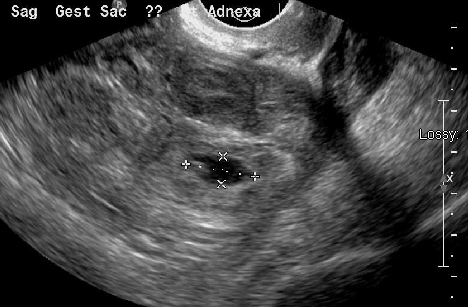
Ultrasound appearance of a uterus after a C-section,
with scar between the yellow arrows.
CC License. Wikimedia Commons.
As in other situations, my first reaction was shame. I was basically silent, although (since no one on my night team knew I'd done this) I did have to offer a half-sentence in explanation to them, which I had not planned to do and certainly not in that setting. Later, I formally apologized to a few attendings and the residents involved. There followed a very uncomfortable month when I felt highly disliked. Stray comments praising BTLs and LARCs and disparaging the ERDs (ordinary fare otherwise) felt sharper.

In this milieu, I felt that just finishing residency without being hated would be great, so I stopped seeking further attention regarding the blog censorship. As of this writing (which occurred originally in March 2018), I just hope to quietly finish residency with no more moral discussion.

Good things came from this CSP episode, too. I had a fruitful conversation with the Ethics Committee meeting that month (which I could only attend because I was on nights and I was off-duty at that hour), and recommended an article on CSPs that I think makes a stab at the truth. And the Ethics Committee saw that there were some communication, personality, and practice concerns surrounding the issue, and my "stop the line" email was not the most concerning aspect of the case. It is a relief that at the end of these two episodes, at least some dialogue occurred. 

Monday, February 15, 2016

Methotrexate

I used to think methotrexate (MTX) was an unacceptable way to treat ectopic pregnancy. Like personal heroes William May and Fr. Tad Pacholcyzk, I saw MTX as a direct attack on fetal cells. MTX was akin to (if not identical to) direct medical abortion.
The question I ask today is: is that true?

Background
MTX inhibits DNA synthesis and has (relatively) selective toxicity to rapidly dividing cells. It appears to select trophoblastic tissue (early placenta) rather than fetal tissue. It is administered for ectopic pregnancies to prevent rupture, which occurs in 0.5% of cases.

MTX can only be given if the mother is hemodynamically stable and if she will be able to follow up with serial hCG measurements. It is considered more strongly if the patient desires future fertility or is a poor surgical candidate. She must have an unruptured ectopic with a gestational sac less than 3.5cm in greatest diameter, there must be no cardiac motion, and the hCG should not exceed 5000-6000 mIU/mL. Further, the following must not be present (these are absolute contraindications):
  1. Breastfeeding
  2. Immunodeficiency
  3. Liver disease (including alcoholism)
  4. Blood dyscrasias (e.g. thrombocytopenia)
  5. Active pulmonary disease
  6. Peptic ulcer disease
  7. Renal dysfunction
Double Effect
The fetus always dies in current ways to treat ectopic pregnancy. Thus, any treatment other than expectant management must employ the principle of double effect. The principle of double effect can only apply if:
  1. The act in question (or the procedure) must be "good" or "neutral" in its moral quality,
  2. The good effect is intended, not the bad,
  3. The good and bad effects must occur simultaneously, thus avoiding a situation in which the bad effect becomes a means for achieving the good effect, and
  4. There should be a proportionate reason, that is, a sufficiently serious reason, to permit the bad effect.
Can the first criterion of the principle of double effect ever apply to methotrexate? The drug is acting directly on a vital organ of the fetus and as such "“a direct and lethal attack on the body of an unborn child" (1). For many years, this has persuaded Catholic theologians that use of methotrexate is illicit, because the "act in question" is not good or neutral.

Christopher Kaczor attempted to defend MTX in 2009, citing some work by Fr. Albert Moraczewski and others (2). He attempts to argue that most administrations of MTX occur after fetal death*, that MTX might be construed as stopping damage to the tube (a secondary effect, at best), that the trophoblast is not a vital organ of the fetus alone (which I find untenable, since its growth is entirely fetus-driven, even though it makes a barrier between mother and child), and that administration of MTX could be considered not "intentional" destruction of the trophoblast (which I find patently false, as that is the sole reason we're giving it).

I don't think Kaczor knocks down the fundamental point: MTX is the destruction of a vital organ of the fetus. I don't think anyone will be able to knock down this point. It's true.

Ectopia and "Diseased"
MTX destroys a vital organ of the innocent human embryo. Strange (and sad) as it may seem, I don't think that poses a problem.

Ablation or resection of vital organs is at times necessary when such organs are diseased. "Diseased" (like "conception") is not a medical term, and it can be difficult for medical professionals to nail down exactly what ethicists had in mind when the word was chosen for moral teaching. I suggest that "diseased" be taken to mean "not according to nature," or not "always or for the most part" (3). 
Trophoblastic tissue, for the most part, implants in the uterine cavity. I suggest that this means it is "diseased." It's not infected or full of cancer, but "diseased" means more than that. In fact, this early placenta is like a tiny failing heart, because it's not implanted in an area designed for it, with the appropriate architecture and blood supply to support it. 

Not all ectopic tissue requires removal. A benign uterine leiomyoma (fibroid) that causes no symptoms should be left alone. But ectopic trophoblast (as in ectopic pregnancy) can pose a danger to the mother. Moreover, ectopic trophoblasts are not the only ectopic tissue that require ablation or removal. Prolactinomas and other endocrinologically active macroadenomas, undescended testes, ectopia lentis**, and arteriovenous malformations are other examples.

Conclusion
Use of methotrexate is legitimate, because the four criteria of the principle of double effect apply. Most importantly, the use of methotrexate itself is morally good (or at least neutral). Although it is removal of a vital organ, it is not a mutilation, as ectopia represents a true disease state when the misplacement threatens human life (in this case, it threatens the fetus with inevitable death, and the mother with possible death or danger).


Notes
* In addition, some will argue that not all products of conception are fetuses, therefore methotrexate is legitimate for "abnormal" pregnancies, such as those without doubling of beta hCG over 48 hours. This argument is shaky. The minimum rise in beta hCG in a normal pregnancy is 35% over 48 hours (99.9% CI) and 4.6% of patients (n=1,249) with an hCG rise of less than that still went on to have a normal pregnancy (4). Even if this were not true, we must be cautious rather than miss one case of viable pregnancy. When we don't know whether the product of conception is a person, we must assume it is in order to protect human life at all stages.

** Ectopia lentis does not always require vitrectomy or lensectomy.

Bibliography
  1. Charles Cavagnaro cited in Anderson MA et al. Ectopic pregnancy and Catholic morality. NCBQ; Spring 2011;667-684. Here.
  2. Kaczor C. The ethics of ectopic pregnancy. Linacre Quarterly; August 2009;265-282. Here.
  3. Aristotle. Physics II:2. Here.
  4. Seeber BE et al. Application of redefined human chorionic gonadotropin curves for the diagnosis of women at risk for ectopic pregnancy. Fertil Steril 2006;86:454–459. Here.